Growing Responsibly. Supporting Farmers. Building a Greener Future.
At Nursery-Plant.com, we believe that plants and agriculture are closely connected with our environment, rural communities and everyday life.
Our goal is not only to sell plants and gardening products online. We want to encourage responsible gardening, sustainable growing practices, plant diversity and stronger connections between growers, farmers, nurseries and customers.
India’s agriculture sector is increasingly focusing on soil health, efficient water use, agroforestry, natural farming, biodiversity and climate-resilient practices.
Our approach is simple:
Grow responsibly. Use resources wisely. Support growers. Reduce unnecessary waste. Encourage more people to grow plants.
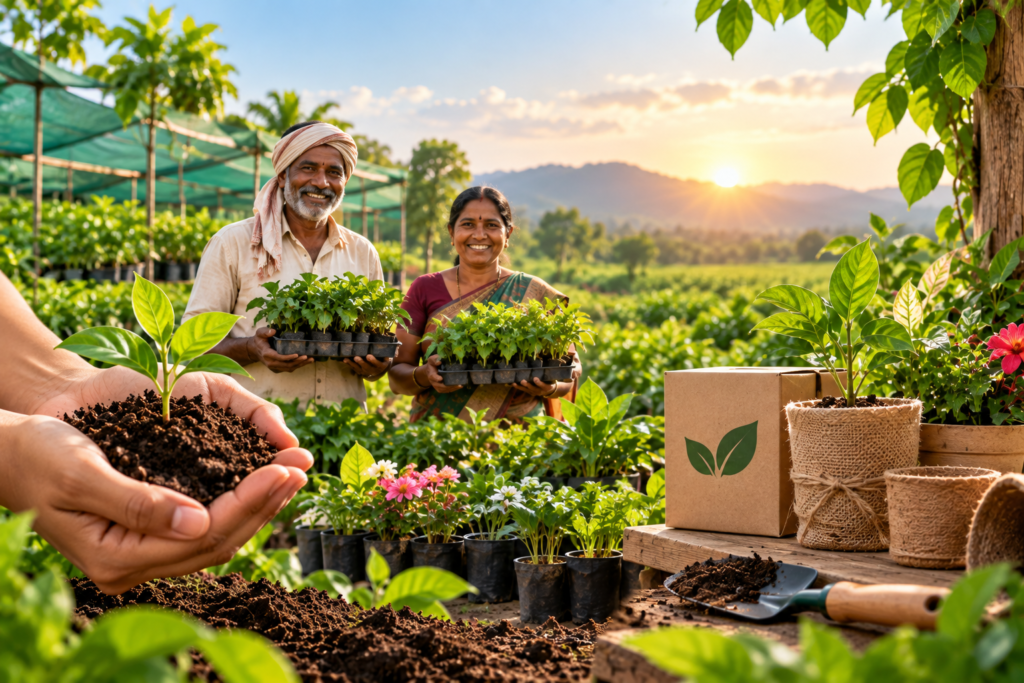
1. Our Commitment to Sustainable Gardening
Sustainability starts with small actions.
Growing a plant at home, maintaining a garden, growing vegetables, raising microgreens or planting fruit trees can help people become more connected with nature.
Through our products, we aim to encourage:
- Home gardening
- Terrace gardening
- Balcony gardening
- Kitchen gardening
- Microgreen growing
- Fruit-tree cultivation
- Plant diversity
- Responsible gardening
- Small-scale growing
- Agricultural awareness
We believe that thousands of small gardens and growing spaces can collectively create a positive impact.
2. Supporting Indian Farmers and Growers
Farmers and growers are an important part of India’s agricultural ecosystem.
We aim to create opportunities to work with farmers, nurseries, growers and agricultural suppliers wherever practical and suitable for our business.
Our broader goal is to help create a marketplace where quality plants and agricultural products can reach customers while creating opportunities for growers.
We believe that a stronger connection between growers and customers can contribute to a healthier agricultural ecosystem.
3. Supporting Small Growers and Nurseries
Small nurseries and growers often have valuable plant varieties, local knowledge and practical experience.
Where possible, we aim to work with suitable growers and nursery partners for sourcing plants and related products.
This can help:
- Create market opportunities
- Increase product reach
- Promote plant diversity
- Encourage nursery businesses
- Connect growers with online customers
We want to grow together rather than simply build a conventional online store.
4. Encouraging Responsible Agriculture
We believe sustainable agriculture should focus on long-term productivity rather than only short-term production.
Responsible agriculture can include practices such as:
- Improving soil health
- Efficient water use
- Crop diversification
- Agroforestry
- Natural and organic farming approaches
- Appropriate nutrient management
- Biodiversity protection
- Climate-resilient farming
These approaches are also reflected in current Indian agricultural initiatives promoting natural farming, micro-irrigation, agroforestry, soil health and climate resilience.
Important: We do not claim that every product sold on Nursery-Plant.com is organic, natural, chemical-free or sustainably produced unless the individual product is specifically described and supported as such.
5. Responsible Water Use
Water is one of the most important resources in gardening and agriculture.
We encourage customers and growers to use water responsibly.
Simple practices can include:
- Watering according to plant requirements
- Avoiding unnecessary overwatering
- Maintaining proper drainage
- Using suitable irrigation methods
- Reusing suitable water where safe and appropriate
- Monitoring soil moisture
Efficient water management is an important part of sustainable agriculture. India’s agricultural programmes also emphasize improved water-use efficiency and micro-irrigation.
6. Encouraging Soil Health
Healthy soil is the foundation of healthy plant growth.
We encourage gardeners and growers to learn about:
- Soil structure
- Organic matter
- Composting
- Balanced nutrients
- Drainage
- Soil moisture
- Appropriate fertilizers
- Crop rotation where applicable
- Mulching
- Beneficial soil organisms
Good soil management can support long-term plant health and productivity.
7. Promoting More Trees and Plants
One of our simplest sustainability goals is to encourage people to grow more plants.
Fruit trees, flowering plants, native plants, ornamental plants and other suitable vegetation can make gardens and growing spaces more productive and enjoyable.
Agroforestry is also being promoted in India as a way to integrate trees with agricultural systems and support sustainable land use.
8. Supporting Plant Diversity
Plant diversity is important for healthy gardens and resilient growing systems.
We aim to offer a wide range of:
- Fruit plants
- Flowering plants
- Indoor plants
- Outdoor plants
- Vegetable plants
- Garden seeds
- Agricultural seeds
- Microgreen seeds
- Specialty plants
By making different varieties available, we hope to encourage customers to explore and grow a wider range of plants.
9. Encouraging Local and Traditional Growing Knowledge
Farmers and traditional growers have developed valuable knowledge through generations of cultivation.
We believe traditional agricultural knowledge can be valuable when combined with appropriate modern agricultural science.
Natural farming initiatives in India similarly emphasize ecological approaches, diverse farming systems and improved resource efficiency.
Our aim is to encourage customers to learn, experiment responsibly and choose cultivation methods suitable for their local conditions.
10. Supporting Home Gardening
Sustainability does not have to begin on a large farm.
It can begin with:
One pot.
One seed.
One plant.
One balcony garden.
Home gardening can encourage people to understand where plants come from and how food and natural resources are connected.
We support customers interested in:
- Balcony gardens
- Terrace gardens
- Kitchen gardens
- Indoor plants
- Fruit plants
- Flower gardens
- Microgreens
- Small growing projects
11. Encouraging Microgreen Growing
Microgreens are an easy way for people to experience growing plants in a small space.
Our microgreen-related products are intended to support customers who want to explore growing microgreens at home or in other suitable environments.
A small growing setup can help beginners learn about:
- Seeds
- Germination
- Moisture
- Light
- Plant growth
- Harvesting
12. Reducing Unnecessary Packaging
Plant packaging needs to protect living plants during transportation.
At the same time, we recognize the importance of reducing unnecessary packaging materials.
We aim to continuously improve our packaging practices by considering:
- Appropriate packaging quantities
- Protective packaging
- Reusable materials where practical
- Recyclable materials where available
- Avoiding unnecessary packaging
Our priority is to balance plant safety during delivery with responsible packaging.
13. Responsible Plant Packaging
Plant packaging is a special challenge.
Too little protection can result in plant damage, while excessive packaging can create unnecessary waste.
Our goal is to find a practical balance:
Protect the plant → Reduce unnecessary material → Deliver safely
Packaging methods may vary depending on the plant, pot, size, destination and courier requirements.
14. Reducing Plant Waste
Plants are living products and cannot always be treated like ordinary inventory.
We aim to improve our inventory and dispatch processes to reduce unnecessary plant loss.
Better planning can help reduce:
- Overstocking
- Unnecessary plant wastage
- Poor inventory management
- Avoidable transportation losses
We continue to improve our processes as our business grows.
15. Supporting Agricultural Diversity
We believe agriculture should not depend on a single type of crop or growing system.
Different plants can serve different purposes:
- Food production
- Fruit production
- Flowers
- Landscaping
- Medicinal and aromatic uses
- Microgreens
- Nursery production
- Agroforestry
Crop diversification and agroforestry are among the approaches being promoted for more resilient agricultural systems in India.
16.Connecting Farmers With Markets
Access to markets is an important part of agricultural livelihoods.
Where practical, we aim to create opportunities for suitable growers and suppliers to reach customers through online commerce.
Digital marketplaces can help connect agricultural products with customers beyond a grower’s immediate local market.
We see this as an important part of the future of agriculture and rural entrepreneurship.
17. Digital Opportunities for Growers
Technology can help agriculture in many ways.
Online platforms can make it easier to:
- Discover products
- Reach customers
- Share plant information
- Manage orders
- Access markets
- Promote specialty varieties
- Build direct customer relationships
We want Nursery-Plant.com to become part of this growing digital agricultural ecosystem.
18. Supporting Responsible Product Choices
We encourage customers to select products based on their actual gardening or agricultural requirements.
Buying the right product can reduce:
- Unnecessary spending
- Product waste
- Failed growing attempts
- Unused gardening supplies
Before purchasing, customers should consider:
Space + Climate + Sunlight + Water + Plant Requirements + Intended Use
19. Education and Awareness
We believe knowledge is an important part of sustainability.
Through product information and website content, we aim to help customers understand:
- Plant requirements
- Basic gardening
- Seed growing
- Microgreen cultivation
- Plant care
- Growing conditions
- Agricultural products
We encourage customers to learn from reliable agricultural resources, local experts and qualified professionals for specialized farming decisions.
20. Climate-Conscious Growing
Climate and weather can strongly affect agriculture.
We encourage growers to consider plants and cultivation methods that are appropriate for their local environment.
Climate-resilient agriculture can involve:
- Appropriate crop selection
- Diversification
- Water efficiency
- Soil management
- Agroforestry
- Natural-resource conservation
Indian agricultural programmes increasingly emphasize climate-resilient technologies and sustainable resource management.
21. Agroforestry and Tree-Based Growing
Trees can have an important role in agricultural landscapes.
Agroforestry combines trees with crops or other agricultural activities and can support diversified production systems.
We support greater awareness of tree planting and suitable agroforestry practices, while recognizing that the right species and system depend on local climate, soil, land use and professional agricultural guidance.
India’s agroforestry programmes also focus on quality planting material and nursery development.
22. Supporting Rural Entrepreneurship
Agriculture can create opportunities beyond traditional crop production.
Nurseries, seed businesses, mushroom cultivation, microgreens, fruit cultivation, gardening services and other agricultural activities can create additional entrepreneurial opportunities.
We want to encourage the idea that agriculture can be both a livelihood and a modern business opportunity.
23. Farmers as Partners
We believe farmers and growers should be viewed as partners in the agricultural ecosystem.
Their knowledge of:
- Local climate
- Soil
- Plant varieties
- Growing practices
- Seasonal conditions
- Crop behaviour
is valuable.
Our aim is to build long-term relationships based on quality, reliability and mutual growth wherever we work with growers and suppliers.
24. Responsible Online Shopping
We also encourage customers to shop responsibly.
Before purchasing a plant or agricultural product, customers should consider:
- Whether the product is suitable for their location
- Whether they have enough space
- Whether they can provide proper care
- Whether the plant is appropriate for their climate
- Whether the product meets their actual needs
Responsible purchasing can help reduce unnecessary product waste.
25. Our Long-Term Sustainability Goal
Sustainability is not a one-time project.
As Nursery-Plant.com grows, we want to continuously improve:
- Plant sourcing
- Supplier relationships
- Packaging
- Delivery processes
- Product selection
- Waste reduction
- Customer education
- Farmer partnerships
We understand that sustainability is a continuous journey, not a claim that everything is already perfect.
26. Supporting Farmers Through Better Market Access
Where possible, we aim to help suitable growers and agricultural suppliers reach more customers through online commerce.
Better market access can help growers find new opportunities while giving customers access to a wider selection of plants and agricultural products.
Our long-term vision is to strengthen the connection:
Farmer → Nursery → Marketplace → Customer
27. Quality Planting Material
Quality planting material is important for successful cultivation.
We aim to provide customers with product information that helps them understand the plant or planting material they are purchasing.
For farmers and growers, selecting appropriate planting material is especially important because plant performance can depend on variety, quality, climate and cultivation practices.
28. Our Approach to Waste Reduction
We continuously look for practical ways to reduce avoidable waste.
This may include:
- Better inventory planning
- Careful plant handling
- Appropriate packaging
- Efficient dispatch
- Reducing unnecessary packaging materials
- Improving product sourcing
We do not claim that our operations are completely waste-free.
Instead, our goal is continuous improvement.
29. Sustainability Is a Shared Responsibility
We believe sustainability cannot be achieved by a seller alone.
It requires participation from:
Customers
Use products responsibly and care for plants properly.
Farmers
Continue improving responsible cultivation practices.
Gardeners
Grow plants thoughtfully and avoid unnecessary resource use.
Businesses
Improve sourcing, packaging and logistics.
Logistics Partners
Handle products responsibly during transportation.
Together, these actions can create a stronger and more responsible agricultural ecosystem.
30. Our Farmer Support Vision
Our long-term vision is to expand our support for growers as Nursery-Plant.com grows.
Future initiatives may include:
- More farmer partnerships
- Better market access
- Nursery partnerships
- Specialty plant sourcing
- Agricultural product sourcing
- Grower education
- Digital marketplace opportunities
- Sustainable gardening awareness
- Rural entrepreneurship opportunities
Any specific farmer-support programme will be introduced when operationally available.
What Sustainability Means to Us
For Nursery-Plant.com, sustainability means:
Grow More Plants
🌱 Encourage planting and gardening.
Use Resources Wisely
💧 Be responsible with water and growing resources.
Protect Soil
🌿 Encourage healthy soil and responsible cultivation.
Support Growers
🧑🌾 Build relationships with farmers and nurseries.
Reduce Waste
♻️ Improve packaging and inventory practices.
Promote Diversity
🌳 Encourage different plants, crops and varieties.
Think Long Term
🌍 Build a business that can grow responsibly.
Our Sustainability Promise
We do not believe sustainability is about making large claims.
We believe it is about making better decisions, one step at a time.
As Nursery-Plant.com grows, we will continue looking for practical ways to:
Support farmers → Encourage gardening → Reduce waste → Protect resources → Promote plant diversity → Build a better agricultural future.
We want to grow our business together with farmers, growers, gardeners and nature.
Nursery-Plant.com
Premium Plants • Fruit Plants • Flowering Plants • Seeds • Microgreens • Pots • Garden Products • Agricultural Products
Grow More. Support Farmers. Live Greener.
Important Transparency Note
Nursery-Plant.com’s sustainability approach is an ongoing commitment. We do not claim that every product is organic, chemical-free, carbon-neutral, zero-waste or sustainably sourced unless that specific claim is clearly stated and supported for the particular product.
Our focus is on continuous improvement, responsible sourcing where practical, farmer/grower relationships, better packaging, reduced waste and encouraging sustainable gardening and agriculture.
India’s current agricultural policy direction also emphasizes soil health, efficient water use, agroforestry, natural farming, organic farming and climate-resilient agriculture, which are relevant areas for long-term responsible growing