AI + Agriculture in India 2030: How Artificial Intelligence Could Transform Indian Farming
AI + Agriculture in India 2030: The Future of Smart Farming
India has always been an agricultural country. Millions of families depend directly or indirectly on farming, and agriculture remains an important part of India’s economy, food security and rural life.
But Indian agriculture is facing a new set of challenges.
Climate change, unpredictable rainfall, increasing input costs, water shortages, pests, soil degradation, changing market prices and small landholdings are making farming more difficult.
Now another technology is entering the field:
Artificial Intelligence — AI.
AI can analyse huge amounts of information about weather, soil, crops, satellite images, pests, water, market prices and farm conditions and convert that information into useful recommendations.
By 2030, the combination of AI + agriculture + sensors + satellites + smartphones + IoT + robotics + digital marketplaces could create a completely new model of farming in India.
The goal should not be to replace farmers with machines.
The goal should be to give farmers better information so they can make better decisions.
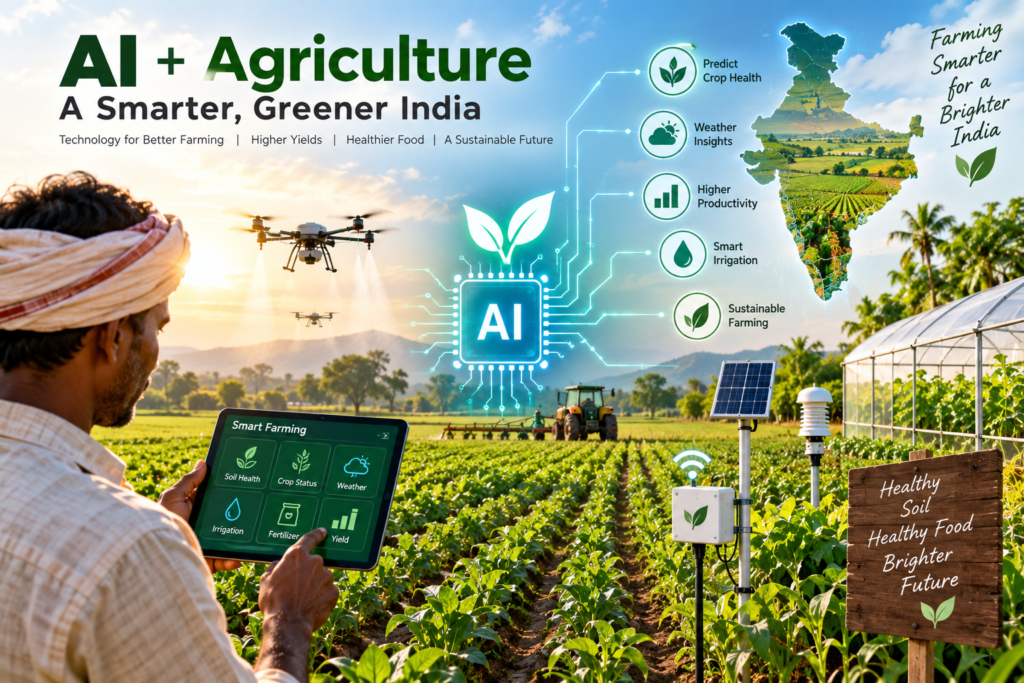
📊 India Agriculture + AI: Important Numbers
🇮🇳 INDIA’S DIGITAL AGRICULTURE SNAPSHOT
7.63+ crore Farmer IDs had been generated under the Digital Agriculture Mission as of November 2025.
23.5 crore crop plots were surveyed during Rabi 2024–25.
66 crops + 432+ pest types are supported by the National Pest Surveillance System.
93 lakh+ queries had been answered by Kisan e-Mitra by December 2025.
3.88 crore farmers were reached by an AI-based local monsoon forecasting pilot for Kharif 2025 across 13 states.
10,000+ extension workers were using the National Pest Surveillance System.
These numbers show that AI-based agriculture in India is already moving beyond theory and into practical applications.
What Does AI in Agriculture Actually Mean?
Artificial Intelligence means computer systems that can analyse information, identify patterns, make predictions and provide recommendations.
In agriculture, AI can combine information from many sources.
For example:
Satellite + Weather + Soil + Crop + Sensor + Historical Data + Market Data
⬇️
AI Analysis
⬇️
Farmer Recommendation
For example:
“Rain is expected in the next 48 hours. Avoid irrigation today.”
Or:
“Your crop image shows signs of possible pest damage. Inspect these plants and consider the recommended treatment.”
Or:
“Based on soil conditions, weather and expected market demand, this crop may be more suitable for your area.”
This is where AI becomes useful to farmers.
🌾 Why Does India Need AI in Agriculture?
Indian agriculture is extremely diverse.
A farmer in Punjab may have completely different soil, weather and crops from a farmer in West Bengal, Maharashtra, Tamil Nadu or Assam.
Even two farms in the same district can have different conditions.
Traditional agricultural advice is often general.
AI can move agriculture toward:
“The right advice for the right farm at the right time.”
India’s current Digital Agriculture Mission is already building digital infrastructure around farmer, land and crop information, while systems such as the Krishi Decision Support System use satellite, weather, soil, water and crop information for agricultural decision-making.
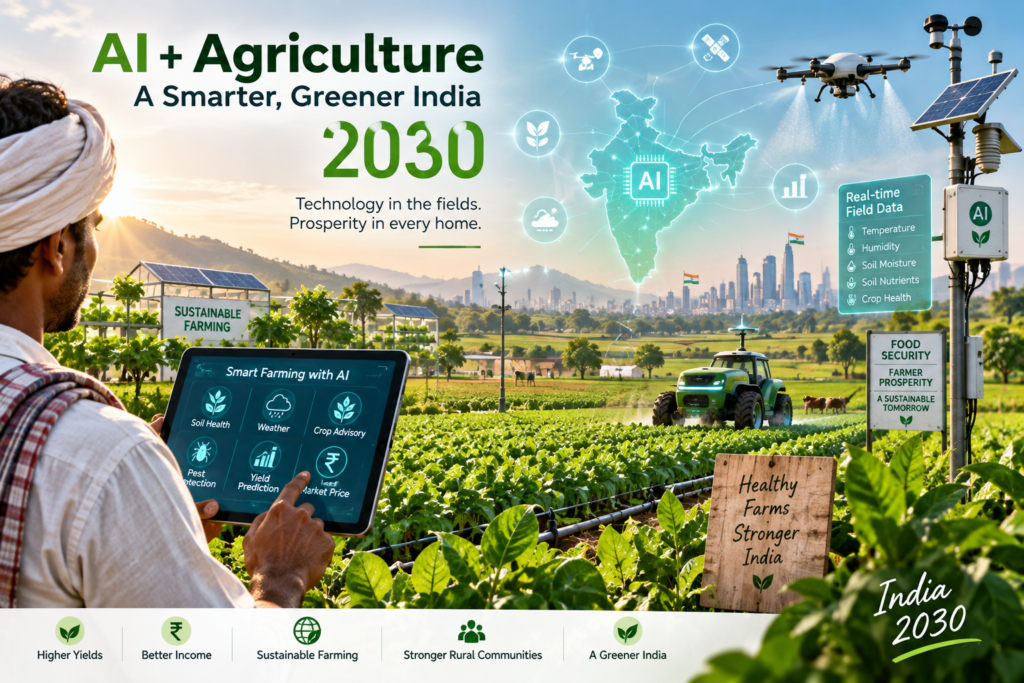
🔮 10 Major Ways AI Could Change Indian Agriculture by 2030
1. 🌱 AI-Based Crop Selection
One of the biggest decisions a farmer makes is:
“What should I grow?”
Today, crop selection can depend heavily on previous experience, local advice and last year’s prices.
AI could consider:
- Soil condition
- Rainfall
- Temperature
- Water availability
- Historical crop performance
- Local demand
- Market prices
- Pest risk
- Weather forecasts
- Government schemes
- Regional consumption
- Export opportunities
It could then provide a recommendation.
Example
A farmer enters:
Location + land size + soil information + available water
AI analyses the data and suggests:
Crop A — high water requirement
Crop B — moderate risk
Crop C — better suited to expected rainfall and market conditions
This does not mean AI will always be correct.
But it can give farmers more information before they make a decision.
The WEF/Principal Scientific Adviser’s Future Farming in India playbook specifically identifies AI-enabled crop planning as an important opportunity for India.
2. 🐛 AI Pest and Disease Detection
Crop diseases and pests can cause serious losses.
A farmer may notice a problem only after it becomes visible across a large part of the field.
AI can help detect problems earlier.
How?
A farmer takes a photograph of a leaf.
📱 Photo
↓
🤖 AI Image Analysis
↓
🌿 Possible Disease/Pest Identification
↓
💡 Recommended Action
AI systems can compare the image with large datasets of crop diseases and pest symptoms.
India’s National Pest Surveillance System is already using AI and machine learning for pest detection. The system supports 66 crops and more than 432 pest types and is used by more than 10,000 extension workers.
3. ☁️ AI Weather and Monsoon Prediction
Indian farming is strongly connected to the monsoon.
A few days of unusual rainfall can change a farmer’s decision about:
- Sowing
- Irrigation
- Fertiliser application
- Spraying
- Harvesting
- Crop selection
AI can analyse historical weather data, satellite information and current weather conditions to generate more localised agricultural forecasts.
India has already tested AI-based local monsoon-onset forecasting. The Kharif 2025 pilot reached 3.88 crore farmers across 13 states through SMS, and surveys found that 31–52% of respondents changed sowing or land-preparation decisions based on the forecasts.
By 2030
A farmer could receive something like:
🌧️ Weather Advisory
Rain probability: High
Irrigation: Delay
Sowing: Suitable after expected rainfall
Fertiliser application: Wait 24–48 hours
The information could arrive through mobile apps, WhatsApp, SMS or voice calls in regional languages.
4. 💧 AI-Powered Smart Irrigation
Water is one of agriculture’s most important resources.
Farmers sometimes irrigate according to fixed schedules rather than actual crop and soil conditions.
AI + IoT can change this.
Example system:
Soil Moisture Sensor
↓
Temperature Sensor
↓
Weather Data
↓
Crop Information
↓
🤖 AI
↓
💧 Automatic Irrigation Recommendation
In advanced systems, the irrigation system could even operate automatically.
For example:
Soil moisture is already sufficient + rain expected tomorrow
→ Do not irrigate today.
This could reduce unnecessary water use and energy consumption.
5. 🌱 AI-Based Soil Management
Healthy soil is the foundation of farming.
AI can combine:
- Soil test results
- Soil moisture
- Nutrient information
- Crop history
- Weather
- Satellite data
- Fertiliser use
- Yield history
and provide more targeted recommendations.
Instead of giving the same recommendation to an entire region, the objective is to move toward:
Farm-specific recommendations.
India’s digital agriculture infrastructure is increasingly integrating soil, land and crop data, while the Krishi Decision Support System is designed to combine multiple agricultural datasets.
6. 🚜 AI + Smart Machines + Robotics
By 2030, AI will not work alone.
It will increasingly connect with:
- Drones
- Agricultural robots
- GPS machinery
- Automatic irrigation
- Smart sprayers
- IoT sensors
- Cameras
- Satellite systems
Imagine a farm where a drone scans a field.
It detects:
🌱 Healthy plants
🟡 Nutrient stress
🔴 Pest-affected areas
💧 Dry areas
Instead of spraying the entire field, a smart system could potentially identify areas requiring attention.
This is the basic idea behind precision agriculture.
7. 🛰️ Satellites + AI
Satellites can see agriculture at a very large scale.
AI can analyse satellite imagery to identify:
- Crop areas
- Crop types
- Water stress
- Vegetation health
- Flooding
- Drought
- Crop damage
- Changes in agricultural land
This is especially important for India because millions of farms are relatively small.
Recent Indian agricultural AI initiatives are already combining satellite imagery and other datasets to create more detailed agricultural intelligence.
8. 📈 AI for Agricultural Market Prices
Growing a crop is only half the problem.
The farmer also needs to sell it.
Prices can change because of:
- Supply
- Demand
- Weather
- Transportation
- Imports
- Exports
- Seasonal production
- Regional shortages
AI can analyse historical and current information to estimate possible market trends.
For example:
“Expected tomato supply may increase significantly next month.”
A farmer could use this information when planning planting dates.
AI cannot guarantee future prices.
But better information can help reduce completely blind decisions.
The Indian AI agriculture roadmap also identifies smarter crop planning and digital marketplaces as important areas for transformation.
9. 🧑🌾 AI Agricultural Assistant in Local Languages
This could become one of the biggest changes.
Many farmers do not want to use complicated English-language software.
The future agricultural AI assistant should communicate in:
- Hindi
- Bengali
- Marathi
- Tamil
- Telugu
- Kannada
- Gujarati
- Punjabi
- Odia
- Assamese
- Malayalam
- Other Indian languages
And importantly:
It should support voice.
A farmer could simply ask:
“আমার ধানের পাতায় দাগ হয়েছে, কী করব?”
or speak naturally in their own language.
The AI could analyse the question, weather, location and crop information and provide an answer.
Kisan e-Mitra had already answered more than 93 lakh queries by December 2025 and was handling more than 8,000 farmer queries per day across 11 regional languages.
10. 🛡️ AI for Crop Insurance
AI can also improve agricultural insurance.
Traditionally, assessing crop damage can take significant time.
AI can use:
- Satellite images
- Weather information
- Crop surveys
- Field photographs
- Historical data
- Drone imagery
to help estimate crop damage.
India is already using AI-enabled tools such as YES-TECH, CROPIC and the PMFBY WhatsApp chatbot in the crop-insurance ecosystem.
📊 AI Agriculture in India: 2025 vs 2030
| Area | Around 2025 | Possible 2030 Direction |
|---|---|---|
| Crop planning | Experience + general advice | AI + local data |
| Pest detection | Manual inspection | AI image detection |
| Weather | General forecasts | Farm/location-specific advisories |
| Irrigation | Fixed/manual | Sensor + AI-based |
| Soil management | Periodic testing | Continuous data-driven recommendations |
| Crop monitoring | Human observation | Satellite + drone + AI |
| Market decisions | Local information | AI-assisted market intelligence |
| Farmer support | Call centres/apps | Voice AI in local languages |
| Insurance | Surveys + documents | AI + satellite + field evidence |
| Machinery | Mostly manual | Semi-autonomous/automated systems |
| Data | Fragmented | Integrated digital agriculture ecosystem |
Important: The 2030 column represents a likely direction and opportunity, not a guarantee that every farm will have all these technologies.
💰 How Big Could AI Agriculture Become?
There is already significant interest in India’s agricultural AI market.
The FAO reported in February 2026 that estimates place the AI-in-Indian-agriculture market at roughly US$1.9–4.7 billion by 2030, while also noting India’s growing AgTech ecosystem and more than 3,000 AgTech startups.
📌 MARKET OPPORTUNITY
Estimated AI in Indian Agriculture Market by 2030
US$1.9 billion – US$4.7 billion
This is a market estimate, not a government target or guaranteed outcome. Actual market size will depend on adoption, investment, infrastructure, regulation and the success of AI solutions.
🇮🇳 Government Is Already Building the Digital Foundation
AI cannot work effectively without data.
India has therefore been developing digital agricultural infrastructure.
The Digital Agriculture Mission, approved in 2024, has a total outlay of ₹2,817 crore and includes foundational components such as AgriStack and the Krishi Decision Support System.
AgriStack is intended to create digital agricultural records and farmer identities, while the Krishi Decision Support System brings together information such as:
- Satellite data
- Weather
- Soil
- Water resources
- Crop information
- Geospatial data
- Drought monitoring
- Flood monitoring
- Yield modelling
This infrastructure can become an important foundation for AI-powered agriculture.
🧠 The Future: AI Will Become a “Digital Farming Brain”
Imagine an Indian farm in 2030.
The farmer has:
📱 Smartphone
🛰️ Satellite monitoring
🌡️ Weather information
💧 Soil sensors
📷 Crop camera
🚜 Smart machinery
🤖 AI agricultural assistant
Every morning, the farmer receives:
Good morning.
🌦️ Rain expected tomorrow
💧 Soil moisture is adequate
🐛 Possible pest risk detected in one section
🌱 Crop growth is normal
🚜 Recommended field activity: inspect Zone B
💰 Local market price trend: moderate
⚠️ Avoid unnecessary irrigation today
This is not science fiction.
Many individual components of this system already exist. The major challenge is connecting them affordably and reliably for millions of farmers.
⚠️ But AI Agriculture Has Challenges
AI is powerful, but it is not magic.
India will face several challenges before AI can reach every farmer.
1. Digital Divide
Some farmers may not have smartphones, reliable internet or digital skills.
2. Data Quality
AI is only as good as the data available to it.
Incorrect soil, weather, crop or farm information can produce poor recommendations.
3. Small Landholdings
India has millions of small and marginal farmers. Expensive AI systems designed for large farms may not work economically for them.
4. Language
An agricultural AI assistant must understand local languages, dialects and real-world farming terminology.
5. Trust
Farmers need to know:
Why is AI recommending this?
They should be able to combine AI recommendations with local agricultural knowledge and expert advice.
6. Connectivity
Rural areas still need reliable digital infrastructure.
7. Privacy and Data Protection
Farmer data is valuable.
Information about land, crops, income, location and farming activity should be handled responsibly and securely.
8. Cost
AI technology must become affordable enough to provide real value to small farmers.
The NITI Aayog roadmap highlights barriers including fragmented agricultural data, trust issues, the digital/physical infrastructure divide, ecosystem fragmentation, talent gaps and limited capital for early-stage AgTech companies.
👨🌾 AI Will Not Replace the Farmer
This is perhaps the most important point.
AI should not replace agricultural knowledge.
A farmer has something AI does not automatically possess:
Local experience.
A farmer knows:
- The local soil
- Local weather behaviour
- Water availability
- Local pests
- Traditional farming methods
- Local market conditions
- Field history
AI should work together with this knowledge.
The future should be:
Farmer + AI + Agricultural Expert
not:
AI instead of Farmer.
Recent work on Indian agricultural AI similarly emphasises that AI can complement traditional farming knowledge rather than simply replace it.
🌾 A Possible Indian Farm of 2030
Here is one possible scenario:
Morning
AI checks overnight weather and field data.
7:00 AM
Farmer receives a local-language voice message.
“Rain expected this evening. Irrigation is not recommended today.”
10:00 AM
A camera identifies unusual leaf symptoms.
11:00 AM
AI recommends inspecting a specific field section.
Afternoon
A drone surveys the field.
Evening
The farmer receives an updated crop-health report.
Market Time
AI shows current market information and possible selling options.
Insurance
If a major weather event damages the crop, satellite and field data can support assessment.
This could turn farming from a largely reactive activity into a more data-informed and predictive system.
📦 The AI Agriculture Ecosystem of 2030
The biggest opportunity may not come from one AI application.
It could come from connecting many technologies.
🌾 FARMER
│
▼
📱 SMARTPHONE
│
┌───────────┼───────────┐
▼ ▼ ▼
🌦️ Weather 🛰️ Satellite 🌱 Soil
│ │ │
└───────────┼───────────┘
▼
🤖 AI ENGINE
│
┌─────────────┼─────────────┐
▼ ▼ ▼
🐛 Pest 💧 Water 🌾 Crop
Detection Management Planning
│ │ │
└─────────────┼─────────────┘
▼
👨🌾 FARMER
│
▼
💰 BETTER DECISION📈 What Could AI Improve?
AI could potentially help agriculture in several areas:
Productivity
Better crop selection and timely interventions.
Cost Management
More targeted use of water, fertiliser, pesticides and machinery.
Risk Management
Earlier warnings about weather, pests and disease.
Sustainability
More efficient use of water, soil nutrients and agricultural inputs.
Market Access
Better information about prices, demand and buyers.
Farmer Services
Faster access to agricultural information and government schemes.
Rural Entrepreneurship
New opportunities for AgTech startups, drone services, farm-data companies, AI advisory platforms and precision-farming businesses.
The Indian government and NITI Aayog are already positioning technologies including AI, predictive analytics, smart sensors, precision agriculture and advanced mechanisation as part of the longer-term transformation of Indian agriculture.
🚀 Opportunities for Indian AgTech Startups
India could become a major market for AI agriculture startups.
Potential startup areas include:
🌱 AI Crop Doctor
Upload a crop photograph and receive disease/pest guidance.
🌦️ AI Weather Advisor
Local weather + crop-specific recommendations.
💧 Smart Irrigation
AI + soil sensors + automatic irrigation.
🛰️ Satellite Farm Monitoring
Monitor crop health remotely.
🐄 AI Livestock Monitoring
Animal health, feeding and productivity analysis.
🧑🌾 Voice AI Farmer Assistant
Agricultural chatbot that speaks Indian languages.
📊 Farm Management Software
Track crops, expenses, labour and yields.
💰 AI Market Intelligence
Market prices, demand forecasting and buyer discovery.
🚁 AI Drone Services
Drone-based crop monitoring and precision spraying.
🧪 AI Soil Advisor
Analyse soil reports and recommend crop/input strategies.
This could create an entirely new generation of Indian agricultural technology businesses.
For More Information Visit: Nursery-Plant.Com
For Contact Visit:Contact Us
For Shopping Visit: Shop Page