🌾 India Agriculture 2030: From Traditional Farming to Intelligent Farming
Indian agriculture is standing at an important turning point.
For generations, farming has depended on land, water, seeds, weather, human labour and farmer experience.
But agriculture in 2030 may look very different.
The next generation of Indian farming will increasingly combine:
Farmer + AI + Data + IoT + Drones + Satellites + Robotics + Biotechnology + Modern Machinery
This does not mean traditional farming knowledge will disappear.
Instead, the biggest opportunity is to combine the experience of Indian farmers with the intelligence of modern technology.
India has already started building this foundation. The government’s Digital Agriculture Mission, AgriStack, AI-based pest surveillance, local weather forecasting and multilingual farmer-assistance systems show that AI agriculture is moving from experimentation toward large-scale implementation.
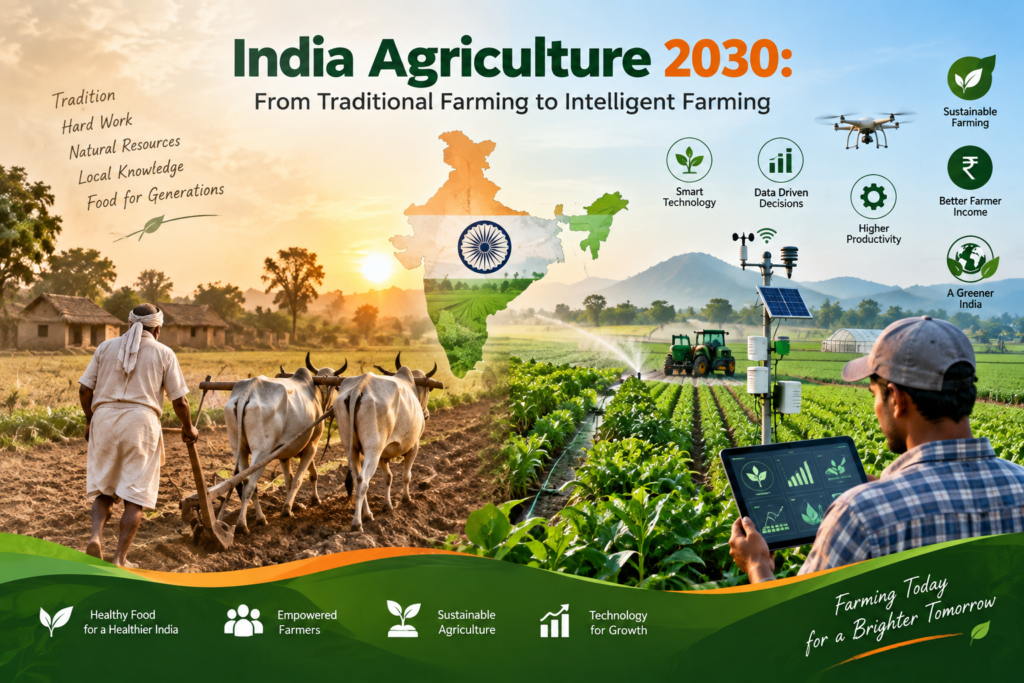
📊 India Agriculture Today vs Agriculture 2030
| Area | Indian Agriculture Today | Possible Agriculture in 2030 |
|---|---|---|
| Crop planning | Experience + local advice | AI + soil + weather + market data |
| Pest detection | Mostly visual/manual | AI image & sensor detection |
| Irrigation | Manual/fixed schedules | Smart sensor-based irrigation |
| Weather | General forecasts | Local crop-specific AI alerts |
| Crop monitoring | Farmer field visits | Satellite + drone + AI |
| Fertiliser | Broad recommendations | Precision application |
| Machinery | Human-operated | GPS/AI-assisted machinery |
| Market decisions | Local market information | Digital + AI market intelligence |
| Farmer advice | Extension workers/call centres | Voice AI + local languages |
| Insurance | Field assessment | Satellite + AI + field data |
| Youth participation | Mainly farming | Farming + AgTech + entrepreneurship |
| Data | Fragmented | Connected agricultural data ecosystem |
| Farming model | Reactive | Predictive and preventive |
Important: The 2030 column describes a realistic direction and opportunity, not a guarantee that every Indian farm will use all these technologies.
🇮🇳 Why Agriculture Matters So Much to India
Agriculture is not simply another industry.
It is connected to:
- Food security
- Rural employment
- Farmers’ income
- Food prices
- Water resources
- Rural businesses
- Manufacturing
- Logistics
- Exports
- Village economies
- India’s social structure
A recent NITI Aayog publication estimates that agriculture employs over 45% of India’s workforce, while contributing about 18% of GDP in 2023–24. It also notes that more than 85% of smallholder farmers continue to operate at subsistence levels.
This creates a major challenge:
How can India increase agricultural productivity and farmer income without simply increasing the use of land, water and expensive inputs?
Technology is one important part of the answer.
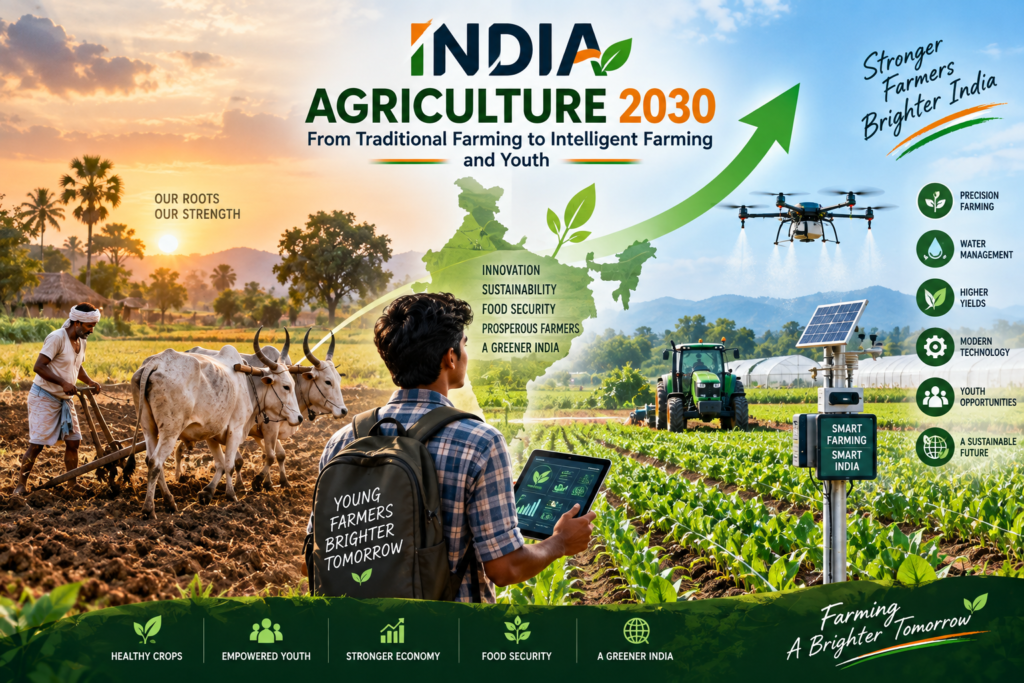
AI Could Become the “Brain” of Indian Agriculture
Think of a future farm as a system.
The farmer provides:
🧑🌾 Experience
🌱 Local knowledge
🚜 Physical decisions
❤️ Understanding of the land
Technology provides:
🛰️ Satellite information
🌦️ Weather data
🌡️ Sensors
📷 Cameras
🚁 Drones
📊 Market information
🤖 Artificial Intelligence
Together:
Human Knowledge + Machine Intelligence
This is likely to be more powerful than either one alone.
NITI Aayog’s agricultural technology roadmap describes the future direction as a move toward AI-powered, real-time decision networks, stronger agricultural data systems and a new generation of AI-literate farmers and agri-entrepreneurs.
🧠 What Will AI Actually Do on a Farm?
AI will not simply be a chatbot.
It could become an agricultural decision-support system.
For example:
Before planting
AI analyses:
- Soil
- Weather
- Water availability
- Previous crops
- Market demand
- Pest risk
Then:
Recommended crop: Crop A
Expected water requirement: Medium
Major risk: Pest X
Suggested sowing period: Week Y
During cultivation
Sensors report:
Soil moisture = low
Weather system reports:
Rain probability = high
AI decides:
Delay irrigation. Rain may provide sufficient water.
When disease appears
Farmer takes a photograph.
📱 Photo
↓
🤖 AI computer vision
↓
🌿 Possible disease/pest
↓
🧑🌾 Farmer receives guidance
Before harvesting
AI analyses:
- Crop maturity
- Weather
- Market conditions
- Storage availability
and helps the farmer decide when to harvest and where to sell.
🚁 Drones Will Change Field Monitoring
Agricultural drones can cover large areas much faster than manual inspection.
A drone can potentially collect information about:
- Crop growth
- Plant stress
- Water stress
- Pest-affected areas
- Weed growth
- Crop damage
AI can then analyse the images.
Instead of:
“The entire field may have a problem.”
The system can potentially identify:
“Problem detected mainly in this section.”
That creates the possibility of precision agriculture.
NITI Aayog identifies precision farming, drones, IoT, remote sensing and image-based crop monitoring as important technologies for Indian agriculture.
💧 Water Will Become Even More Important
India’s agricultural future cannot depend simply on using more water.
Smart agriculture can help answer:
“Does this crop actually need water right now?”
Imagine:
Soil Sensor → Weather Data → Crop Data → AI
If soil moisture is sufficient and rain is expected:
🚫 No irrigation.
If soil moisture is low and rain is unlikely:
💧 Irrigation recommended.
This approach can potentially reduce unnecessary water use while improving crop management.
🛰️ Satellites Will Give India a New View of Agriculture
A farmer sees one field.
A satellite can observe thousands or millions of hectares.
AI can analyse satellite information to help identify:
- Crop growth
- Drought conditions
- Flood damage
- Vegetation health
- Crop areas
- Changes in land use
- Possible crop stress
India is already building digital agricultural infrastructure around satellite, weather, soil, water and crop information.
By 2030, satellite data may become a normal part of agricultural decision-making rather than something used only by government agencies or large organisations.
🧬 Biotechnology + AI: Another Big Revolution
AI agriculture should not be limited to software.
The next agricultural transformation could combine:
AI + Biotechnology + Better Seeds
AI can help researchers analyse huge amounts of biological and agricultural data.
This could support development of crops with desirable characteristics such as:
- Drought tolerance
- Disease resistance
- Heat tolerance
- Improved nutritional quality
- Better productivity
Biotechnology will still require scientific validation, regulation and responsible deployment.
But the combination of biological science and computational intelligence could become a major agricultural research area.
🏭 Modern Machines Will Reduce Some Manual Work
Agriculture has historically required significant physical labour.
The future may involve more:
- GPS-guided tractors
- Smart harvesters
- Robotic weed control
- Automated irrigation
- Precision seeders
- Smart sprayers
- Agricultural robots
- Autonomous or semi-autonomous machinery
India’s agricultural robotics ecosystem is already developing systems for soil sampling, sowing, harvesting and crop surveillance.
This does not mean every farm will suddenly become fully automated.
For small farms, shared equipment and “Farming-as-a-Service” models may be more practical than buying expensive machines individually.
👨🌾 The Biggest Change May Be the Farmer Himself
Technology will change the definition of a farmer.
The farmer of 2030 may not only be:
“A person who works on land.”
He or she may also be:
A farm manager + data user + entrepreneur + technology operator.
A modern farmer may use:
📱 Smartphone
📊 Farm dashboard
🌦️ Weather alerts
🛰️ Satellite data
🚁 Drone services
🤖 AI advisor
💰 Digital marketplace
🏦 Digital finance
🚜 Machinery services
This creates a much broader agricultural profession.
👦👧 India’s Youth Could Be the Biggest Force Behind Agricultural Change
This is one of the most important parts of India’s agriculture story.
Many young Indians are interested in:
- Technology
- AI
- Coding
- Startups
- Drones
- Robotics
- Electronics
- E-commerce
- Digital marketing
- Data science
At the same time, agriculture needs a new generation of entrepreneurs.
This creates an opportunity.
Instead of asking:
“Why would a young person enter agriculture?”
India should increasingly ask:
“How can we make agriculture attractive to young technology-skilled Indians?”
🚀 Agriculture Could Become a New Career for India’s Youth
Imagine a young person starting an agricultural technology business.
They don’t necessarily need to own 100 acres.
They could provide services to hundreds of farmers.
Example 1 — Drone Service
One entrepreneur purchases agricultural drones.
They provide:
Crop monitoring + spraying + mapping
to nearby farms.
Example 2 — AI Crop Doctor
A young developer builds an AI application.
Farmers upload crop photographs.
The system provides:
Possible disease + risk + recommended next step.
Example 3 — Smart Irrigation
An IoT startup installs:
🌡️ Temperature sensors
💧 Soil moisture sensors
📡 Internet connectivity
and provides automated irrigation management.
Example 4 — Farm Data Company
A startup combines:
Satellite + Weather + Soil + Market Data
and sells agricultural intelligence to farmers, FPOs, banks, insurers and agribusinesses.
Example 5 — Rural AI Service Centre
A young entrepreneur creates a village-level technology centre offering:
- Soil testing
- Drone services
- AI crop diagnosis
- Digital agriculture support
- Government scheme assistance
- Farm machinery booking
This could create technology-enabled rural employment.
📊 Youth + Agriculture: An Important Fact
NITI Aayog’s analysis of PLFS 2020–21 found that young people aged 15–29 constituted about 23% of the agriculture workforce in that period. It also found that around 40% of young workers were employed in agriculture, although young people showed a stronger preference for non-agricultural occupations than older workers.
This tells us something important:
Young Indians are not completely disconnected from agriculture.
But many may want better income, better technology, better working conditions and new career opportunities.
Technology could help create those opportunities.
💡 Agriculture 2030 Could Create New Jobs
People often say:
“AI will destroy jobs.”
That is only one side of the story.
AI can automate some tasks.
But new technologies can also create new occupations.
Possible 2030 agricultural jobs
| New Role | What They Could Do |
|---|---|
| AI Agriculture Advisor | Provide AI-based farm guidance |
| Drone Pilot | Operate agricultural drones |
| Farm Data Analyst | Analyse crop and farm data |
| IoT Technician | Install and maintain farm sensors |
| Agri-Robotics Technician | Maintain agricultural robots |
| Precision Farming Specialist | Manage data-driven farms |
| Soil Technology Specialist | Analyse soil and nutrient data |
| Agri-App Developer | Build agricultural applications |
| Rural Technology Entrepreneur | Provide technology services |
| Digital Agriculture Trainer | Train farmers |
| Agri Marketplace Manager | Connect farmers with buyers |
| Smart Irrigation Technician | Install automated irrigation systems |
| Agri Content Creator | Educate farmers through digital media |
⚡ AI Will Change Rural Entrepreneurship
Today’s rural business might be:
Farm → Local Market
The future could increasingly look like:
Farm → Digital Platform → Multiple Markets
A farmer could potentially receive information about:
- Nearby buyers
- Wholesale markets
- Processing companies
- Online marketplaces
- Storage
- Transportation
- Export opportunities
AI could help compare options.
This is especially important because producing more is not enough.
Farmers also need better market access.
📈 Agriculture 2030: Where the Impact Could Be Highest
🟢 High Potential
AI crop advisory
Pest detection
Weather intelligence
Precision irrigation
Drone monitoring
Soil analysis
Digital marketplaces
🟡 Medium-to-High Potential
Robotics
Autonomous machinery
AI-based crop breeding
Smart livestock systems
🔴 Major Challenges
Small farm sizes
Cost of technology
Internet connectivity
Farmer training
Data privacy
Trust in AI recommendations
Lack of local-language technology
The government’s own AI agriculture roadmap identifies fragmented data, limited infrastructure, affordability and last-mile delivery as important barriers to scaling AI.
📦 The New Agriculture Technology Stack
A farm in 2030 could potentially use a technology stack like this:
👨🌾 FARMER
│
▼
📱 MOBILE
│
┌────────────┼────────────┐
▼ ▼ ▼
🌦️ WEATHER 🛰️ SATELLITE 🌱 SOIL
│ │ │
└────────────┼────────────┘
▼
🤖 AI
│
┌─────────────┼─────────────┐
▼ ▼ ▼
🐛 PEST 💧 WATER 🌾 CROP
DETECTION MANAGEMENT PLANNING
│ │ │
└─────────────┼─────────────┘
▼
🚜 MACHINES
│
▼
🌾 FARM
│
▼
💰 DIGITAL MARKET📊 A Simple Comparison: Old Model vs New Model
Traditional Model
Experience → Decision → Action
Example:
“It usually rains around this time, so I will sow now.”
Technology-Assisted Model
Data → AI Analysis → Recommendation → Farmer Decision → Action
Example:
Soil + weather + satellite + crop history + market information
↓
AI analysis
↓
“Conditions are favourable for sowing within the next 3–5 days.”
↓
Farmer decides.
The farmer still makes the final decision.
That human role is important.
🌱 AI Should Not Destroy Traditional Agricultural Knowledge
This is a critical point.
An AI model may have access to millions of data points.
But a farmer may know:
“This particular field behaves differently after heavy rain.”
That knowledge is valuable.
Therefore:
AI should learn from farmers too.
The best future model is not:
Technology vs Farmer
It is:
Technology + Farmer
NITI Aayog’s latest agriculture roadmap similarly argues for technology that makes farmers participants and co-creators of the agricultural transformation rather than simply passive users.
For More Information Visit: Nursery-Plant.Com
For Contact Visit:Contact Us
For Shopping Visit: Shop Page