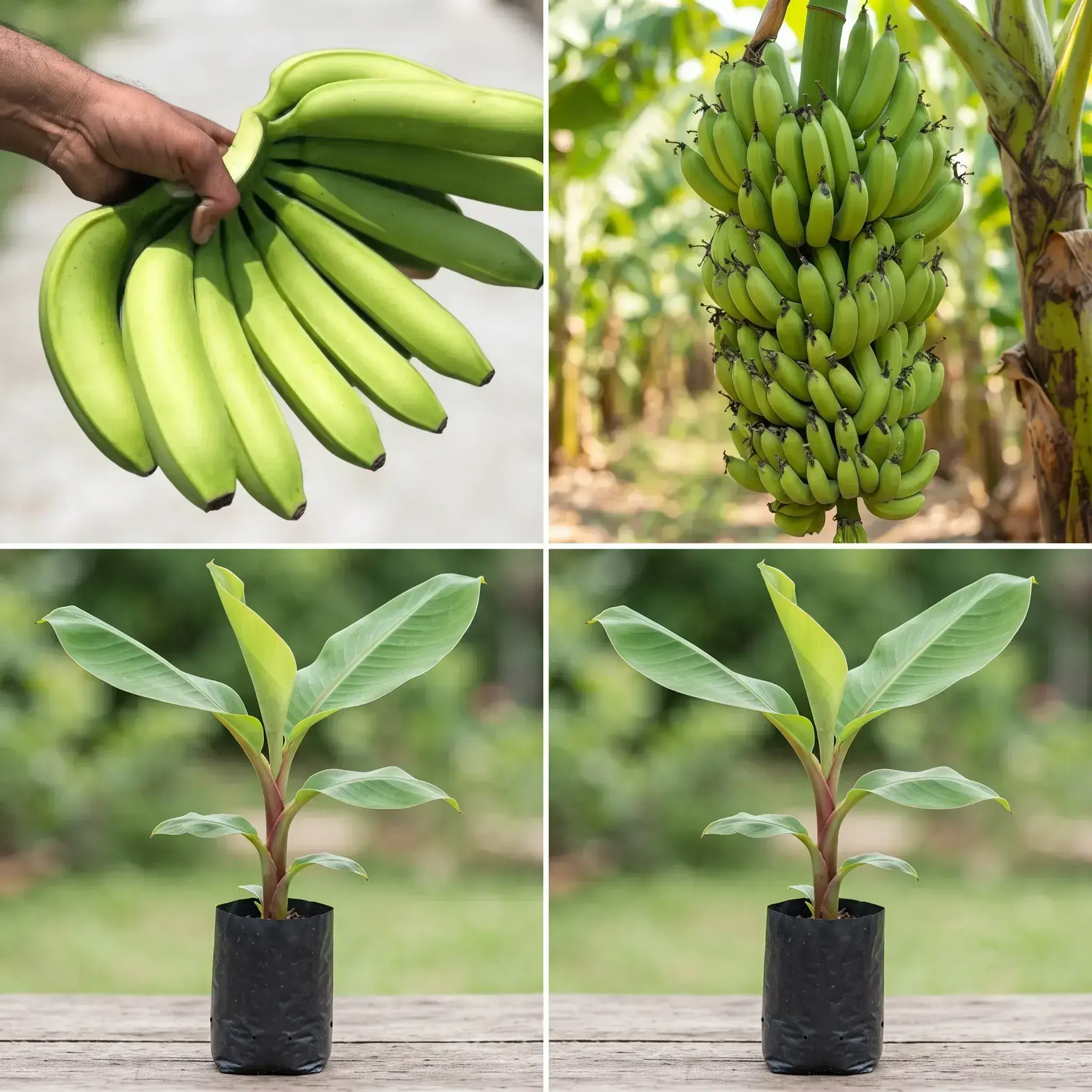
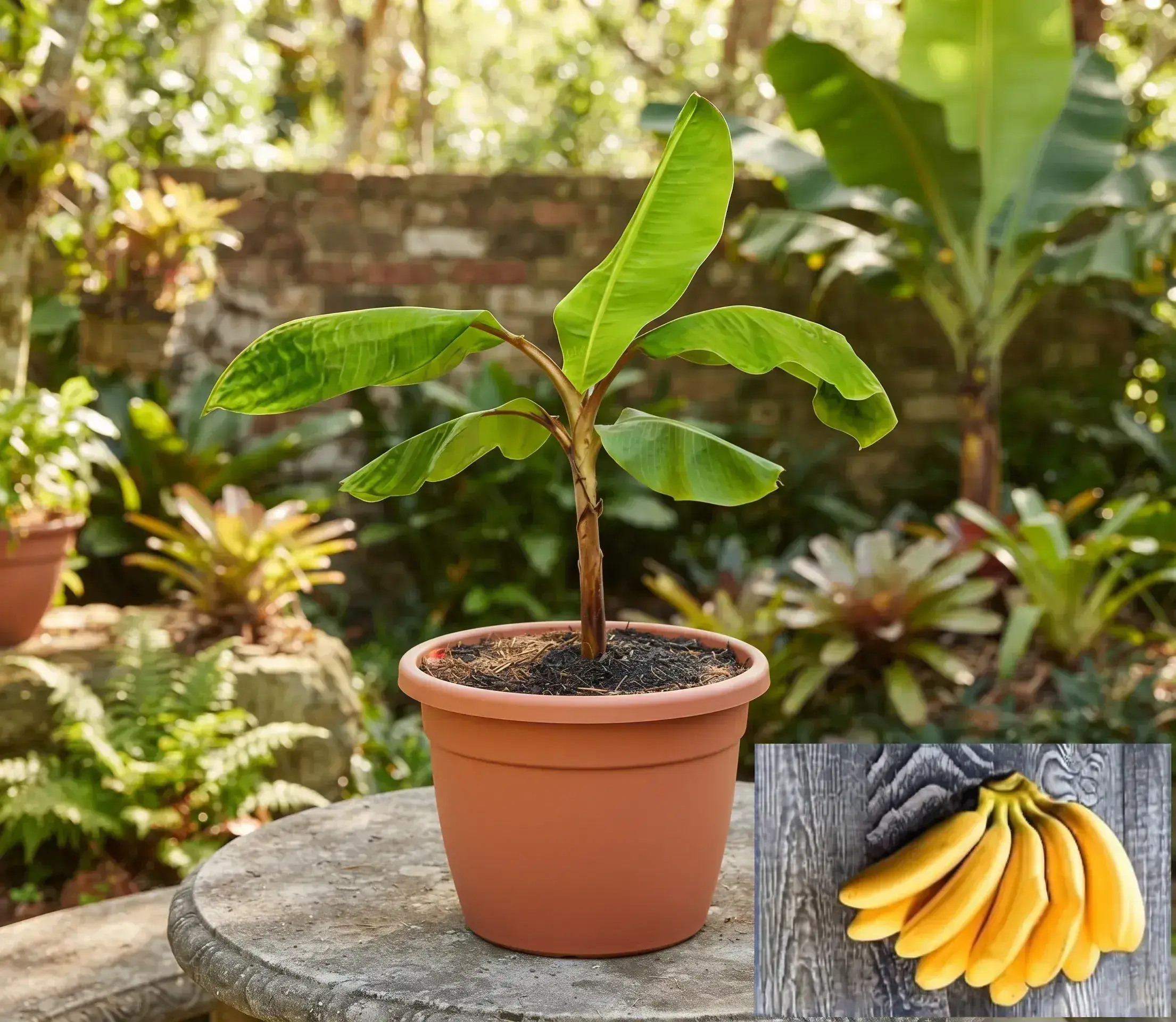
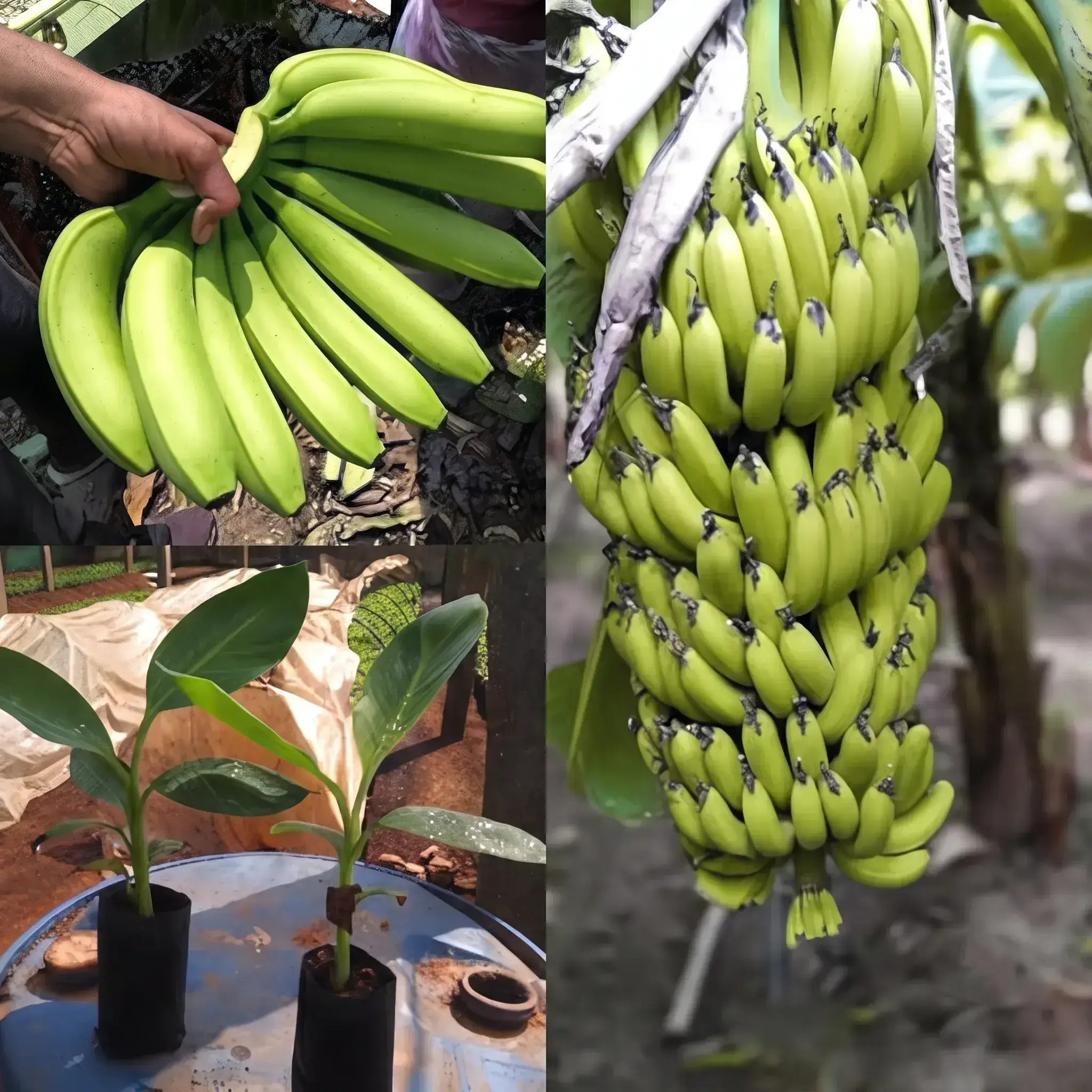
Singapuri Banana Tissue Cultured Fruit Plant – Premium High Yield Banana Variety
🌿 About the Plant
Singapuri Banana is a commonly used Indian market name for a banana type associated with Dwarf Cavendish (AAA). An official CSIR-linked Indian Science & Technology portal lists Singapuri among the common names used for Dwarf Cavendish, along with Basrai, Bhusawal, Jahaji, Kabuli, Mauritius and Morris. It describes Dwarf Cavendish as an important commercial banana cultivar in several Indian states.
The botanical genus is Musa and cultivated dessert bananas in this group are generally associated with the Musaceae family. The exact cultivar identity represented by the nursery trade name “Singapuri” can vary between sellers, so it is safer not to treat every plant sold under this market name as a separately standardized cultivar.
This product is supplied as a tissue-cultured banana plant. Tissue culture, also called micropropagation, allows large numbers of plants to be produced from selected mother material under controlled laboratory conditions. TNAU explains that micropropagated banana plants can provide uniform planting material, rapid multiplication and healthy plants when proper laboratory selection, virus indexing, hardening and quality control are followed.
For Indian home gardens, a tissue-cultured banana can be an attractive option where gardeners want a relatively fast-growing fruit plant without starting from a conventional sucker.
🌱 Plant Characteristics
- Plant type: Tropical fruit plant
- Botanical genus: Musa
- Family: Musaceae
- Common name: Banana
- Market name: Singapuri
- Associated type: Dwarf Cavendish/AAA banana type
- Propagation: Tissue culture / micropropagation
- Growth habit: Herbaceous perennial with a pseudostem
- Fruit: Seedless edible banana under normal cultivated conditions
- Growing purpose: Fresh fruit production
- Climate preference: Warm tropical and subtropical conditions
Unlike a conventional woody tree, a banana plant does not develop a permanent woody trunk. What looks like a trunk is a pseudostem formed by overlapping leaf bases.
After producing a bunch, the main pseudostem normally completes its productive cycle and should be removed after harvest, allowing healthy suckers from the base to continue the plantation.
🍌 Fruits
Bananas produced by cultivated dessert varieties are generally seedless or nearly seedless, with edible pulp and a soft texture when ripe.
Dwarf Cavendish is a commercially important banana type in India. The National Horticulture Board describes Dwarf Cavendish as an important commercial cultivar and lists several regional names associated with it, while the CSIR-linked India Science & Technology portal specifically includes Singapuri among those names.
Depending on the particular planting material and growing conditions, fruit characteristics can vary. Do not treat nursery-market descriptions of exact fruit size, bunch weight or number of fruits as guaranteed for every plant.
Bananas are commonly eaten:
- Fresh when ripe
- In smoothies and shakes
- In desserts
- With breakfast foods
- In traditional Indian recipes
☀️ Sunlight Requirements
Banana is a sun-loving tropical crop and performs best with abundant sunlight.
For home cultivation:
- Select an open outdoor location.
- Provide several hours of direct sunlight every day.
- Avoid deep shade beneath large trees or buildings.
- Good sunlight supports vigorous leaf growth and fruit development.
- Protect very young tissue-cultured plants from sudden harsh exposure while they are still acclimatising.
Freshly hardened tissue-culture plants can initially be more sensitive to strong environmental changes. TNAU recommends gradual hardening of tissue-cultured banana plants before field establishment.
💧 Watering
Bananas need a consistent supply of moisture, particularly during active vegetative growth and bunch development.
Follow these practical steps:
- Check the soil moisture regularly.
- Water when the upper soil begins to dry.
- Give sufficient water to moisten the root zone.
- Increase watering during hot and dry weather.
- Reduce additional irrigation when heavy monsoon rainfall is already keeping the soil moist.
- Ensure excess water can drain away.
- Avoid allowing the roots to remain in stagnant water.
Banana plants have relatively high water requirements compared with many drought-tolerant fruit plants. TNAU provides irrigation recommendations for banana and emphasises appropriate water management during cultivation.
For container-grown plants, check moisture more frequently because containers can dry faster than garden soil.
🪴 Soil & Potting
Banana grows well in fertile, organic-rich and well-drained soil with adequate moisture-holding capacity.
A practical container mix can include:
- Garden soil
- Well-decomposed compost
- Vermicompost or farmyard manure
- Cocopeat
- Coarse sand or another drainage-supporting material
The growing medium should retain enough moisture for the banana’s active growth while allowing excess water to drain.
Use a large container with several drainage holes. Never allow the pot to remain standing in collected water.
For ground planting, choose deep soil with good drainage and incorporate well-decomposed organic matter before planting where necessary.
🌱 Fertilizer & Nutrition
Bananas are relatively nutrient-demanding fruit crops, especially when grown for bunch production.
Useful nutrient sources include:
- Well-decomposed farmyard manure
- Compost
- Vermicompost
- A suitable banana or fruit-crop fertilizer
- Potassium-rich nutrition where recommended
- Micronutrients when a genuine deficiency is identified
Rather than applying large quantities of fertilizer at once, use a balanced feeding programme appropriate for the plant’s growth stage.
Always follow the manufacturer’s recommended dosage when using packaged fertilizer.
Good nutrition should be combined with adequate sunlight, irrigation and healthy soil.
🌼 Flowering & Fruit Development
Bananas do not flower like conventional woody fruit trees. After sufficient vegetative growth, the plant produces an inflorescence, which develops into the banana bunch.
Tissue-cultured plants can show relatively uniform growth when produced from selected material and properly hardened. TNAU reports that tissue-culture plants can have advantages such as uniformity, rapid growth and potentially earlier flowering compared with conventional planting material under suitable cultivation conditions.
Fruit development depends on:
- Plant age
- Variety or cultivar type
- Plant health
- Sunlight
- Water availability
- Soil fertility
- Temperature
- Nutrition
- Pest and disease management
The main plant normally completes its productive cycle after producing the bunch. A healthy sucker can then be retained for the next crop cycle.
Fruiting is not guaranteed immediately after delivery and depends on plant maturity, planting material quality, climate, sunlight, nutrition, water management and growing conditions.
🏡 Home Garden Suitability
Singapuri banana can be suitable for:
- 🏡 Home gardens
- 🌱 Kitchen gardens
- 🌳 Backyard fruit gardens
- ☀️ Sunny outdoor spaces
- 🌾 Small-scale fruit cultivation
- 🪴 Large containers while plants are young
Bananas are particularly suitable for warm regions of India. In cooler areas, growth may slow significantly during winter, while frost or prolonged cold can damage the plant.
For humid parts of eastern and southern India, adequate drainage remains important during the monsoon.
🪴 Container / Terrace Gardening
A tissue-cultured banana plant can be grown in a large container, particularly for home and terrace gardening.
For container cultivation:
- Choose a large, stable pot or grow bag.
- Provide multiple drainage holes.
- Use fertile, well-draining soil.
- Place the plant in strong sunlight.
- Water regularly without creating waterlogging.
- Feed the plant appropriately during active growth.
- Provide support if the plant becomes unstable under a heavy bunch.
- Replace or refresh the growing medium when the root system becomes crowded.
Bananas are not permanent miniature plants merely because they are grown in containers. A productive plant may become substantial in height and require adequate space.
✂️ Pruning & Maintenance
Banana maintenance is different from pruning a woody fruit tree.
Recommended practices include:
- Remove completely dead or severely damaged leaves.
- Keep unnecessary suckers under control.
- Retain one healthy mother plant and suitable follower sucker where appropriate.
- Remove the harvested pseudostem after the fruiting cycle.
- Keep the area around the plant free from excessive weeds.
- Remove badly diseased plant material promptly.
- Support the plant if a heavy bunch creates a risk of lodging.
Do not remove healthy green leaves unnecessarily because the leaves contribute to photosynthesis and bunch development.
🌳 Space Requirement
Although banana is not a conventional tree, each plant requires adequate space for its leaves, root zone and developing bunch.
For home gardens:
- Avoid planting directly against a wall.
- Leave sufficient room for leaf expansion.
- Provide access for harvesting.
- Avoid crowded planting where air circulation is poor.
- Allow space for new suckers if you want to maintain future plants.
Commercial spacing varies according to the banana variety and production system. TNAU lists different spacing recommendations for different tissue-cultured banana types, demonstrating that spacing should be selected according to the particular cultivar and cultivation system.
🌱 Special Cultivation Notes
Tissue Culture Plant
The main feature of this product is its tissue-culture propagation.
TNAU explains that banana micropropagation involves selecting suitable mother material, establishing cultures, multiplication, rooting, primary hardening, secondary hardening, rouging of off-types and quality-control procedures.
Potential advantages of good-quality tissue-cultured banana plants include:
- More uniform planting material
- Rapid multiplication
- Healthy starting plants
- Potentially more uniform crop establishment
- Availability of planting material beyond conventional sucker multiplication
However, tissue culture itself does not guarantee a specific yield. Plant performance still depends on cultivar identity, plant quality, hardening, soil, irrigation, nutrition, climate and crop management.
TNAU also notes that banana tissue-culture production requires careful management because off-types or somaclonal variation can occur if multiplication and quality-control procedures are inadequate.
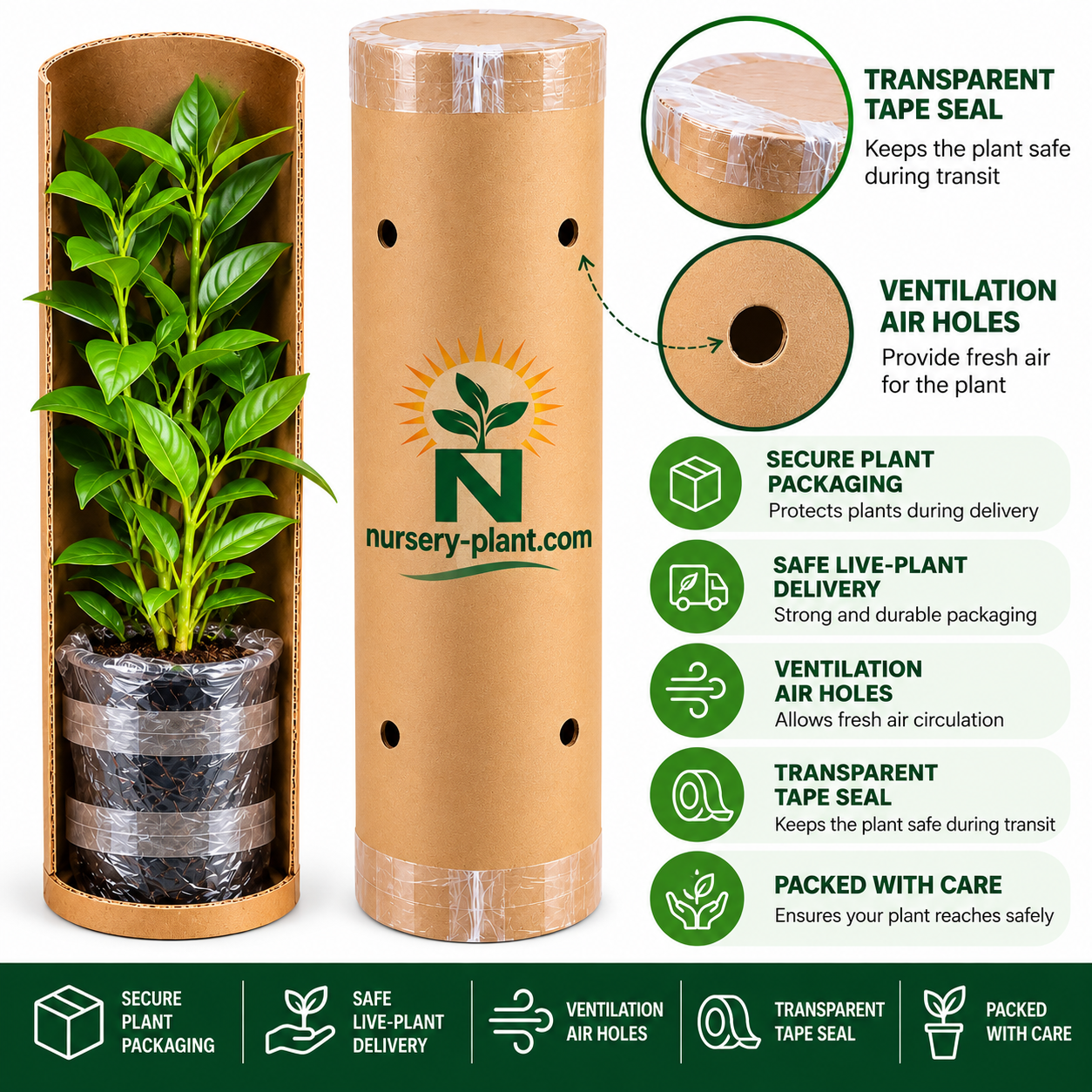
📦 Live Plant Delivery & Natural Variation
This is a live tissue-cultured plant, so natural variation in appearance is expected.
Depending on the plant’s age, season and transportation conditions, it may arrive with:
- Slight leaf yellowing
- Temporary leaf drooping
- Minor leaf damage
- Different plant height
- Different leaf size
- Different pseudostem thickness
- Slight transportation stress
Tissue-cultured plants may also need a short acclimatisation period after transportation.
Changes in light, temperature, humidity and watering during shipping can temporarily affect the appearance of a live plant.
The delivered plant may therefore not look exactly like the product photograph. Product photographs represent the general variety and mature appearance, while individual plants naturally differ according to their growth stage.
⚠️ Important Note
“Singapuri” is a market/common name that is associated with Dwarf Cavendish in Indian sources, but nursery listings may use the name inconsistently. The CSIR-linked India Science & Technology portal identifies Singapuri as one of the common names associated with Dwarf Cavendish.
Therefore, exact claims about fruit length, bunch weight, number of fruits or plant height should not be treated as guaranteed unless they are confirmed for the specific planting material supplied.
The term “Premium High Yield” describes the intended product positioning and does not guarantee a particular yield.
Also, tissue culture does not mean the plant will produce fruit immediately after delivery. The plant must first establish, grow to reproductive maturity and develop a bunch under suitable environmental conditions.
🌱 Why Choose This Plant?
- 🍌 Popular Indian banana type associated with Singapuri/Dwarf Cavendish
- 🧬 Produced through tissue-culture propagation
- 🌱 Uniform planting material when produced under proper quality-control conditions
- ☀️ Suitable for sunny home gardens
- 🏡 Suitable for backyard and kitchen gardens
- 🪴 Can be grown in a sufficiently large container
- 🇮🇳 Suitable for many warm regions of India
- 🍌 Produces edible dessert bananas under suitable conditions
- 🌿 Fast-growing tropical fruit plant
- 🌱 Suitable for home gardeners interested in tissue-cultured fruit plants
🌿 Botanical Information
- Botanical Name: Musa spp. — Singapuri is commonly associated in Indian sources with Dwarf Cavendish/AAA banana
- Family: Musaceae
- Common Names: Banana, Singapuri, Dwarf Cavendish; regional names vary
- Variety/Cultivar: Marketed as Singapuri; associated with Dwarf Cavendish in Indian references
- Plant Type: Herbaceous perennial fruit crop
- Propagation: Tissue culture / micropropagation
- Growth Habit: Clump-forming herbaceous plant with a pseudostem
- Fruit: Edible seedless or nearly seedless cultivated banana
- Suitable Growing Conditions: Warm tropical to subtropical climate, good sunlight, fertile soil, regular moisture and good drainage
🔗 Botanical Information & Further Reading
For Indian banana variety information and the association of Singapuri with Dwarf Cavendish, see the CSIR-linked India Science, Technology & Innovation portal.
India Science & Technology – Dwarf Cavendish Banana
For banana tissue-culture propagation, micropropagation, hardening, uniformity and planting-material quality, see the Tamil Nadu Agricultural University (TNAU) Banana Expert System.
TNAU – Banana Micro-Propagated Plants
For tissue-culture banana cultivation and varieties used in India, see the TNAU Agritech Portal.
TNAU – Banana Tissue Culture
For commercial banana cultivars, planting material and cultivation information, see the National Horticulture Board (NHB).
NHB – Banana Detailed Project Report
For scientific research and institutional information about banana varieties and new planting material, see the ICAR – National Research Centre for Banana (NRCB).
ICAR – National Research Centre for Banana
For general customer-friendly information about banana taxonomy, cultivation and plant characteristics, see Wikipedia – Banana.
Wikipedia – Banana
For scientific literature concerning banana taxonomy, genetics, tissue culture and crop science, Google Scholar and ResearchGate can also be useful starting points. Specific research papers should be evaluated according to their study location, cultivar and experimental conditions before applying their findings to a particular nursery plant.
For More Information Visit: Nursery-Plant.Com
For Contact Visit:Contact Us
For Shopping Visit: Shop Page


Reviews
There are no reviews yet.