
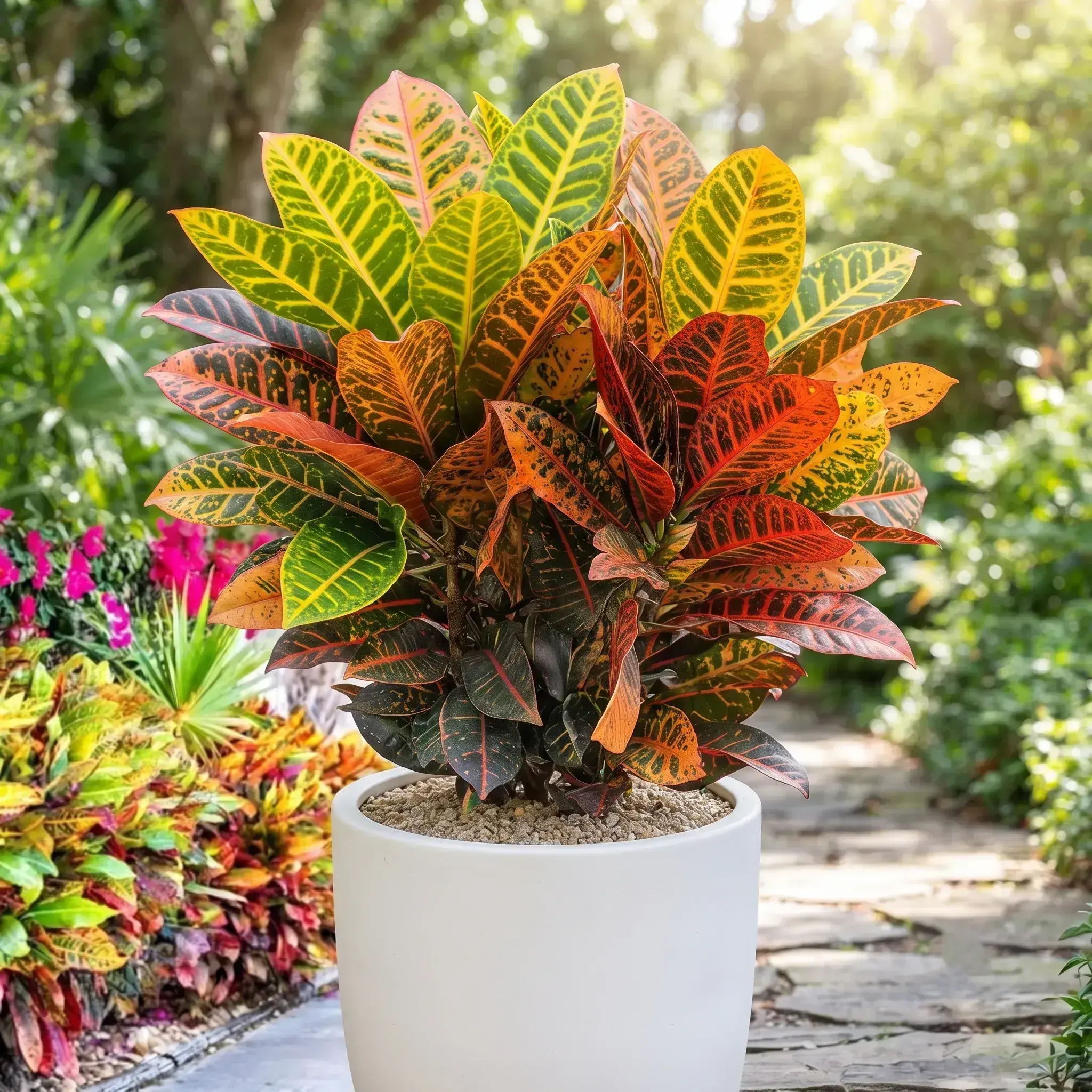

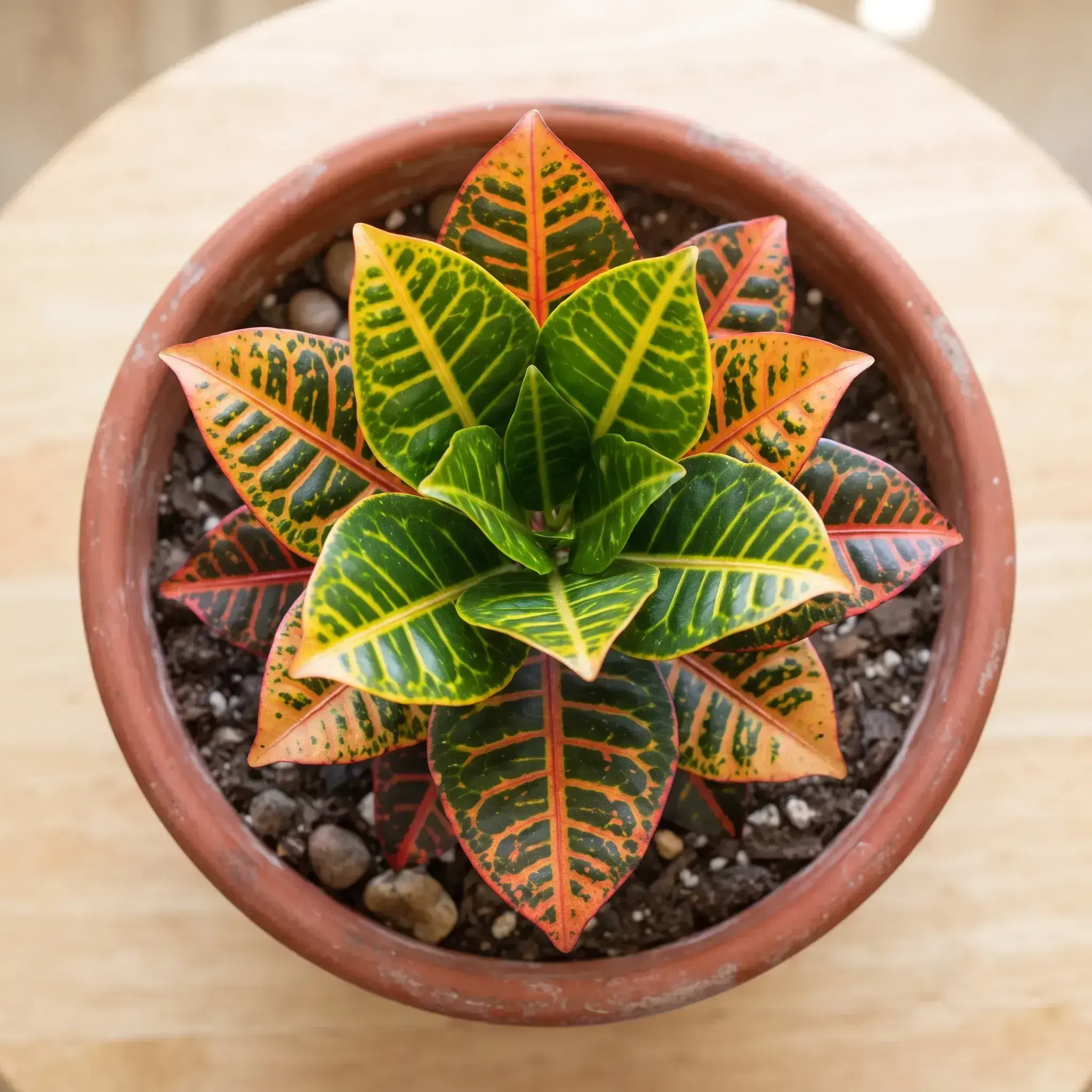

Codiaeum Variegatum Croton Plant with Pot | Live Colorful Indoor Croton Plant for Home & Office
🌿 About the Plant
Croton, botanically known as Codiaeum variegatum, is one of the most popular ornamental foliage plants for adding bright, tropical colour to homes, offices, balconies and garden spaces. Its large, leathery leaves can display combinations of green, yellow, orange, red, pink and burgundy, creating a naturally colourful appearance without relying on flowers.
Croton belongs to the Euphorbiaceae family and is naturally a tropical shrub or small tree. Kew currently accepts Codiaeum variegatum as the botanical name. The name Croton is widely used in horticulture, although the ornamental plant commonly sold as Croton is actually a member of the genus Codiaeum.
This live Croton plant with pot is a beautiful choice for gardeners who want colourful foliage and a tropical appearance in a relatively compact container-grown plant.
🌱 Plant Characteristics
- Common Name: Croton, Garden Croton, Variegated Croton, Joseph’s Coat
- Scientific Name: Codiaeum variegatum
- Family: Euphorbiaceae
- Plant Type: Evergreen tropical shrub
- Growth Habit: Upright and branching
- Leaves: Large, leathery and glossy
- Leaf Colours: Green, yellow, orange, red, pink and burgundy combinations
- Light Requirement: Bright indirect or filtered light
- Water Requirement: Moderate and regular
- Humidity: Moderate to high humidity preferred
- Soil: Well-drained, fertile and slightly acidic
- Container Suitable: Yes
- Indoor Suitable: Yes, with sufficient light and warmth
- Main Ornamental Feature: Colourful foliage
RHS describes Crotons as tropical shrubs with spectacular, multicoloured foliage, while NC State Extension recommends bright light for maintaining strong leaf colour.
🍃 Colourful Foliage
The leaves are the main attraction of Croton.
Unlike many indoor plants that remain mostly green, Codiaeum variegatum can produce leaves with striking combinations of several colours. Depending on the particular plant and cultivar, leaves may be:
- Green and yellow
- Green and orange
- Yellow and red
- Red and burgundy
- Green with orange markings
- Green with yellow veins
- Mixed combinations of several colours
Croton has considerable horticultural diversity, with many cultivated forms displaying different leaf shapes, sizes and colour patterns. Therefore, the exact foliage pattern of an individual plant should be expected to vary naturally.
RHS notes that Crotons are available with brightly splashed or boldly veined leaves in shades including red, pink, burgundy, orange, yellow and green.
☀️ Sunlight Requirements
Bright light is one of the most important requirements for a colourful Croton.
For indoor growing, place the plant in a bright location with filtered or indirect sunlight. Good light helps maintain attractive foliage colour.
RHS recommends bright but indirect light, while NC State notes that Crotons need bright light with some direct sun for the best leaf colour.
A suitable location may include:
- Bright east-facing window
- Bright west-facing window with protection from harsh afternoon heat
- Bright balcony with filtered sunlight
- Covered terrace
- Bright office near a window
Avoid suddenly moving a Croton from low light into intense direct summer sunlight. Strong sunlight through glass can become very hot and may scorch the leaves.
💧 Watering
Croton prefers consistent moisture without waterlogging.
Unlike many drought-tolerant succulents, it should not be allowed to remain extremely dry for long periods.
A practical watering routine is:
- Check the top layer of soil before watering.
- Water when the surface has started to dry.
- Water thoroughly until some excess drains from the bottom.
- Empty standing water from the outer pot or tray.
- Avoid allowing the soil to remain completely dry for extended periods.
RHS notes that Crotons can drop leaves when the air is dry or the compost becomes too dry. NC State recommends more generous watering from spring through autumn and reduced watering during winter.
During India’s monsoon season, reduce watering if the potting medium is already staying wet because of high humidity or reduced evaporation.
🪴 Soil & Potting
Croton performs best in a fertile, moisture-retentive but well-drained growing medium.
For container cultivation, a suitable mix can include:
- Good-quality potting soil
- Organic compost
- Cocopeat or another moisture-retaining component
- Perlite, coarse sand or grit for drainage
RHS recommends a light, fast-draining acidic/ericaceous compost for container-grown Crotons.
The pot should always have adequate drainage holes.
Avoid heavy soil that stays saturated for long periods. At the same time, avoid a very dry, gritty mix designed for desert cacti, because Croton has different moisture requirements.
🌱 Fertilizer & Nutrition
Croton benefits from regular nutrition during active growth because healthy foliage requires an adequate supply of nutrients.
A balanced liquid or slow-release fertilizer suitable for ornamental foliage plants can be used according to the manufacturer’s instructions.
For best results:
- Feed during active growth.
- Follow the recommended dosage.
- Avoid excessive fertilizer.
- Water appropriately after applying granular fertilizer.
- Reduce feeding when growth slows.
- Allow newly delivered plants to acclimatise before beginning a strong fertilizer routine.
Good nutrition can support healthy leaf development and colour, but fertilizer alone cannot replace adequate light.
🌸 Flowers
Croton is primarily grown for its decorative foliage, not for its flowers.
Mature plants can produce small flowers, but they are generally much less noticeable than the colourful leaves.
Flowering is not the main ornamental feature of this plant and should not be expected immediately after purchase.
If grown indoors, the plant may devote most of its ornamental value to foliage rather than producing conspicuous flowers.
🏡 Home & Office Suitability
Croton can make an attractive statement plant in:
- Living rooms
- Home offices
- Workspaces
- Reception areas
- Study rooms
- Bright bedrooms
- Balconies
- Covered patios
- Terraces
- Entryways
- Indoor plant corners
Its colourful leaves can provide strong visual contrast against plain walls, furniture and other green plants.
For office use, place it near a bright window rather than in a dark interior corner.
🪴 Container & Indoor Gardening
Croton is particularly suitable for container cultivation.
When growing it indoors:
- Use a pot with drainage holes.
- Provide bright filtered light.
- Maintain reasonably consistent moisture.
- Avoid sudden temperature changes.
- Provide adequate humidity.
- Keep the plant away from strong air-conditioner drafts.
- Rotate the pot occasionally if growth becomes uneven.
RHS recommends warm conditions and high humidity for maintaining Croton in good condition. It gives an ideal temperature range of approximately 18–35°C for cultivation.
Because Croton is tropical, an indoor environment that is warm and reasonably humid is generally more suitable than a cold, dry location.
💦 Humidity Requirements
Humidity is particularly important for maintaining attractive Croton foliage.
Dry air can contribute to leaf drop and reduced appearance quality. RHS recommends high humidity and suggests methods such as placing the pot on a tray of damp pebbles, while keeping the plant away from direct heat sources.
In Indian homes, natural humidity may already be relatively high during the monsoon. During dry periods, however, avoid placing Croton directly beside:
- Air-conditioner outlets
- Strong fans
- Heaters
- Hot ventilation outlets
Good airflow is still useful, but continuous hot or very dry air can stress the foliage.
✂️ Pruning & Maintenance
Croton can be pruned to maintain a compact shape and encourage branching.
Pruning may be useful for:
- Removing damaged leaves
- Removing weak branches
- Controlling height
- Maintaining a fuller appearance
- Encouraging branching
Use clean pruning tools when cutting stems.
Croton produces milky sap when stems or leaves are damaged, so gloves are recommended during pruning and handling.
Avoid excessive pruning immediately after delivery. Allow the plant time to recover from transportation and adjust to its new environment first.
🌳 Space Requirement & Growth
Croton can develop into a fairly substantial shrub when grown under favourable tropical conditions, although container-grown plants are often maintained at a smaller size.
RHS notes that indoor Crotons are commonly sold at approximately 30–90 cm in height, while the species itself can become much larger when grown in suitable outdoor tropical conditions.
The final size depends on:
- Cultivar
- Container size
- Light
- Temperature
- Nutrition
- Watering
- Pruning
- Plant age
Allow enough space around the plant for its leaves to develop without being constantly pressed against walls or furniture.
🇮🇳 Growing in Indian Conditions
Croton is well suited to warm Indian conditions, particularly in areas where frost is not a concern.
For Indian home gardens:
- Provide bright filtered light.
- Protect from extreme afternoon heat when necessary.
- Maintain moderate soil moisture.
- Avoid waterlogging during monsoon.
- Provide good humidity and airflow.
- Protect from cold conditions.
- Keep indoor plants near a bright window.
NC State notes that Crotons are tropical plants and are best treated as houseplants or outdoor accent plants only in frost-free climates.
In most parts of India, Croton can therefore be grown as an outdoor ornamental in suitable warm locations or as a potted indoor plant with adequate light.
🌿 Leaf Colour & Light
Croton’s colourful foliage is strongly influenced by its growing environment.
Too little light:
Leaves may become greener, less colourful and the plant may lose lower leaves.
Very intense direct sunlight:
Leaves may develop scorch or heat damage, particularly when the plant has not been acclimatised.
Bright filtered light:
Generally provides a useful balance between strong growth and attractive foliage colour.
This is why a bright indoor location with filtered sunlight is often a practical choice.
🐛 Common Problems
Croton can experience problems when environmental conditions change suddenly.
Leaf Drop:
Dry soil, low humidity, sudden temperature changes or insufficient light can contribute to leaf drop.
Leaf Scorch:
Sudden exposure to intense sunlight, particularly through hot glass, can damage leaves.
Root Problems:
Constantly wet soil and poor drainage can create root-related problems.
Pests:
Crotons may be affected by common houseplant pests such as scale insects, mealybugs and spider mites.
Regularly inspect the undersides of leaves and young shoots.
🌱 Propagation
Croton can be propagated through stem cuttings, although successful propagation requires suitable warmth, humidity and growing conditions.
For home gardeners, propagation is best carried out using healthy stem sections with appropriate moisture control.
If you want to preserve the characteristics of a particular named Croton cultivar, vegetative propagation is generally preferable to growing from seed because seedlings may not reproduce the exact appearance of the parent plant.
⚠️ Safety & Toxicity
Croton should be treated as an ornamental plant, not an edible plant.
The plant produces a milky sap when leaves or stems are damaged. Because of this, avoid contact with the sap and wash your hands after pruning or handling damaged plant material.
Do not intentionally consume leaves, stems or other plant parts.
The ASPCA notes that its plant database is not exhaustive and recommends checking the exact botanical name when assessing plant safety.
For households with children or pets, placing Croton where it cannot be chewed is a sensible precaution.
🐶 Pet Safety
Because Croton can be irritating and is not intended for consumption, keep it away from pets that frequently chew plants.
If a dog or cat has eaten an unknown amount of Croton, contact a veterinarian for advice rather than assuming that the plant is harmless.
ASPCA advises pet owners to seek veterinary assistance when an animal may have ingested a potentially poisonous plant.
🌿 Botanical Naming Note
The accepted botanical name is Codiaeum variegatum (L.) Rumph. ex A.Juss., according to Kew’s Plants of the World Online. It belongs to the family Euphorbiaceae.
The name Croton variegatus is an older botanical synonym of Codiaeum variegatum.
The common horticultural name “Croton” is therefore widely used, but the ornamental Croton sold by nurseries should botanically be referred to as Codiaeum, not confused with the much larger and unrelated genus Croton. Kew specifically notes that Codiaeum variegatum is often called Croton in horticulture.
📦 Live Plant Delivery & Natural Variation
This product contains a live Croton plant supplied with a pot.
Because plants are living organisms, the exact appearance of the delivered plant may naturally differ from product photographs.
Natural variation may occur in:
- Plant height
- Number of leaves
- Leaf size
- Leaf shape
- Colour intensity
- Green, yellow, orange or red patterning
- Branching
- Plant fullness
- Pot appearance
- Growing-medium appearance
Crotons can also react visibly to changes in light, temperature, humidity and watering during transportation and after delivery. Temporary leaf drooping or minor leaf shedding may occur while the plant adjusts.
These natural variations do not necessarily indicate a problem with the plant.
Product photographs are representative of the plant type and may not show the exact individual plant delivered.
After delivery, place the plant in a warm, bright location with filtered light and allow it to gradually acclimatise.
⚠️ Important Note
Croton is a tropical foliage plant and should not be treated like a drought-tolerant succulent.
Its colourful foliage generally develops best with bright light, warmth, adequate humidity and consistent but well-controlled watering.
Avoid sudden environmental changes immediately after delivery. Give the plant time to adapt before moving it repeatedly between indoor and outdoor locations.
The exact colour combination and leaf shape can vary naturally because Codiaeum variegatum includes many horticultural forms and cultivars.
🌱 Why Choose This Plant?
- Beautiful multicoloured tropical foliage
- Green, yellow, orange, red and burgundy colour combinations
- Excellent decorative plant for homes
- Attractive addition to offices and workspaces
- Suitable for pots and containers
- Can be grown indoors with sufficient bright light
- Suitable for balconies and terraces
- Provides colour even when not flowering
- Excellent foliage contrast plant
- Attractive tropical appearance
- Suitable for warm Indian climates
- Can be pruned to maintain a compact shape
- Available in many distinctive foliage patterns
- Ideal for gardeners who prefer colourful foliage plants
🌿 Botanical Information
Scientific Name: Codiaeum variegatum (L.) Rumph. ex A.Juss.
Common Name: Croton, Garden Croton, Variegated Croton, Joseph’s Coat
Family: Euphorbiaceae
Plant Type: Evergreen tropical shrub
Native Range: Malesia to the Southwest Pacific
Growth Habit: Upright and branching
Leaves: Glossy, leathery and highly variable in shape and colour
Foliage Colours: Green, yellow, orange, red, pink and burgundy combinations
Flowers: Small and inconspicuous compared with the foliage
Light: Bright indirect or filtered light
Water: Moderate and regular; avoid prolonged dryness and waterlogging
Humidity: Moderate to high preferred
Soil: Fertile, well-drained, preferably slightly acidic
Container Suitable: Yes
Indoor Suitable: Yes, with warmth and adequate light
Main Ornamental Feature: Multicoloured foliage
Safety: Ornamental plant; do not consume
🔗 Botanical Information & Further Reading
- Kew Science – Codiaeum variegatum | Plants of the World Online
- Royal Horticultural Society – Codiaeum / Croton Guide
- Royal Horticultural Society – How to Grow Codiaeum
- NC State Extension – Codiaeum variegatum
- Kew – Codiaeum variegatum Taxonomy & Distribution
- ASPCA – Toxic and Non-Toxic Plants Database
Nursery-Plant.com: Bring vibrant tropical colour into your home or office with a beautiful Codiaeum variegatum Croton. Its naturally colourful foliage, compact container-friendly growth and striking leaf patterns make it an excellent decorative choice for bright indoor spaces, balconies, terraces and warm home gardens.
For More Information
Visit: Nursery-Plant.Com
For Contact Visit:Contact Us
For Shopping Visit: Shop Page


Reviews
There are no reviews yet.