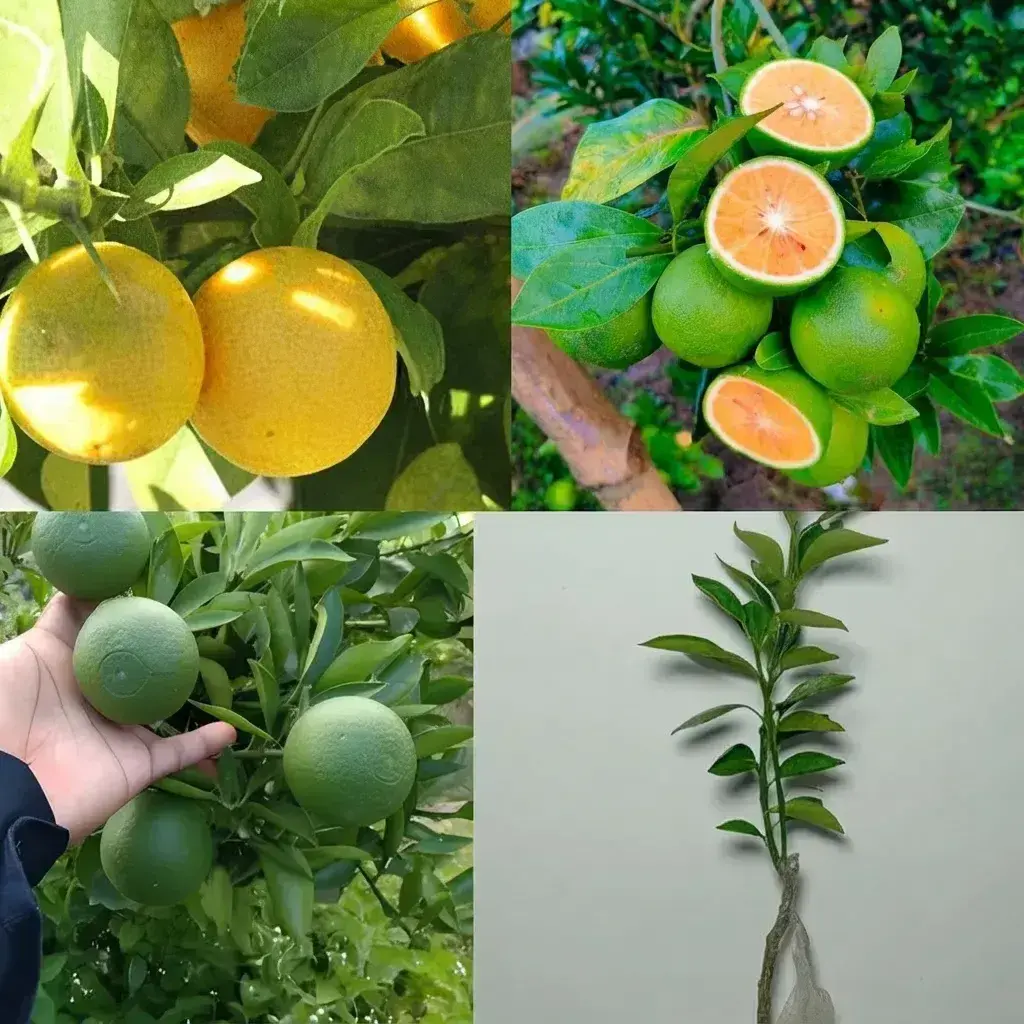

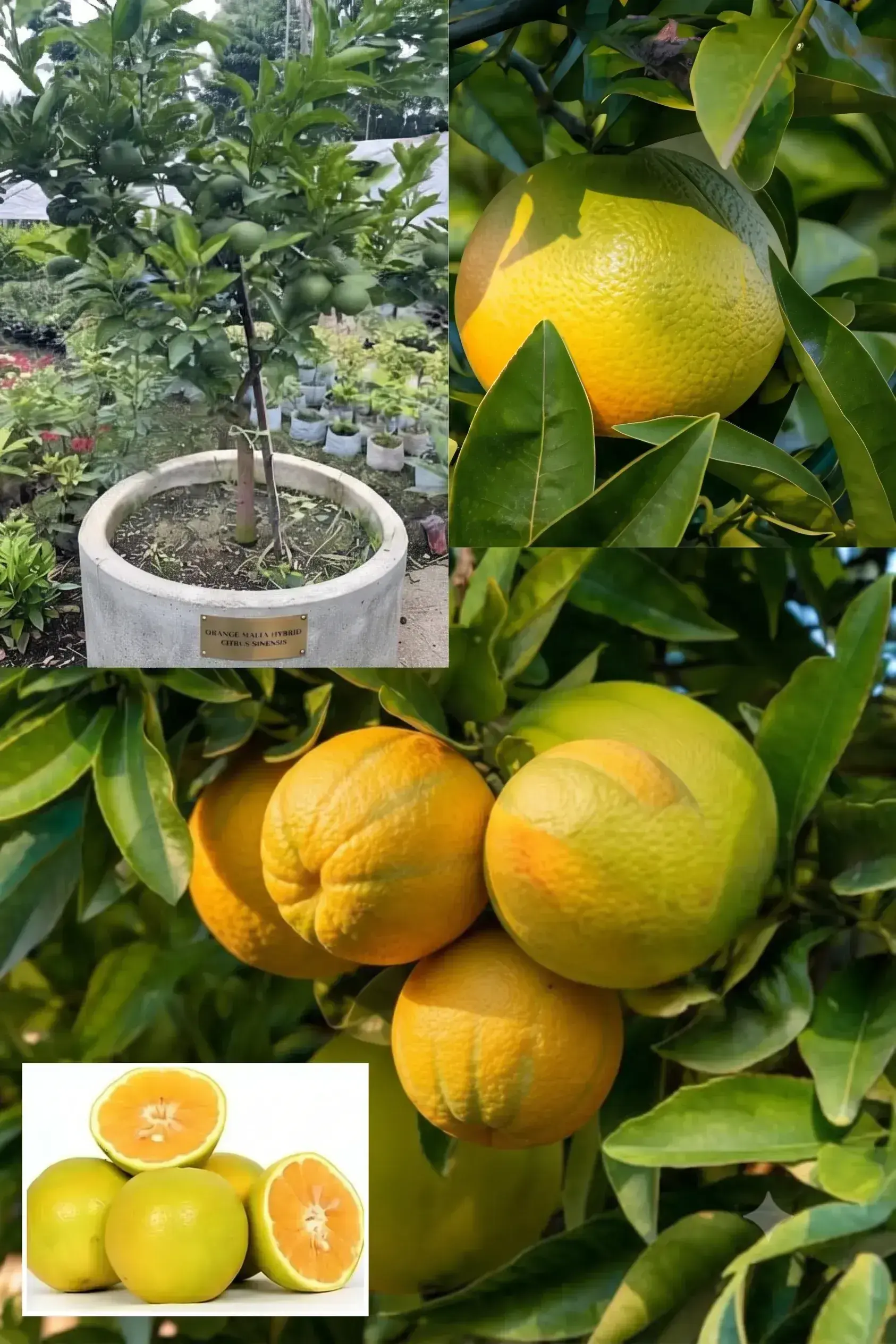


Orange Malta Hybrid Plant | Citrus × sinensis
🌿 About the Plant
The Orange Malta Hybrid Plant is a live citrus fruit plant selected for home gardeners who want to grow sweet, juicy orange-type fruit at home. The plant is marketed under the common Indian name Malta Orange, with the botanical identity commonly given in horticultural sources as Citrus sinensis, while modern citrus taxonomy may treat sweet orange within the broader hybrid complex Citrus × sinensis.
The National Horticulture Board describes Malta (Common) as a sweet-orange type with orange-yellow fruit, smooth skin, spherical shape, medium-to-large size, orange pulp, abundant juice and good flavour. It also separately lists Malta (Blood Red) as a distinct type.
The exact name “Malta” can be used differently in Indian nursery and horticultural markets, so the product should be understood as a marketed Malta sweet-orange selection unless a specific registered cultivar is identified. Indian horticultural sources list Malta alongside other sweet-orange types such as Mosambi and Sathgudi.
This plant is supplied with a pot, making it convenient for home gardeners who want to begin growing a citrus fruit plant without immediately needing to purchase a separate container.
🌱 Plant Characteristics
- Common Name: Malta Orange, Sweet Malta, Malta Orange Plant
- Botanical Name: Citrus × sinensis / Citrus sinensis
- Family: Rutaceae
- Plant Type: Evergreen citrus fruit tree
- Product Type: Live fruit plant with pot
- Fruit: Sweet orange
- Growth Habit: Bushy, branching citrus tree
- Foliage: Evergreen and glossy
- Flowers: Fragrant white citrus flowers
- Sunlight: Full sun to strong sunlight
- Soil: Fertile and well-drained
- Climate: Tropical, subtropical and suitable warm citrus-growing conditions
- Growing Options: Pot, terrace, courtyard or ground garden
TNAU’s sweet-orange cultivation guidance lists several Indian sweet-orange varieties and recommends well-drained loamy soils, with budded planting material commonly used for commercial production.
🍃 Leaves & Plant Appearance
The plant develops glossy green evergreen leaves that provide attractive foliage throughout the year in suitable climates.
Healthy citrus plants generally produce new flushes of growth periodically. Young leaves may initially appear lighter green before becoming darker and tougher as they mature.
The plant’s compact branching habit makes it suitable for:
- Home gardens
- Kitchen gardens
- Courtyards
- Terrace gardens
- Large balconies with adequate sunlight
- Container fruit gardens
- Open ground planting
A young plant supplied in a nursery pot will naturally be much smaller than a mature fruit-bearing orange tree.
🌸 Flowers
Sweet orange produces attractive white, fragrant flowers.
Flowering can occur in flushes depending on:
- Temperature
- Variety
- Plant maturity
- Water availability
- Sunlight
- Nutrition
- Pruning
- Local climate
The fragrance of citrus flowers is an additional ornamental feature of the plant.
A young nursery plant may require time to establish a healthy root system before producing significant flowering.
🍊 Malta Orange Fruit
The fruit is the main attraction of this plant.
The National Horticulture Board describes Common Malta as producing spherical, medium-to-large fruit with an orange-yellow skin, smooth surface, medium-thick rind, orange pulp, abundant juice and good flavour.
Depending on the particular selection and maturity, Malta-type sweet oranges can have:
- Orange to orange-yellow skin
- Juicy orange-coloured pulp
- Sweet to pleasantly sweet-tangy flavour
- Distinctive citrus aroma
- Segmented flesh
- Useful juice content
Fruit size, seed content, rind thickness, sweetness and acidity can naturally vary between plants and growing conditions.
🍹 Culinary Uses
Fresh Malta oranges can be enjoyed in many ways.
Common uses include:
- Fresh eating
- Fresh orange juice
- Breakfast fruit
- Fruit salads
- Desserts
- Smoothies
- Homemade beverages
- Garnishing
- Marmalade and other fruit preparations
The naturally sweet-tangy flavour makes the fruit useful both for direct consumption and for homemade drinks.
🌼 Flowering & Fruit Development
After flowering, successfully set flowers develop into small green citrus fruits.
The fruits gradually increase in size and undergo colour and flavour changes as they mature.
Good fruit development depends on:
- Strong sunlight
- Healthy foliage
- Adequate water
- Balanced nutrition
- Good root health
- Suitable temperatures
- Appropriate pruning
- General plant health
A heavy crop should not be expected from a newly planted young tree.
☀️ Sunlight Requirements
Sweet orange performs best with strong sunlight.
For home cultivation:
- Provide approximately 6–8 hours of direct sunlight where practical.
- Place the pot in an open, bright location.
- Avoid permanent deep shade.
- Keep the plant away from large trees that compete for sunlight.
- Strong light is particularly important for flowering and fruit development.
TNAU recommends suitable sunny conditions as part of successful sweet-orange cultivation and emphasizes appropriate climatic conditions for citrus production.
If a plant has been grown under protected nursery conditions, gradually acclimatise it to intense direct sunlight rather than moving it suddenly into harsh midday sun.
💧 Watering
Malta orange prefers regular moisture but excellent drainage.
Water thoroughly when the upper layer of the growing medium begins to dry.
During hot weather:
- Check potted plants frequently.
- Water deeply enough to moisten the root zone.
- Do not keep the pot permanently saturated.
- Increase watering during prolonged hot and dry periods.
During monsoon:
- Reduce additional irrigation when rainfall is sufficient.
- Ensure the pot drains freely.
- Never allow the container to remain standing in water.
Both drought stress and prolonged waterlogging can affect citrus growth and fruit development.
🪴 Soil & Potting
Use a fertile, porous and well-drained citrus-friendly growing medium.
A practical home mixture can include:
- Good-quality garden soil
- Mature compost
- Well-decomposed farmyard manure
- Cocopeat
- Coarse sand or another drainage-improving material
The growing medium should retain sufficient moisture while allowing excess water to escape.
Because this product comes with a pot, make sure the supplied container has functioning drainage holes. If the plant eventually becomes root-bound, move it to a larger container without unnecessarily disturbing the root ball.
🌱 Fertilizer & Nutrition
Sweet orange benefits from balanced nutrition for healthy leaves, flowering and fruit development.
Useful inputs include:
- Mature compost
- Vermicompost
- Well-decomposed organic manure
- A balanced citrus fertilizer
- Potassium-containing fertilizer when appropriate
- Micronutrients where an actual deficiency is identified
Do not apply concentrated fertilizer directly against the stem.
For container plants, nutrients can be depleted more quickly than in open ground, so regular but moderate feeding is important.
Avoid excessive nitrogen because it can encourage vigorous leafy growth without necessarily improving flowering or fruiting.
🪴 Container Gardening With the Supplied Pot
The included pot makes this plant especially convenient for:
- Terrace gardens
- Balcony gardens with strong sunlight
- Courtyards
- Small home gardens
- Kitchen gardens
For long-term container cultivation:
- Keep the pot in strong sunlight.
- Ensure drainage holes remain unobstructed.
- Water according to soil moisture.
- Feed regularly but moderately.
- Rotate the pot occasionally if growth becomes strongly one-sided.
- Increase container size when roots become restricted.
- Prune lightly when necessary to maintain a manageable canopy.
Remember that a citrus tree can eventually outgrow a small nursery container.
🌱 Grafted / Budded Plant Information
Sweet oranges are commonly propagated vegetatively through budding or grafting to maintain selected fruit characteristics.
TNAU identifies budded sweet-orange planting material and notes Rangpur lime as a commonly used rootstock, with rough lemon also used.
If the supplied plant is grafted or budded:
- Keep the graft/bud union above soil level.
- Never bury the union.
- Remove shoots growing from below the union.
- Do not allow soil or mulch to cover the graft area.
- Avoid damaging the union during repotting.
Vegetative propagation can help maintain the characteristics of selected fruiting material more reliably than ordinary seed propagation.
🍊 Fruiting Expectations
A nursery-grown grafted or budded citrus plant can reach reproductive maturity sooner than a seed-grown tree, but the actual fruiting period varies.
The time to first fruit depends on:
- Plant age at delivery
- Rootstock
- Scion variety
- Plant health
- Climate
- Sunlight
- Nutrition
- Water management
- Container size
- Transplanting stress
Fruiting is not guaranteed immediately after delivery and depends on plant age, variety, climate, sunlight, nutrition, water management and growing conditions.
If the plant already carries flower buds or fruit when delivered, some of these may naturally drop while the plant adjusts to its new environment.
✂️ Pruning & Maintenance
Sweet orange generally needs light and purposeful pruning.
Remove:
- Dead branches
- Broken branches
- Diseased growth
- Weak or crossing shoots
- Unwanted rootstock shoots below a graft/bud union
Avoid excessive pruning of healthy branches, especially immediately before a period of expected flowering.
A balanced canopy helps maintain good light penetration and air circulation.
🌳 Space Requirement
In a container, the plant can be kept relatively compact with suitable pruning and root-space management.
For ground planting, provide enough room for the tree’s eventual canopy and root system.
Keep the plant away from:
- Building foundations
- Large trees
- Electrical wires
- Narrow passageways
- Permanently shaded areas
Commercial sweet-orange planting commonly uses substantial spacing because mature citrus trees require room for canopy development. TNAU gives approximately 7 × 7 metres for conventional field planting.
A home gardener can maintain a smaller tree with container culture and appropriate pruning, but natural growth potential should still be considered.
🇮🇳 Growing Malta Orange in India
Malta-type sweet oranges are well represented in Indian horticulture. The National Horticulture Board lists Common Malta among sweet-orange varieties and associates it particularly with Punjab and Haryana.
TNAU lists Malta blood red alongside other sweet-orange varieties used in Indian horticulture.
For successful home cultivation in other parts of India, the most important factors are:
- Adequate sunlight
- Suitable warm conditions
- Well-drained soil
- Balanced nutrition
- Regular but controlled irrigation
- Good air circulation
- Protection from prolonged waterlogging
Local performance can vary substantially according to climate and the exact Malta selection.
🌧️ Monsoon Care
In high-rainfall areas:
- Check pot drainage after heavy rain.
- Avoid unnecessary irrigation.
- Do not let the pot sit in collected water.
- Remove severely damaged leaves or branches.
- Keep the canopy reasonably open for air circulation.
Heavy, continuously wet soil can cause root problems even though citrus plants require regular moisture.
🌞 Summer Care
During hot Indian summers:
- Check the pot regularly because containers dry faster.
- Water deeply when the soil begins drying.
- Keep the plant in strong sunlight after proper acclimatisation.
- Mulch the soil surface if appropriate.
- Protect a newly delivered nursery plant from sudden extreme heat until it acclimatises.
A stable water supply is especially important during active growth and fruit development.
🍊 Harvesting
Harvesting time varies according to the particular Malta selection, local climate and fruit maturity.
Mature fruit generally develops its characteristic orange or orange-yellow colour, aroma and flavour as it approaches eating maturity.
Avoid harvesting solely according to skin colour because citrus fruit can sometimes remain greenish even when sufficiently mature under particular environmental conditions.
Use fruit taste, firmness, aroma and the known characteristics of the particular selection as practical maturity indicators.
⚠️ Important Note About “Hybrid”
The product is marketed as a “Hybrid Malta Orange Plant.” The word hybrid should not be interpreted as a specific scientifically documented hybrid cultivar unless the nursery provides verified parentage.
“Malta Orange” is used as a regional/common horticultural name for sweet-orange types. The National Horticulture Board itself lists Malta (Common) and Malta (Blood Red) among sweet-orange types, while some Indian nurseries use Malta as a broader trade name.
Therefore, the exact cultivar characteristics may vary depending on the planting material supplied.
📦 Live Plant With Pot – Natural Variation
This product contains a live plant with a pot, so the delivered plant may naturally differ from product photographs.
During transportation, temporary stress can occur because of changes in:
- Light
- Temperature
- Humidity
- Air circulation
- Water availability
- Handling
- Transportation duration
Minor leaf yellowing, temporary drooping, slight leaf shedding or small changes in foliage can occur after delivery.
Natural differences in plant height, leaf size, stem thickness, branching and canopy shape are also expected.
The pot supplied may also differ slightly in appearance, colour or shape depending on nursery availability.
Product photographs are representative. The exact plant delivered may not look identical to the photographed specimen.
After receiving the plant, place it in a suitable bright location, water according to soil moisture and allow it to acclimatise before major pruning or repotting.
🌱 Why Choose Orange Malta Plant?
- Premium sweet-orange type
- Popular Malta orange selection for home gardening
- Botanical identity commonly given as Citrus sinensis
- Attractive evergreen foliage
- Fragrant citrus flowers
- Juicy orange-coloured pulp
- Sweet to pleasantly tangy flavour
- Suitable for fresh eating and homemade juice
- Supplied with a pot
- Suitable for terrace and courtyard gardening
- Can also be planted in the ground
- Excellent addition to a home fruit garden
- Enjoy the experience of growing your own fresh citrus fruit
🌿 Botanical Information
Botanical Name: Citrus × sinensis / Citrus sinensis (L.) Osbeck
Family: Rutaceae
Genus: Citrus
Common Names: Sweet Orange, Malta Orange, Malta
Plant Type: Evergreen fruit tree
Fruit: Sweet orange
Flesh: Typically orange in Common Malta
Growth Habit: Branching citrus tree
Sunlight: Full sun
Soil: Deep, fertile and well-drained
Climate: Tropical and subtropical
Primary Uses: Fresh fruit, juice, home gardening and container cultivation
TNAU uses Citrus sinensis (L.) Osbeck for sweet orange in its horticultural guidance, while modern citrus taxonomy recognises the complex hybrid origin of cultivated sweet orange.
🔗 Botanical Information & Further Reading
- Kew Science – Plants of the World Online — Current botanical and taxonomic resources for the Citrus genus.
- National Horticulture Board – Sweet Orange / Citrus Varieties — Indian reference describing Common Malta, Malta Blood Red and other sweet-orange types.
- TNAU Agritech Portal – Sweet Orange Cultivation — Indian guidance covering varieties, soil, climate, planting material, irrigation and training.
- ICAR – Indian Council of Agricultural Research — Indian agricultural and horticultural research resources.
- National Horticulture Board – Fruit Crops Resources — Indian horticulture information and crop-production resources.
- University of Malta – Citrus Garden — Useful botanical and horticultural background on Citrus sinensis and its varieties.
- ICAR – Central Citrus Research Institute — Indian research resources relating to citrus production, varieties and propagation.
For More Information
Visit: Nursery-Plant.Com
For Contact Visit:Contact Us
For Shopping Visit: Shop Page


Reviews
There are no reviews yet.