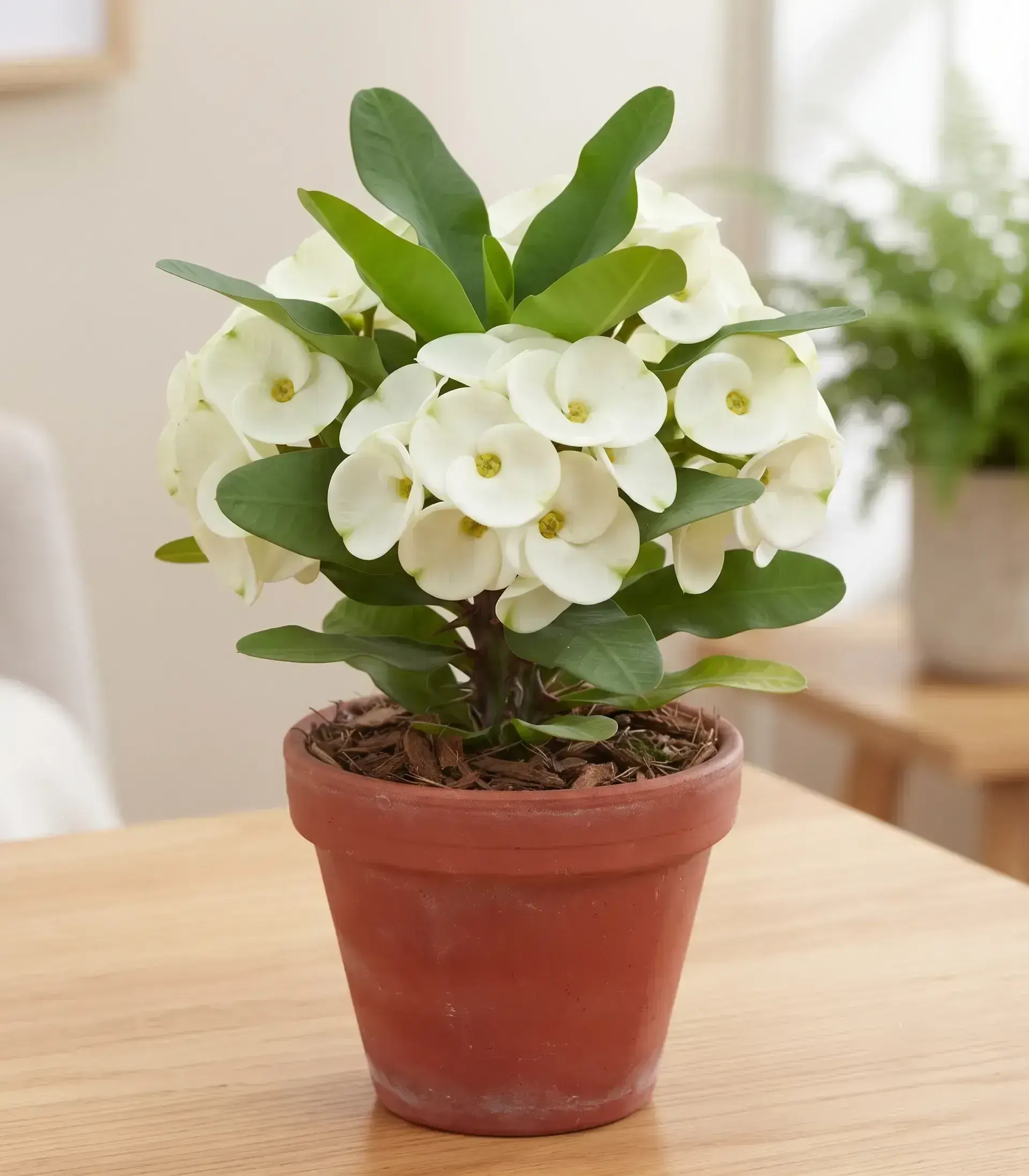
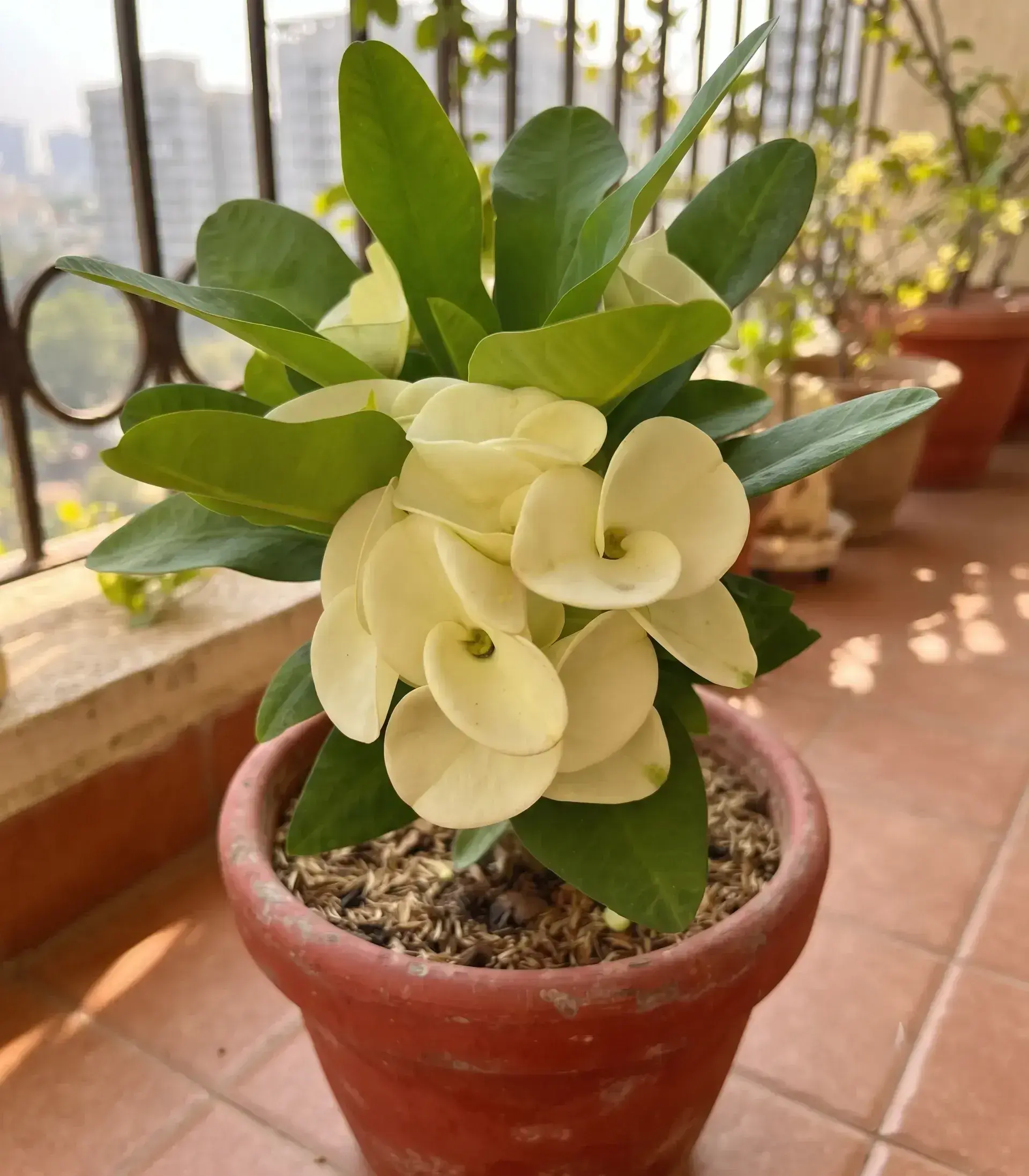
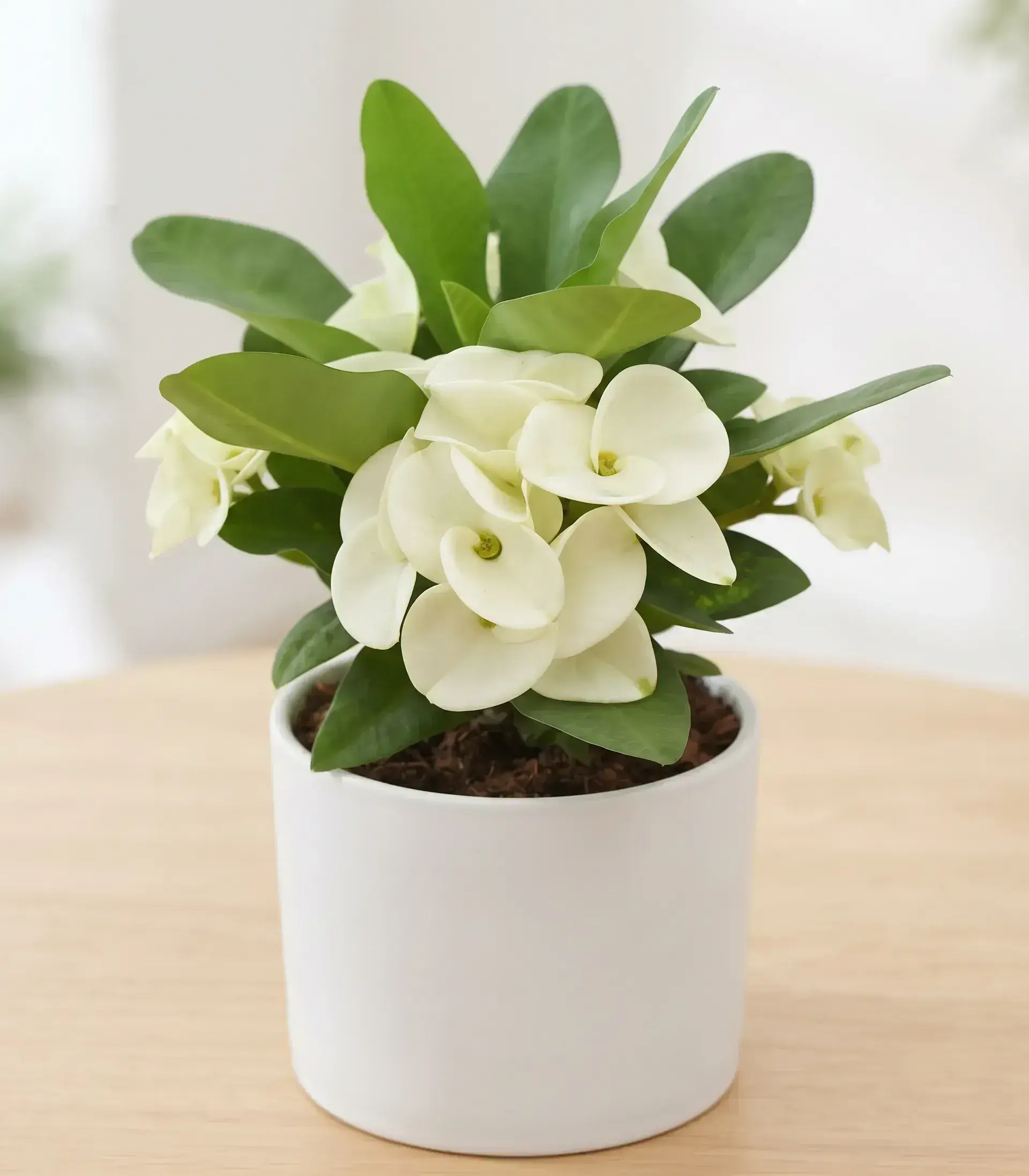
Euphorbia plant | Euphorbia spurge plant – ( euphorbia milii ) White variety for Indoor & Home Garden
🌿 About the Plant
Euphorbia tithymaloides, commonly known as the Devil’s Backbone, Zigzag Plant, Japanese Poinsettia, Redbird Flower or Slipper Flower, is an unusual ornamental succulent shrub appreciated for its distinctive zigzag-shaped stems and attractive foliage.
The plant belongs to the Euphorbiaceae family. Older gardening references and nursery listings may use the name Pedilanthus tithymaloides, which is a synonym associated with the currently accepted name Euphorbia tithymaloides.
Its stems change direction at the nodes, creating a characteristic zigzag or crooked appearance. This unusual architecture makes it an interesting decorative plant for pots, indoor plant collections, balconies, patios and sheltered home gardens.
The plant is succulent in nature and can tolerate periods of relatively dry soil once established. It prefers a well-drained growing medium and bright light, making it particularly suitable for gardeners who enjoy distinctive, low-maintenance ornamental plants.
🌱 Plant Characteristics
- Common Name: Devil’s Backbone, Zigzag Plant
- Scientific Name: Euphorbia tithymaloides
- Older Synonym: Pedilanthus tithymaloides
- Family: Euphorbiaceae
- Plant Type: Succulent shrub
- Growth Habit: Upright, branching and zigzag
- Stem: Green, fleshy and distinctly crooked
- Leaves: Green, smooth and pointed
- Flowering: Seasonal, with colourful red bracts
- Water Requirement: Low to moderate
- Light: Bright indirect light to suitable filtered/direct light
- Soil: Well-draining succulent or cactus-type mix
- Container Suitable: Yes
- Indoor Suitable: Yes, when adequate light is available
- Maintenance: Relatively low
North Carolina Extension describes Euphorbia tithymaloides as an erect succulent shrub with green zigzag stems and identifies it as an ornamental houseplant and container plant.
🌿 Zigzag Stems
The most attractive feature of Devil’s Backbone is its unusual stem structure.
Instead of growing as a straight vertical stem, the plant changes direction at successive nodes. This creates a repeated zigzag or “backbone-like” pattern, which is responsible for the common name Devil’s Backbone.
The stems are green and somewhat succulent, helping the plant tolerate periods of dry conditions.
As the plant develops, branching can create a fuller and more architectural appearance.
🍃 Leaves & Foliage
The leaves are generally:
- Green
- Smooth
- Ovate to elliptical
- Pointed at the tip
- Alternately arranged along the stems
- Sometimes marked with pale or white edging depending on the form
North Carolina Extension reports leaves up to approximately 3.2 inches long and 2 inches wide, while particular cultivated forms may show different foliage characteristics.
The foliage gives the plant a fresh green appearance while the unusual stems provide its main ornamental character.
☀️ Sunlight Requirements
Devil’s Backbone grows best with bright light.
For indoor cultivation, a location receiving bright filtered or indirect light is a good starting point. North Carolina Extension recommends bright indirect light, while RHS information for the species and cultivated forms includes sunny positions with appropriate protection.
A bright location can help maintain compact, attractive growth.
Avoid suddenly moving a plant from a low-light indoor position into intense afternoon sunlight. Strong direct sunlight can scorch the foliage, particularly when the plant has not been acclimatised.
For Indian homes, an east-facing window, bright balcony or filtered light near a sunny window can be suitable.
💧 Watering
Although Devil’s Backbone is succulent, it still needs appropriate watering during active growth.
The basic rule is:
Allow the growing medium to dry before watering again.
A practical routine is:
- Check the soil before watering.
- If the upper layer is still damp, wait.
- Water thoroughly once the soil has dried sufficiently.
- Allow excess water to drain completely.
- Never leave the pot standing in water.
North Carolina Extension recommends watering when the soil has become dry approximately 1–2 inches below the surface.
Overwatering is a more common problem than occasional underwatering. Constantly wet soil can contribute to root rot.
During India’s monsoon season, watering may need to be reduced because humidity and rainfall can keep the growing medium wet for longer.
🪴 Soil & Potting
Use a well-draining potting mix suitable for succulents.
A useful mixture can include:
- Well-draining potting soil
- Coarse sand
- Perlite or pumice
- A moderate amount of organic matter
The objective is to prevent water from remaining around the roots for extended periods.
North Carolina Extension recommends a well-drained succulent-style potting mix, while RHS recommends a loam-based growing medium amended with sharp sand for suitable cultivation.
The supplied pot should always have suitable drainage.
🌱 Fertilizer & Nutrition
Devil’s Backbone does not require heavy feeding.
During active growth, a balanced liquid fertilizer diluted according to the manufacturer’s instructions can be used periodically.
Avoid applying excessive fertilizer, particularly when the plant is growing slowly.
A newly delivered plant should first be allowed to adjust to its new environment before starting a regular fertilizer routine.
RHS recommends balanced liquid fertilizer approximately monthly during the active growing period for its cultivated form.
🌸 Flowers
Under suitable outdoor growing conditions, Devil’s Backbone can produce clusters of small flowers surrounded by attractive red bracts.
The colourful bracts are much more visually noticeable than the tiny flowers themselves. North Carolina Extension reports flowering in late spring or early summer, while also noting that the plant rarely flowers indoors.
Flowering depends on:
- Plant maturity
- Light
- Temperature
- Nutrition
- Seasonal growth
- Overall plant health
Therefore, flowering should not be expected immediately after purchase, particularly when the plant is grown indoors.
🏡 Home & Office Suitability
This plant can be used as an unusual decorative specimen in:
- Living rooms
- Home offices
- Study rooms
- Bright bedrooms
- Reception areas
- Sheltered balconies
- Patios
- Terrace gardens
- Indoor plant collections
- Decorative plant corners
Its unusual stem shape makes it different from ordinary leafy houseplants.
However, an indoor location should still provide adequate light. A dark room without natural or suitable artificial light is not ideal for long-term healthy growth.
🪴 Container & Indoor Gardening
Devil’s Backbone performs well in containers and is naturally suited to potted cultivation.
When grown indoors:
- Choose a bright location.
- Use a drainage hole.
- Use well-draining soil.
- Avoid excessive watering.
- Provide reasonable airflow.
- Keep the plant away from sudden temperature extremes.
If the plant receives too little light, it may develop elongated or “leggy” growth. North Carolina Extension specifically identifies insufficient light as a cause of leggy growth.
✂️ Pruning & Maintenance
Regular heavy pruning is generally unnecessary.
Light pruning can be useful if you want to:
- Remove damaged growth
- Maintain a compact shape
- Encourage branching
- Remove old or unattractive stems
Always use clean tools.
Wear gloves when pruning or propagating this plant because Euphorbia species produce milky latex sap that can irritate the skin and eyes.
🌳 Space Requirement & Growth
Devil’s Backbone can eventually become a relatively large branching shrub when grown under favourable outdoor conditions. North Carolina Extension gives a potential height range of approximately 2–10 feet, although plants maintained in containers or indoors are often kept considerably smaller.
RHS lists the cultivated variegated form Euphorbia tithymaloides ‘Variegata’ at approximately 0.5–1 metre in height and 0.1–0.5 metre spread under its listed conditions.
Actual size depends on the particular form, container, pruning, light, climate and growing conditions.
🇮🇳 Growing in Indian Conditions
Devil’s Backbone can be grown as a container ornamental plant in many parts of India.
For Indian conditions:
- Provide bright filtered light.
- Protect indoor plants from harsh sudden afternoon sunlight.
- Use a fast-draining soil mix.
- Reduce watering during prolonged rainy periods.
- Make sure the pot drains completely.
- Avoid keeping the plant in permanently wet soil.
- Provide airflow during humid weather.
- Move the plant to a brighter location if growth becomes weak or stretched.
In humid regions, including areas with strong monsoon conditions, drainage becomes especially important.
🌱 Propagation
Devil’s Backbone can be propagated from stem cuttings.
Stem propagation is generally carried out during active growth using healthy sections of the plant. Because the stems contain irritating latex, protective gloves should be used during cutting and handling. North Carolina Extension and RHS both list stem cuttings as a propagation method.
For home gardeners, propagation is best treated as an optional gardening activity rather than a requirement for maintaining the supplied plant.
⚠️ Important Safety Note
Like other members of the genus Euphorbia, Devil’s Backbone produces milky latex sap.
North Carolina Extension states that the sap can cause contact dermatitis and that contact with the eyes can cause serious corneal injury. Ingestion can also irritate the mouth and cause blistering.
Therefore:
- Do not intentionally consume any part of the plant.
- Wear gloves when pruning or repotting.
- Avoid touching your eyes after handling the plant.
- Keep broken stems away from children.
- Keep the plant away from pets that may chew plants.
- Wash hands after handling.
RHS also classifies the plant as an irritant to skin and eyes and potentially harmful if eaten.
🐶 Pet & Child Safety
This is not a pet-safe plant to place where dogs, cats or children can easily chew or handle it.
The primary concern is its irritating milky sap. Because online toxicity databases may list different plants under the common name “Devil’s Backbone,” it is important to identify the plant by its scientific name rather than relying only on the common name.
For Euphorbia tithymaloides, North Carolina Extension specifically records concerns for humans, children, cats and dogs.
If accidental ingestion or significant sap exposure occurs, seek appropriate medical or veterinary advice.
🌿 Special Cultivation Notes
The product name identifies the plant as Euphorbia tithymaloides, rather than a specific cultivar.
There are cultivated forms with different foliage patterns. For example, RHS lists Euphorbia tithymaloides ‘Variegata’ with leaves edged in white or pale pink, while North Carolina Extension also lists forms such as ‘Variegatus’, ‘Nana’ and ‘Variegata’.
Unless a specific cultivar is stated by the nursery, the plant should be considered the species Euphorbia tithymaloides and not assumed to be a particular named cultivar.
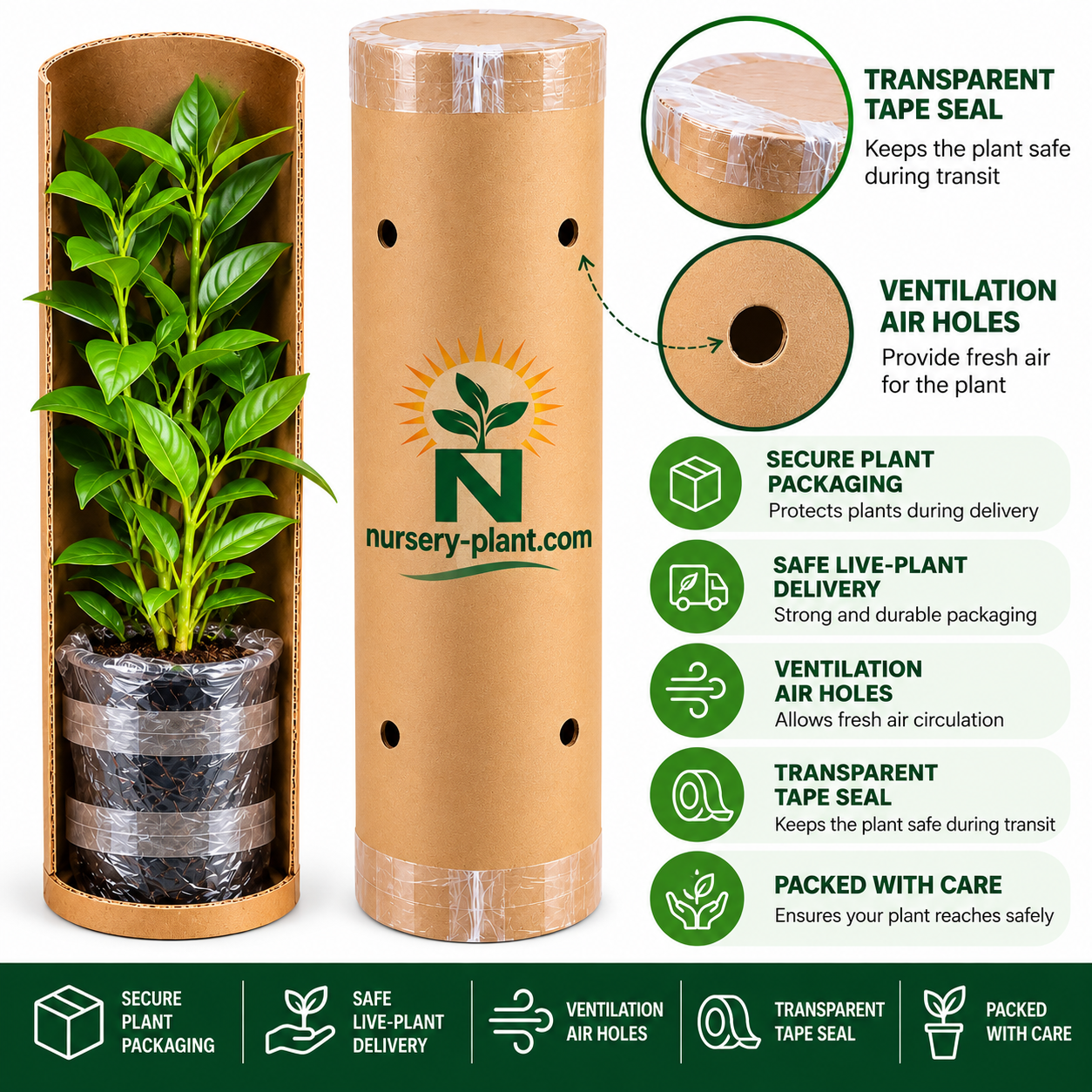
📦 Live Plant Delivery & Natural Variation
This product contains a live Devil’s Backbone plant supplied with a pot.
Because plants are living organisms, the individual plant delivered may naturally differ from product photographs.
Natural differences may include:
- Plant height
- Number of stems
- Number of leaves
- Branching pattern
- Leaf size
- Leaf colour
- Plant fullness
- Pot appearance
- Growing-medium appearance
During transportation, temporary stress can cause slight leaf drooping, minor leaf shedding or small changes in appearance. Changes in light, temperature, humidity and watering after delivery can also affect the plant.
These natural differences do not necessarily indicate a problem.
Product photographs are representative of the plant type and may not show the exact individual plant delivered.
After delivery, place the plant in a suitable bright location and allow it to gradually adjust to its new surroundings.
⚠️ Important Note
Euphorbia tithymaloides is an ornamental plant and should not be consumed.
Its milky sap can irritate skin and eyes. Handle the plant carefully, particularly when pruning, repotting or propagating.
The plant may be marketed under its older botanical name Pedilanthus tithymaloides. This is why customers may find both names in gardening literature and nursery listings.
🌱 Why Choose This Plant?
- Distinctive zigzag-shaped stems
- Attractive ornamental foliage
- Unusual architectural appearance
- Suitable for container gardening
- Suitable for bright indoor locations
- Can be grown on balconies and patios
- Relatively low-maintenance
- Tolerates periods of dry soil
- Requires well-drained soil rather than frequent watering
- Can produce colourful red bracts under suitable conditions
- Interesting choice for succulent and unusual-plant collections
- Suitable for gardeners who want something different from ordinary foliage plants
🌿 Botanical Information
Scientific Name: Euphorbia tithymaloides
Older Synonym: Pedilanthus tithymaloides
Family: Euphorbiaceae
Common Names: Devil’s Backbone, Zigzag Plant, Japanese Poinsettia, Redbird Flower, Slipper Flower
Plant Type: Succulent shrub
Growth Habit: Upright, branching and zigzag
Stem: Green, fleshy and zigzag-shaped
Leaves: Simple, alternate, ovate to elliptical
Flowers: Small flowers surrounded by colourful red bracts
Flowering Season: Mainly spring to early summer under suitable conditions
Light: Bright indirect light; suitable sun exposure with acclimatisation
Water: Moderate during active growth; allow soil to dry between watering
Soil: Well-drained succulent/cactus-style mix
Container Suitable: Yes
Indoor Suitable: Yes, with adequate light
Special Feature: Distinctive zigzag stems
Safety: Irritating milky latex; handle with care
🔗 Botanical Information & Further Reading
- Royal Horticultural Society – Euphorbia tithymaloides
- Royal Horticultural Society – Euphorbia tithymaloides ‘Variegata’
- North Carolina Extension – Devil’s Backbone / Zig Zag Plant
- North Carolina Extension – Zig Zag Plant Care & Characteristics
- North Carolina Extension – Euphorbia Genus Information
- ASPCA – Toxic & Non-Toxic Plant Database
Nursery-Plant.com: Add a distinctive architectural touch to your home or office with the unusual Devil’s Backbone (Euphorbia tithymaloides). Its naturally zigzagging stems and attractive foliage make it a memorable addition to a bright indoor space, balcony, patio or home garden.
For More Information
Visit: Nursery-Plant.Com
For Contact Visit:Contact Us
For Shopping Visit: Shop Page


Reviews
There are no reviews yet.