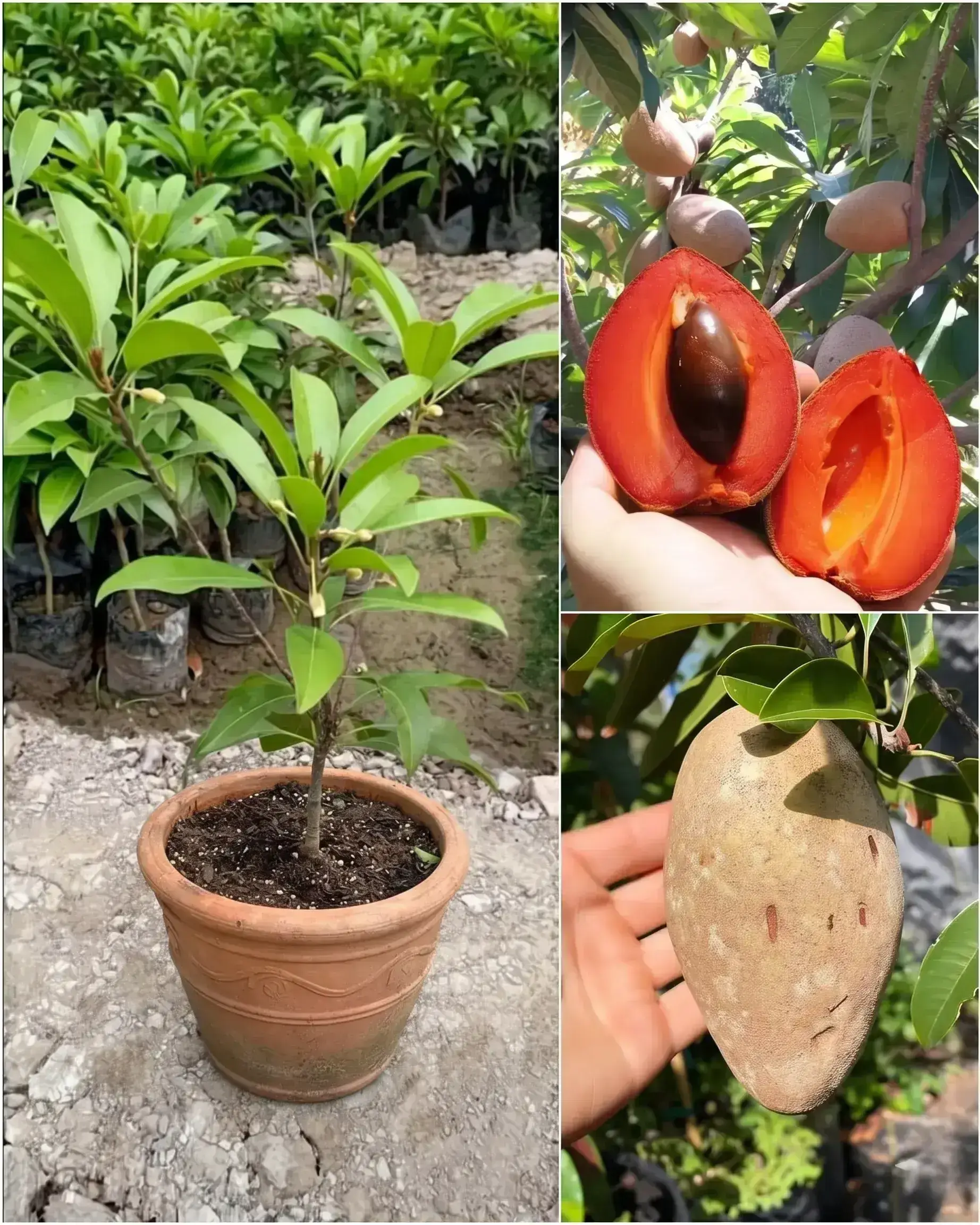
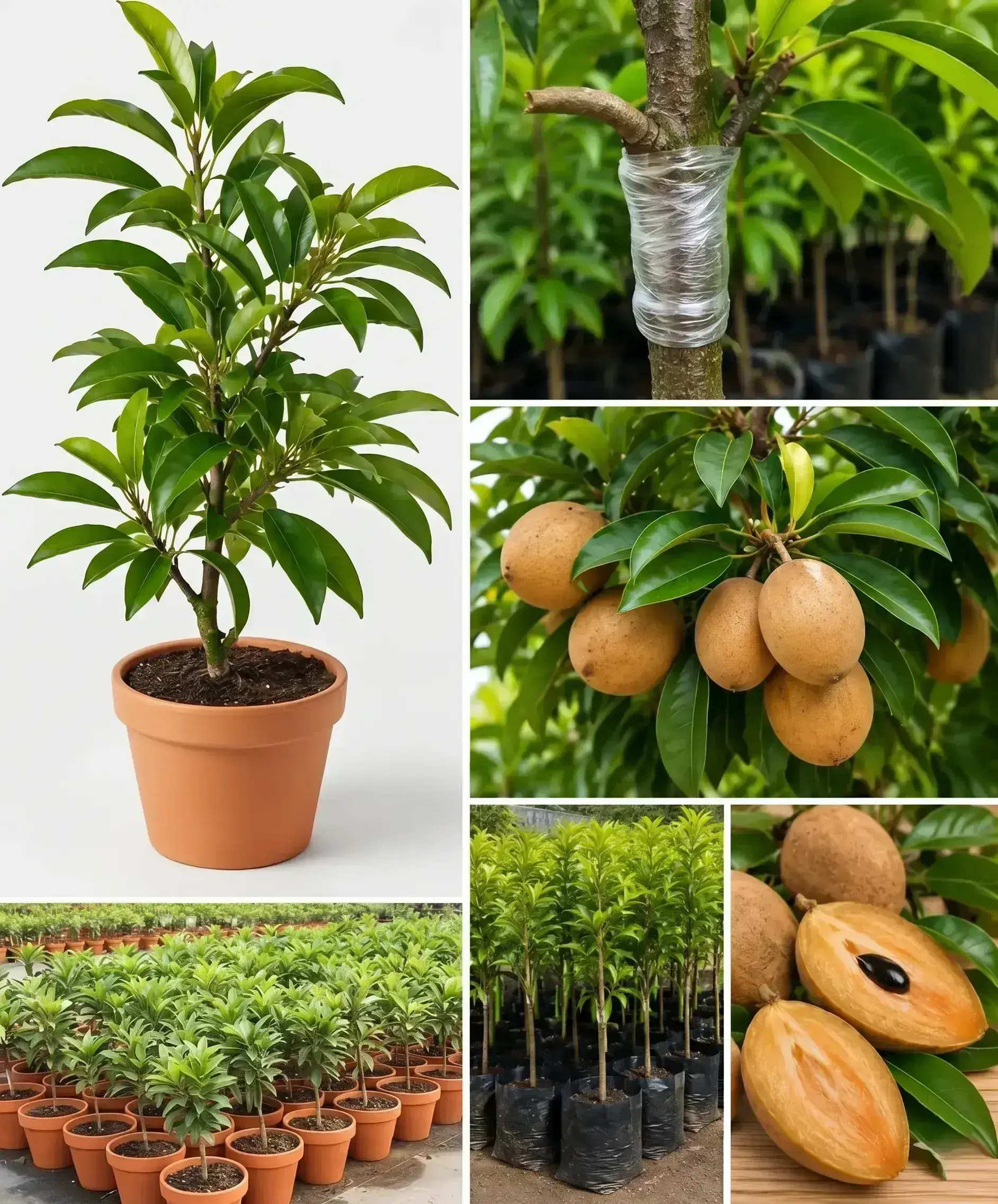
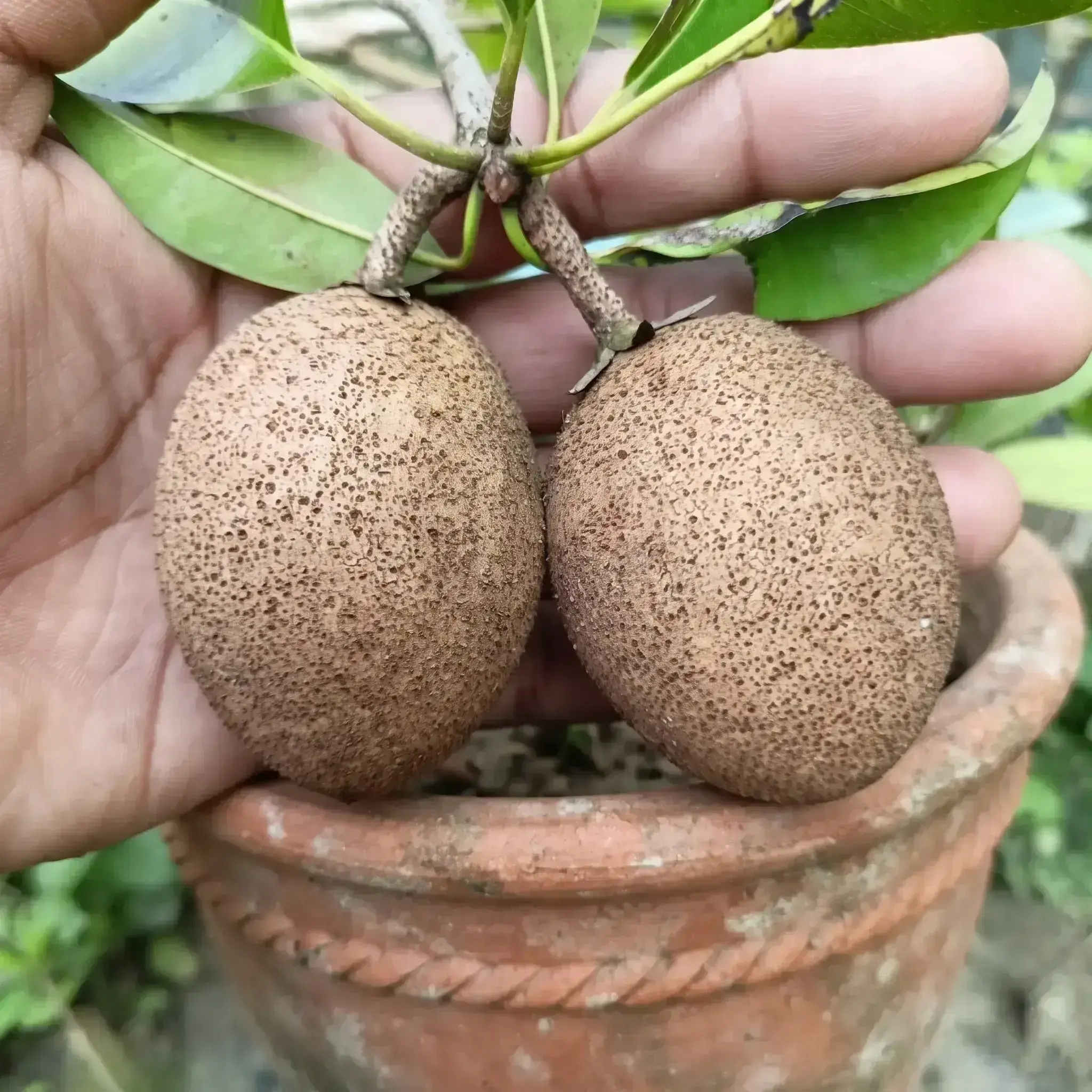
All Time Kalapatti Sapota (Chiku) Grafted Plant | Manilkara zapota
🌿 About the Plant
The Kalapatti Sapota, commonly known as Kalipatti Chiku or Chikoo, is one of India’s well-known commercial sapota varieties. It is valued for its sweet, soft pulp, attractive fruit quality and suitability for both commercial cultivation and home gardens.
The accepted botanical name is Manilkara zapota (L.) P.Royen, belonging to the Sapotaceae family. Older Indian agricultural literature may use names such as Achras zapota or Manilkara achras as synonyms. ICAR-CCARI and TNAU agricultural resources commonly refer to sapota under these older names, while modern botanical databases use Manilkara zapota.
Kalipatti is a documented variety rather than simply an invented nursery name. TNAU describes it as a popular table-purpose variety with broad, thick green leaves, oblong to round fruits and soft, sweet pulp.
The National Horticulture Board identifies Kalipatti as an important variety in Maharashtra, Gujarat and North Karnataka, describing its fruits as oblong/round with soft, sweet pulp and good fruit quality.
This product is supplied as a grafted sapota plant. Grafting is widely used for sapota because it allows selected planting material to be propagated while retaining the characteristics of the desired variety.
The phrase “All Time” in the product title should be understood as a nursery/market name. It does not guarantee that the plant will produce fruit continuously throughout every month of the year.
🌱 Plant Characteristics
- Botanical Name: Manilkara zapota
- Family: Sapotaceae
- Common Names: Sapota, Sapodilla, Chikoo, Chiku
- Variety: Kalipatti / Kalipatti Sapota
- Market Name: All Time Kalapatti Sapota
- Plant Type: Evergreen perennial fruit tree
- Propagation: Grafted
- Growth Habit: Woody evergreen tree
- Leaves: Broad, thick, glossy green leaves
- Flowers: Small, inconspicuous flowers
- Fruit: Brown-skinned sapota with soft, sweet pulp
- Primary Use: Fresh fruit and commercial/home-garden cultivation
TNAU classifies sapota as a tropical fruit crop and lists Kalipatti among its commercially cultivated varieties.
🍈 Fruits
Kalipatti is especially valued for its sweet and soft edible pulp.
According to TNAU and NHB descriptions, the variety generally produces oblong to round fruits with high fruit quality and soft, sweet flesh.
Typical characteristics include:
- Brown to brownish fruit skin when mature
- Oblong to rounded fruit shape
- Soft and sweet pulp
- Pleasant flavour
- Good table quality
- Edible pulp surrounding several seeds
The National Horticulture Board describes Kalipatti as a popular table-purpose variety and reports a main picking season during winter in the regions covered by its variety description.
Fruit size, sweetness, yield and harvest timing can vary according to:
- Tree age
- Rootstock
- Climate
- Soil
- Irrigation
- Nutrition
- Flowering conditions
- Crop load
- Pruning and general management
A recent ICAR study on Kalipatti also demonstrates that nutrition management can influence fruit size, weight and quality, reinforcing that varietal characteristics are not identical under every growing condition.
☀️ Sunlight Requirements
Sapota is a tropical fruit tree and performs well in a bright outdoor location.
For healthy growth and fruit production:
- Provide plenty of direct sunlight.
- Choose an open garden location.
- Avoid deep permanent shade.
- Keep competing trees from heavily shading the canopy.
- Allow good air circulation around the plant.
TNAU describes sapota as a tropical crop that can be cultivated across a broad range of Indian conditions, provided the growing environment is suitable.
A sunny backyard, orchard, farm or open garden is generally more suitable than a heavily shaded location.
💧 Watering
A newly planted grafted sapota needs regular moisture while its root system becomes established.
Follow these practical steps:
- Check the soil around the root zone before watering.
- Water thoroughly when the upper soil begins to dry.
- Maintain adequate moisture during establishment.
- Increase watering during prolonged hot and dry weather.
- Adjust irrigation according to rainfall during the monsoon.
- Reduce unnecessary watering when the soil is already wet.
- Ensure excess water can drain away.
- Avoid keeping the root zone continuously waterlogged.
Sapota is relatively adaptable, but good drainage remains important for healthy root development.
For container-grown plants, check the soil more frequently because containers can dry faster than ground soil.
🪴 Soil & Potting
Sapota can grow in a range of soils, but a fertile, well-drained growing medium is preferable for healthy long-term growth.
A suitable soil environment should provide:
- Good drainage
- Adequate organic matter
- Good root penetration
- Reasonable moisture retention
- Sufficient depth for root development
TNAU states that sapota can be grown in different soil types and identifies it as a tropical crop.
For a large container, a practical mixture can contain:
- Garden soil
- Well-decomposed compost or vermicompost
- Cocopeat
- Coarse sand or another drainage-improving material
The exact ratio does not need to be identical for every garden.
Always use a container with adequate drainage holes.
For permanent ground planting, select a location where the tree will have enough root space and will not remain in standing water.
🌱 Fertilizer & Nutrition
Kalipatti sapota benefits from appropriate nutrition for healthy vegetative growth and fruit production.
For home gardening:
- Add well-decomposed compost or farmyard manure.
- Vermicompost can be used as an organic amendment.
- Use a balanced fertilizer according to the plant’s age and growth.
- Adjust feeding as the tree becomes larger and begins producing fruit.
- Avoid excessive fertilizer application.
- Follow the fertilizer manufacturer’s recommended dosage.
Recent ICAR research on Kalipatti found that integrated nutrient management involving recommended fertilizer, vermicompost and beneficial microbial inputs affected fruit size, diameter, weight and other quality parameters.
This does not mean a home gardener must reproduce the exact research treatment. It demonstrates why balanced nutrition is important rather than relying on excessive fertilizer.
🌼 Flowering & Fruit Development
Sapota can flower over extended periods in suitable tropical conditions. ICAR-CCARI notes that in warm, humid climates sapota can flower and fruit throughout the year, whereas in subtropical or higher-elevation conditions fruiting may be concentrated into fewer seasons.
Kalipatti is a recognised commercial cultivar. TNAU describes it as a popular table-purpose variety, while ICAR research has evaluated Kalipatti for flowering, fruit set, yield and fruit quality.
Fruit production depends on:
- Plant age
- Graft maturity
- Rootstock
- Climate
- Sunlight
- Water availability
- Nutrition
- Flowering
- Pollination
- Pest and disease management
Grafted sapota generally reaches the productive stage earlier than seed-grown trees, but the actual timing depends on the age and condition of the supplied plant.
Fruiting is not guaranteed immediately after delivery and depends on plant age, graft maturity, variety, climate, nutrition, sunlight, irrigation and growing conditions.
The term “All Time” should not be interpreted as a guarantee of continuous year-round fruiting.
🏡 Home Garden Suitability
Kalipatti Sapota can be grown in:
- 🏡 Home gardens
- 🌳 Backyards
- 🌱 Kitchen gardens
- 🌾 Orchards
- 🚜 Farms
- 🌴 Tropical gardens
- 🪴 Large terrace gardens while young
- 🏞️ Fruit-tree collections
It is particularly suitable for gardeners who want a named Indian sapota cultivar rather than an unknown seed-grown plant.
NHB identifies Kalipatti as an important variety in Maharashtra, Gujarat and North Karnataka, while research from ICAR also demonstrates its performance under high-rainfall conditions in Coorg.
🪴 Container / Terrace Gardening
A young grafted Kalipatti Sapota can be grown in a large container with sufficient sunlight, drainage and root space.
For terrace cultivation:
- Use a large, sturdy container.
- Provide multiple drainage holes.
- Use fertile, well-drained growing media.
- Place the plant in a sunny location.
- Monitor soil moisture regularly.
- Feed appropriately during active growth.
- Prune when necessary to control the canopy.
- Repot or refresh the growing medium when roots become crowded.
Container cultivation can help manage the plant’s size, but it does not automatically make a naturally large sapota tree permanently dwarf.
For long-term terrace cultivation, remember that the combined weight of the tree, container and wet soil can become substantial.
✂️ Pruning & Maintenance
Young grafted sapota plants benefit from sensible training so that they develop a strong and manageable framework.
Basic maintenance includes:
- Remove dead or damaged branches.
- Remove weak or poorly positioned shoots.
- Maintain a balanced canopy.
- Remove unwanted basal growth.
- Keep the centre reasonably open when necessary.
- Remove shoots developing below the graft union.
- Avoid excessive pruning of healthy productive branches.
ICAR-CCARI recommends training sapota plants during the early years and removing lower branches to establish an appropriate framework.
🌳 Space Requirement
A grafted sapota plant may arrive small, but it is still an evergreen fruit tree with long-term space requirements.
Before planting in the ground, consider:
- Distance from buildings
- Boundary walls
- Electrical wires
- Nearby trees
- Future canopy spread
- Root-zone space
- Access for pruning
- Access for harvesting
ICAR-CCARI recommends approximately 7–8 m spacing between sapota plants and rows under its conventional cultivation guidance. This is a plantation reference and should not be interpreted as a mandatory distance for every home garden.
Home gardeners can manage individual trees through suitable training and pruning, but the tree should still have adequate long-term space.
🌱 Special Cultivation Notes
Kalipatti cultivar: Kalipatti is a documented sapota variety. TNAU describes it as a popular table-purpose variety with soft sweet pulp, while NHB identifies it as important in Maharashtra, Gujarat and North Karnataka.
Grafted plant: This product is supplied as grafted planting material. Grafting helps maintain selected cultivar characteristics.
Graft union: Keep the graft union above the soil level when planting. ICAR-CCARI specifically recommends keeping the graft joint at least 15 cm above ground level.
Rootstock shoots: Remove vigorous shoots developing below the graft union because these belong to the rootstock rather than the desired Kalipatti scion.
“All Time”: This is best treated as a nursery/market name. Suitable tropical conditions may support extended or multiple flowering and fruiting cycles, but continuous fruit production throughout the entire year is not guaranteed.
Pollination: ICAR-CCARI notes that planting more than one variety or tree is advocated for better fruit set and yield under its cultivation guidance.
📦 Live Plant Delivery & Natural Variation
This is a live grafted plant, so natural differences in appearance are expected.
During packing, transportation and acclimatisation, the plant may show:
- Slight leaf yellowing
- Temporary drooping
- Minor leaf shedding
- Different plant height
- Different leaf size
- Different stem thickness
- Different branching
- Temporary transportation stress
Changes in light, temperature, humidity and watering during shipping can temporarily affect the plant’s appearance.
The product photograph represents the general plant type and expected cultivar characteristics. Every individual live plant will not necessarily look exactly the same as the product photograph.
After delivery, place the plant in a suitable location and allow it to acclimatise gradually.
⚠️ Important Note
- The botanical name is Manilkara zapota.
- The family is Sapotaceae.
- Kalipatti is a documented commercial sapota cultivar.
- Older agricultural sources may use Manilkara achras or Achras zapota for sapota.
- This product is supplied as a grafted plant.
- Keep the graft union above soil level.
- Remove shoots developing below the graft union.
- Fruiting is not guaranteed immediately after delivery.
- “All Time” should not be interpreted as a guarantee of 12-month continuous fruiting.
- Fruit size, sweetness, yield and fruiting frequency depend on climate, soil, irrigation, nutrition and plant management.
- A grafted plant does not automatically remain small.
- Give the mature tree sufficient space.
- Avoid prolonged waterlogging, particularly during heavy monsoon periods.
🌱 Why Choose This Plant?
- 🍈 Recognised Kalipatti Sapota cultivar
- 🌱 Supplied as a grafted live fruit plant
- 😋 Known for soft, sweet pulp
- 🌿 Popular Indian table-purpose variety
- 🏡 Suitable for home gardens
- 🌾 Suitable for orchard and farm cultivation
- ☀️ Performs well in suitable tropical conditions
- 🪴 Can be grown in a large container while young
- ✂️ Can be trained and managed through pruning
- 🇮🇳 Established commercial variety in India
- 🌳 Suitable for gardeners interested in growing a named Chikoo cultivar
🌿 Botanical Information
- Botanical Name: Manilkara zapota (L.) P.Royen
- Family: Sapotaceae
- Common Names: Sapota, Sapodilla, Chikoo, Chiku
- Indian Name: Chikoo / Chiku
- Variety: Kalipatti
- Market Name: All Time Kalapatti Sapota
- Plant Type: Evergreen perennial fruit tree
- Propagation: Grafted
- Growth Habit: Woody evergreen tree
- Leaves: Broad, thick, green leaves
- Fruit: Oblong to round sapota with soft sweet pulp
- Primary Use: Fresh fruit
- Suitable Growing Conditions: Warm tropical conditions, good sunlight, fertile soil, adequate moisture and good drainage
TNAU identifies sapota as a tropical crop and lists Kalipatti among its commercially cultivated varieties.
🔗 Botanical Information & Further Reading
- ICAR-CCARI – Sapota: Indian cultivation guidance covering climate, planting, grafting, training, spacing and major varieties including Kalipatti. ICAR-CCARI – Sapota
- Tamil Nadu Agricultural University – Kalipatti: Variety-specific information on fruit characteristics and yield. TNAU – Kalipatti Sapota
- National Horticulture Board – Sapota Varieties: Indian information on Kalipatti’s distribution, fruit quality and production characteristics. NHB – Sapota Varieties
- ICAR – Indian Journal of Agricultural Sciences: Research on yield and fruit quality of Kalipatti sapota under different plant-growth-regulator treatments. ICAR – Kalipatti Sapota Research
- ICAR – Recent Nutrient Management Research: Research on integrated nutrient management and fruit quality of Kalipatti sapota. ICAR – Nutrient Management in Kalipatti
- ICAR-IIHR – Performance Under High Rainfall: Evaluation of Kalipatti and other sapota cultivars under humid tropical conditions. ICAR-IIHR – Sapota Cultivar Performance
For More Information
Visit: Nursery-Plant.Com
For Contact Visit:Contact Us
For Shopping Visit: Shop Page


Reviews
There are no reviews yet.