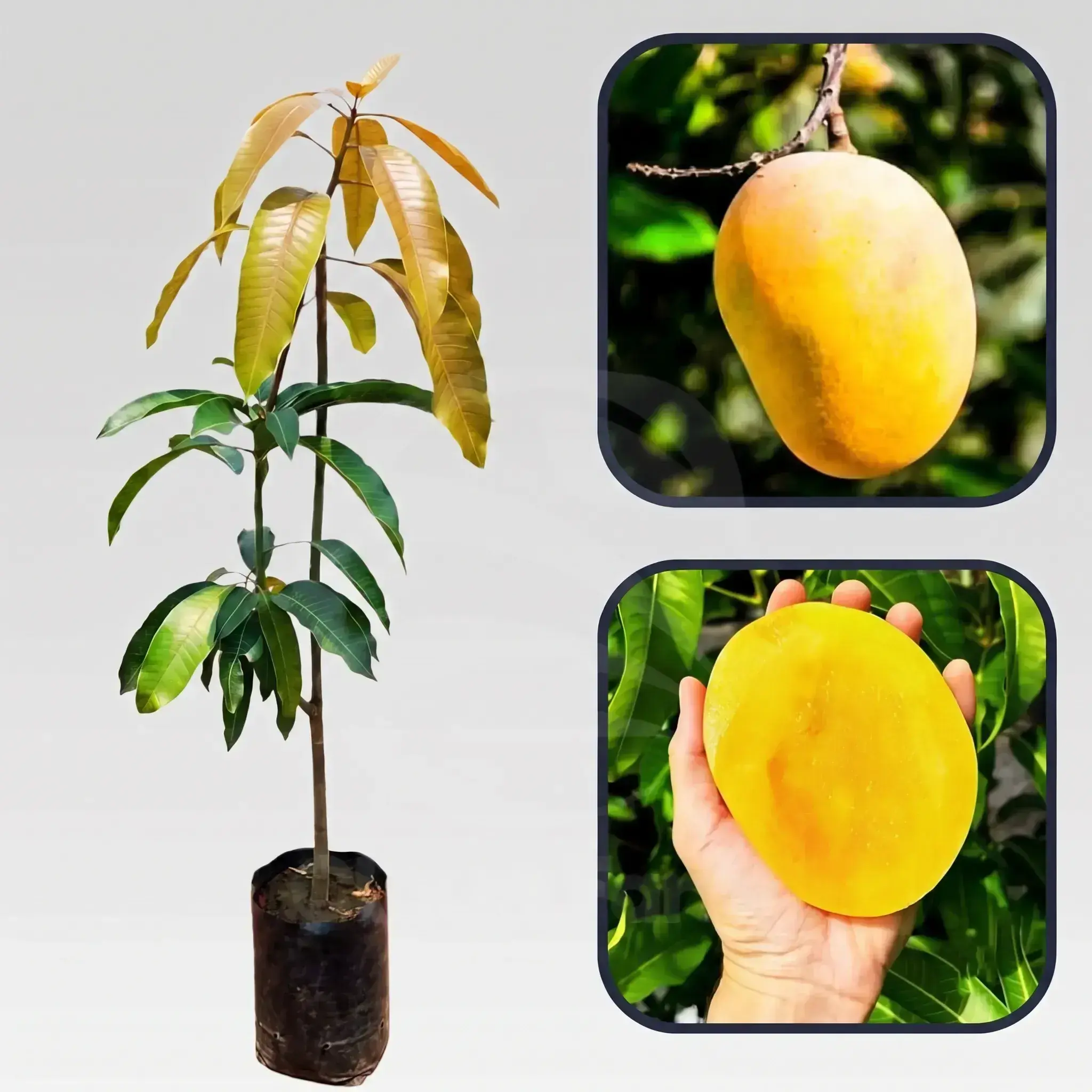
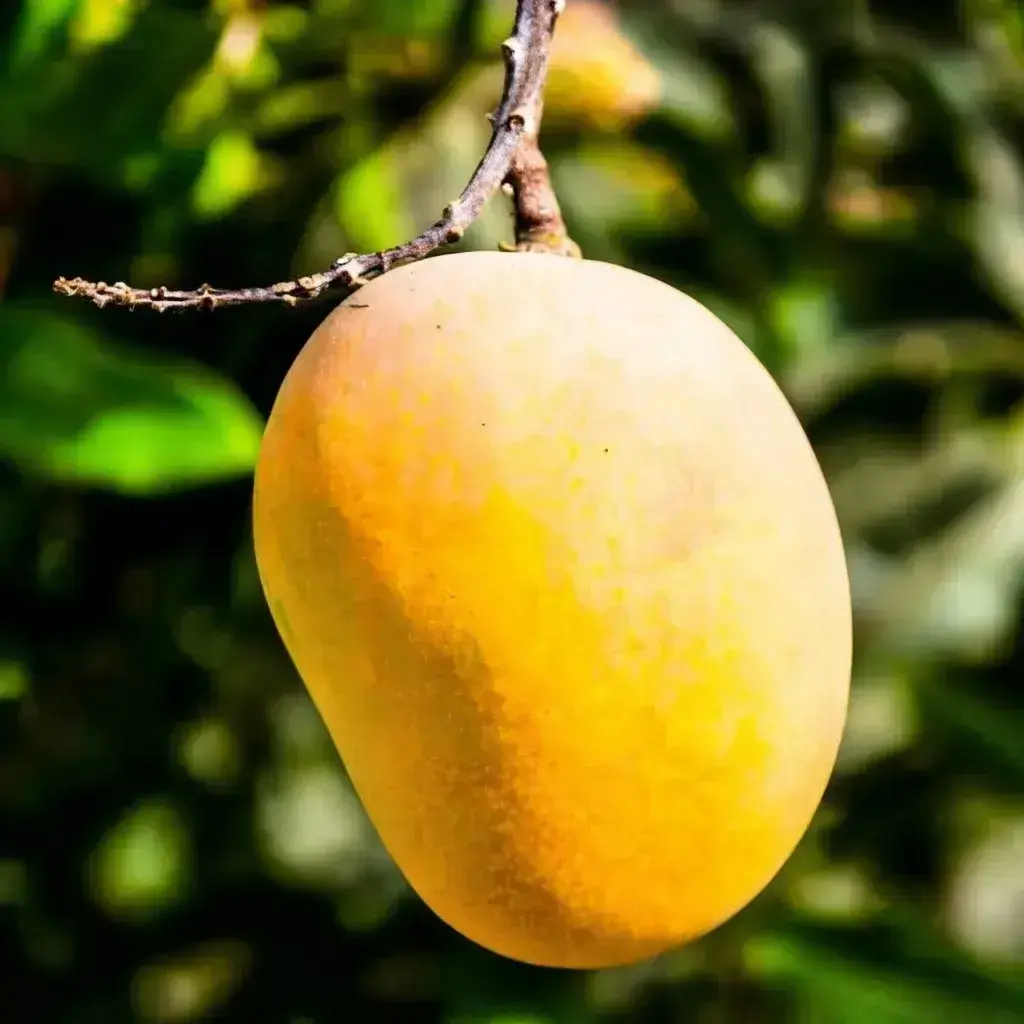
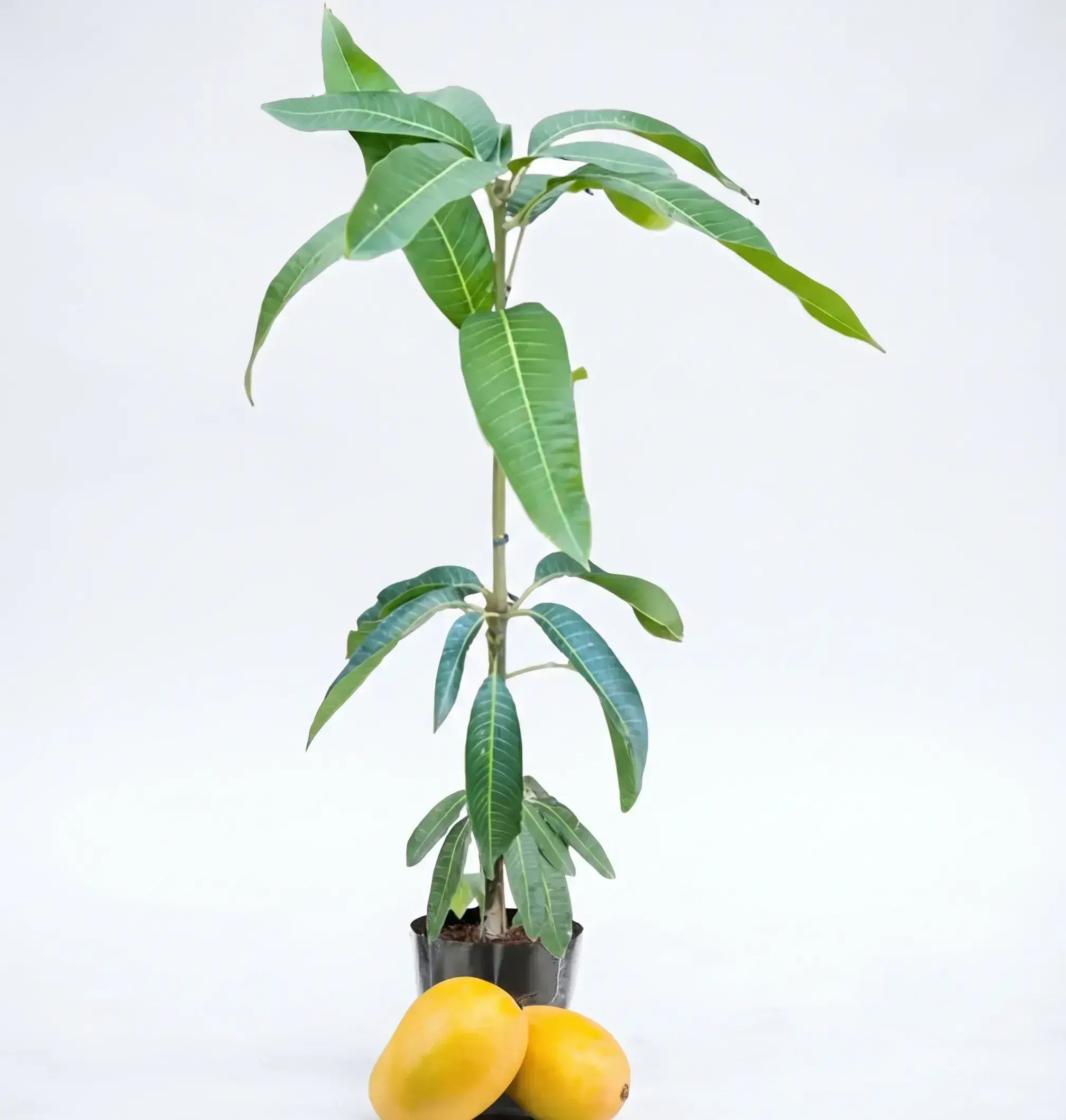

Anwar Ratol (Rataul) Mango Plant (Grafted) | Mangifera indica
🌿 About the Plant
Anwar Ratol, also known as Rataul, Anwar Rataul or Ratol Mango, is a distinctive mango cultivar of Mangifera indica known for its very sweet taste, strong aroma and low-fibre flesh. The variety is historically associated with Rataul village in present-day Baghpat district, Uttar Pradesh, India. It later became widely cultivated in parts of Pakistan, particularly Punjab and Sindh.
The mango is relatively small compared with large commercial mango varieties, but its eating quality is valued for its concentrated sweetness and aromatic character. A Pakistan Trade Portal brochure based on Mango Research Institute, Multan data reports approximately 200–250 g average fruit weight, lemon-yellow peel, cadmium-yellow pulp and 24–26°Brix total soluble solids for Anwar Rataul.
This product is supplied as a grafted mango plant, making it suitable for gardeners who want vegetatively propagated planting material rather than growing a mango tree from seed.
The name Anwar Ratol is sometimes written as Anwar Rataul, while Rataul is also used as the Indian name associated with the variety.
🌱 Plant Characteristics
- Botanical Name: Mangifera indica L.
- Family: Anacardiaceae
- Common Names: Anwar Ratol, Anwar Rataul, Rataul, Ratol Mango
- Plant Type: Evergreen tropical fruit tree
- Propagation: Grafted
- Fruit Type: Fleshy mango fruit
- Fruit Size: Generally small to medium; published commercial data commonly reports around 200–250 g
- Ripe Fruit Colour: Yellow to golden-yellow
- Pulp Colour: Yellow
- Fibre: Low to very low
- Taste: Very sweet and aromatic
- Typical Use: Fresh/table mango
- Suitable For: Home gardens, orchards and larger garden spaces
Anwar Ratol is documented as a small yellow mango with very high sweetness and comparatively low fibre.
🥭 Fruit Characteristics
The fruit of Anwar Ratol is particularly appreciated for its sweet, aromatic eating quality rather than its large size.
Typical characteristics include:
- Small-to-medium fruit size
- Smooth skin
- Yellow to lemon-yellow colour when ripe
- Yellow to deep yellow pulp
- Very sweet flavour
- Strong pleasant aroma
- Soft, juicy eating texture
- Very low fibre compared with many traditional mangoes
The Pakistan Trade Portal’s Mango Research Institute data lists an average fruit size of approximately 200–250 g, lemon-yellow peel, cadmium-yellow pulp and 24–26°Brix total soluble solids.
Some horticultural databases report smaller average fruit weights, illustrating that fruit size can vary according to location, selection, crop load and cultivation conditions. Therefore, individual fruits should not be expected to reach one exact weight.
🍯 Taste & Eating Quality
Anwar Ratol is particularly known for its intense sweetness and characteristic fragrance.
Its low-fibre flesh makes it suitable for eating fresh. The ripe pulp can become very soft and juicy, giving the fruit a rich dessert-like eating experience.
Published data from the Mango Research Institute, Multan reports 24–26°Brix total soluble solids for Anwar Rataul, although actual sweetness varies with maturity, climate, crop load and growing conditions.
This mango is primarily valued as a table fruit, meaning it is especially suited for fresh consumption rather than being selected primarily for pickle or processing purposes.
🌸 Flowers & Pollination
Mango trees produce flowers in large branched clusters called panicles.
Flowering is influenced by:
- Temperature
- Tree age
- Variety
- Nutrition
- Previous crop load
- Water availability
- Pruning
- Local climate
Pollination is affected by insects and environmental conditions. Not every flower develops into a mature mango, and natural fruit drop is a normal part of mango production.
For a young grafted tree, healthy vegetative growth should generally be established before expecting substantial flowering and fruit production.
☀️ Sunlight Requirements
Mango is a sun-loving fruit tree and should be planted where it receives abundant direct sunlight.
For best garden performance:
- Provide approximately 6–8 hours or more of direct sunlight.
- Select an open location rather than a permanently shaded corner.
- Avoid planting immediately beneath large trees.
- Good sunlight helps maintain healthy foliage and supports flowering and fruit development.
- Container-grown plants should also be placed in a bright, sunny position.
Insufficient light can result in weak, elongated growth and reduced flowering potential.
💧 Watering
Watering requirements depend on the plant’s age, soil, weather and growing environment.
Young grafted plant:
- Water thoroughly after planting.
- Keep the root zone moderately moist while roots establish.
- During hot summer weather, check the soil frequently.
- Do not allow the root zone to remain continuously saturated.
Established tree:
- Water deeply when the soil becomes sufficiently dry.
- Reduce unnecessary irrigation during periods of heavy monsoon rain.
- Avoid frequent shallow watering when deep irrigation is more appropriate.
- Maintain good drainage.
Excessive water around the roots can create problems even though mango is a vigorous tropical fruit tree.
🪴 Soil & Planting
Mango performs well in deep, fertile, well-drained soil.
For home gardening:
- Use good-quality garden soil.
- Add mature compost or well-decomposed organic manure.
- Improve drainage in heavy clay soil.
- Avoid permanently waterlogged locations.
- Give the grafted plant sufficient root space.
- Keep the graft union above the soil surface.
When planting a grafted mango, do not bury the graft union. The grafted portion should remain clearly above the surrounding soil level.
A well-drained planting location is especially important in areas receiving heavy monsoon rainfall.
🌱 Fertilizer & Nutrition
A young mango plant benefits from balanced nutrition during its establishment period.
Suitable practices include:
- Regular application of well-decomposed organic compost.
- Use of a balanced fruit-tree fertilizer according to label directions.
- Adequate potassium and micronutrients where soil conditions require them.
- Avoiding excessive nitrogen.
- Maintaining organic matter in the root zone.
Excessive nitrogen can encourage vigorous leafy growth without necessarily improving flowering and fruit production.
For mature fruiting trees, fertilizer requirements should ideally be adjusted according to tree age, soil fertility, crop load and local horticultural recommendations.
🌳 Grafted Plant Advantage
This Anwar Ratol mango is supplied as a grafted plant.
Grafting allows a selected mango variety to be propagated vegetatively by joining selected scion material with a compatible rootstock.
This is important for named mango varieties because a mango grown from a seed may not reproduce the exact characteristics of the parent tree.
A grafted Anwar Ratol plant is therefore intended to preserve the characteristics associated with the selected Anwar Ratol planting material more reliably than seed propagation.
🌱 Graft Union Care
After planting:
- Keep the graft union above soil level.
- Do not cover the graft with soil or mulch.
- Inspect the trunk periodically.
- Remove vigorous shoots arising from below the graft.
- Do not allow rootstock shoots to dominate the plant.
- Support the young plant if strong wind is present.
Rootstock shoots can compete with the grafted variety and should be removed carefully when they appear.
⏳ Fruiting Time
A grafted mango can generally enter production earlier than a seed-grown mango, but the exact fruiting period cannot be guaranteed.
Fruiting depends on:
- Age and maturity of the grafted plant
- Quality of grafting material
- Rootstock
- Climate
- Sunlight
- Nutrition
- Water management
- Flowering conditions
- Pruning
- Plant health
An already established grafted plant may flower earlier than a very young nursery plant, but customers should not assume that a newly delivered plant will produce fruit immediately.
Fruiting is not guaranteed immediately after delivery and depends on plant age, variety, climate, sunlight, nutrition, water management and growing conditions.
🥭 Harvest Season
The exact harvest period varies according to location and growing conditions.
Anwar Ratol is generally associated with the early-to-mid mango season, although different growing regions can have different harvest windows. Pakistan Trade Portal data places Anwar Rataul availability broadly around June to early July in its commercial production context.
A nursery source specifically reports June harvesting in West Bengal and July in North India, illustrating the effect of regional climate on maturity timing.
Therefore, customers should treat harvest dates as approximate rather than fixed.
🏡 Home Garden Suitability
Anwar Ratol is an attractive option for gardeners who want to grow a specialty mango variety with a strong sweet and aromatic flavour profile.
It can be grown in:
- Home gardens
- Backyard orchards
- Farmhouses
- Fruit gardens
- Larger terrace gardens
- Small orchards
- Mango collections
Although the fruit itself is relatively small, the mature tree requires considerably more space than the young nursery plant suggests.
🪴 Container & Terrace Gardening
A young grafted Anwar Ratol mango can be maintained in a large container, especially during its early years.
For container cultivation:
- Use a large, sturdy pot with drainage holes.
- Select a well-draining growing medium.
- Provide maximum available sunlight.
- Avoid keeping water standing in the drainage tray.
- Feed according to plant age and container volume.
- Prune appropriately to maintain a manageable canopy.
- Repot when the root system becomes excessively restricted.
Container growing can restrict the eventual size of a mango tree, but it may also limit long-term root development and fruit production compared with suitable open-ground cultivation.
For reliable long-term growth and fruit production, ground planting is generally preferable where enough space is available.
✂️ Pruning & Training
Pruning can help develop a balanced mango canopy and make the plant easier to manage.
For young grafted trees:
- Remove weak or damaged shoots.
- Remove branches growing in undesirable directions.
- Maintain a balanced framework.
- Remove rootstock shoots below the graft union.
- Avoid excessive pruning.
For mature trees, selective pruning can improve canopy management and access to fruit.
Regular light structural training is generally preferable to severe, unnecessary cutting.
🌳 Space Requirement
Anwar Ratol is not a permanently miniature mango tree.
The young grafted plant may be compact, but Mangifera indica can develop into a substantial tree if allowed to grow naturally.
When choosing the planting location, consider:
- Future canopy size
- Root-zone space
- Distance from buildings
- Distance from walls
- Overhead electrical wires
- Nearby trees
- Access for pruning and harvesting
A gardener can maintain a mango tree at a more manageable height through appropriate training and pruning, but this does not mean the plant remains naturally dwarf.
🌦️ Growing in Indian Conditions
Anwar Ratol has a strong historical connection with Rataul in Uttar Pradesh, while the cultivar is also widely associated with mango-growing regions of Pakistan.
For Indian home gardens:
North India:
Warm summers can be favourable for mango growth and fruit maturation.
Eastern India:
The plant can be grown successfully with good sunlight and drainage. Heavy monsoon rainfall makes drainage particularly important.
West Bengal:
A nursery source reports Anwar Ratol harvesting around June under West Bengal conditions, although actual timing varies with local weather and plant maturity.
South India:
Warm conditions can support healthy vegetative growth when adequate sunlight, drainage and nutrition are provided.
Regional differences in temperature and rainfall can affect flowering, fruit set and harvest timing.
🌬️ Protection During Flowering & Fruit Development
Anwar Ratol’s early-season form has been described as relatively sensitive to strong winds and heavy rain, with the early crop occurring over a short period.
For home gardeners:
- Avoid highly exposed planting locations where possible.
- Provide wind protection for young plants.
- Do not overwater during periods of heavy rainfall.
- Ensure good drainage.
- Avoid unnecessary pruning during flowering.
- Support young branches if fruit load becomes significant.
Weather can influence fruit set and cause natural flower or young-fruit drop.
🥭 Fruit Use
The ripe fruits are particularly suitable for fresh eating.
Anwar Ratol’s low-fibre, sweet pulp makes it attractive as a dessert mango.
Ripe mangoes can also be used in:
- Mango shakes
- Smoothies
- Desserts
- Pulp
- Ice cream
- Mango drinks
- Fresh fruit preparations
Actual flavour intensity depends on fruit maturity and growing conditions.
🌿 History & Origin
The variety is historically connected with Rataul village in Uttar Pradesh.
Accounts of its development describe the selection and grafting of a distinctive mango plant in the early 20th century, followed by vegetative propagation. After Partition, planting material was taken to Pakistan, where Anwar Ratol became an important commercial mango variety.
The name Anwar Ratol is closely associated with the variety, while Rataul refers to the village and Indian mango identity.
India’s Geographical Indications system granted Rataul Mango GI registration in 2021, according to published records. The GI refers specifically to the registered geographical indication and should not be interpreted as proof that every plant sold under a similar nursery name originates from the GI production area.
🌱 Botanical Information
Botanical Name: Mangifera indica L.
Family: Anacardiaceae
Genus: Mangifera
Species: Mangifera indica
Plant Type: Evergreen tropical fruit tree
Fruit: Mango
Cultivar / Variety: Anwar Ratol / Anwar Rataul / Rataul
Origin Associated With: Rataul, Uttar Pradesh, India
Propagation for this product: Grafted
📦 Live Plant Delivery & Natural Variation
This is a live grafted mango plant.
Because plants are living organisms, the plant delivered may naturally differ from product photographs in:
- Height
- Number of leaves
- Leaf size
- Branching
- Stem thickness
- Canopy shape
- Overall appearance
During transportation, temporary effects such as:
- Slight leaf drooping
- Minor yellowing
- Leaf shedding
- Small bends in tender shoots
- Changes in soil moisture
- Temporary transport stress
may occur.
These are normal possibilities with live-plant shipping and do not automatically indicate poor plant health.
After delivery:
- Carefully unpack the plant.
- Do not pull the plant by its leaves or tender branches.
- Check the moisture level of the growing medium.
- Water only when appropriate.
- Place the plant in bright light and gradually establish it in its final sunny location.
- Avoid heavy fertilizer immediately after delivery.
- Allow the plant time to recover from transportation.
Product images are representative. The actual plant supplied may vary naturally according to season, nursery stock and plant growth stage.
⚠️ Important Note
- 🥭 Anwar Ratol is a named mango variety associated with Rataul, Uttar Pradesh.
- 🌱 This product is supplied as a grafted plant.
- ☀️ Full sunlight is recommended.
- 💧 Avoid prolonged waterlogging.
- 🌳 The mature tree can become large if not trained.
- 🥭 Fruit size and sweetness vary with climate, maturity and cultivation.
- ⏳ Fruiting is not guaranteed immediately after delivery.
- 🌸 Flowering and fruit set depend on weather, tree maturity and growing conditions.
- 🌬️ Strong wind and heavy rain can affect flowering and young fruit.
- 📸 The delivered plant may differ naturally from product photographs.
- 🌱 Keep the graft union above the soil surface.
🌱 Why Choose Anwar Ratol Mango?
- 🥭 Distinctive traditional mango variety
- 🍯 Known for very sweet eating quality
- 🌸 Characteristic aromatic fragrance
- 🌱 Low-fibre to very low-fibre flesh
- 🌳 Supplied as a grafted plant
- 🇮🇳 Historically associated with Rataul, Uttar Pradesh
- ☀️ Suitable for sunny Indian gardens
- 🏡 Suitable for home gardens and fruit collections
- 🥭 Excellent choice for fresh table-mango use
- 🌿 Attractive evergreen mango-tree foliage
- 🌱 Can be trained and maintained with appropriate pruning
🔗 Botanical Information & Further Reading
- Kew – Plants of the World Online: Mangifera indica
- ICAR – Central Institute for Subtropical Horticulture
- Pakistan Trade Portal – Mango varieties and Anwar Rataul characteristics
- Mango Database – Anwar Ratol variety information
- MangoPlant – Anwar Rataul / Ratol variety profile
- ResearchGate – Anwar Ratol Mango GI research
- Wikipedia – Anwar Ratol
For More Information
Visit: Nursery-Plant.Com
For Contact Visit:Contact Us
For Shopping Visit: Shop Page


Reviews
There are no reviews yet.