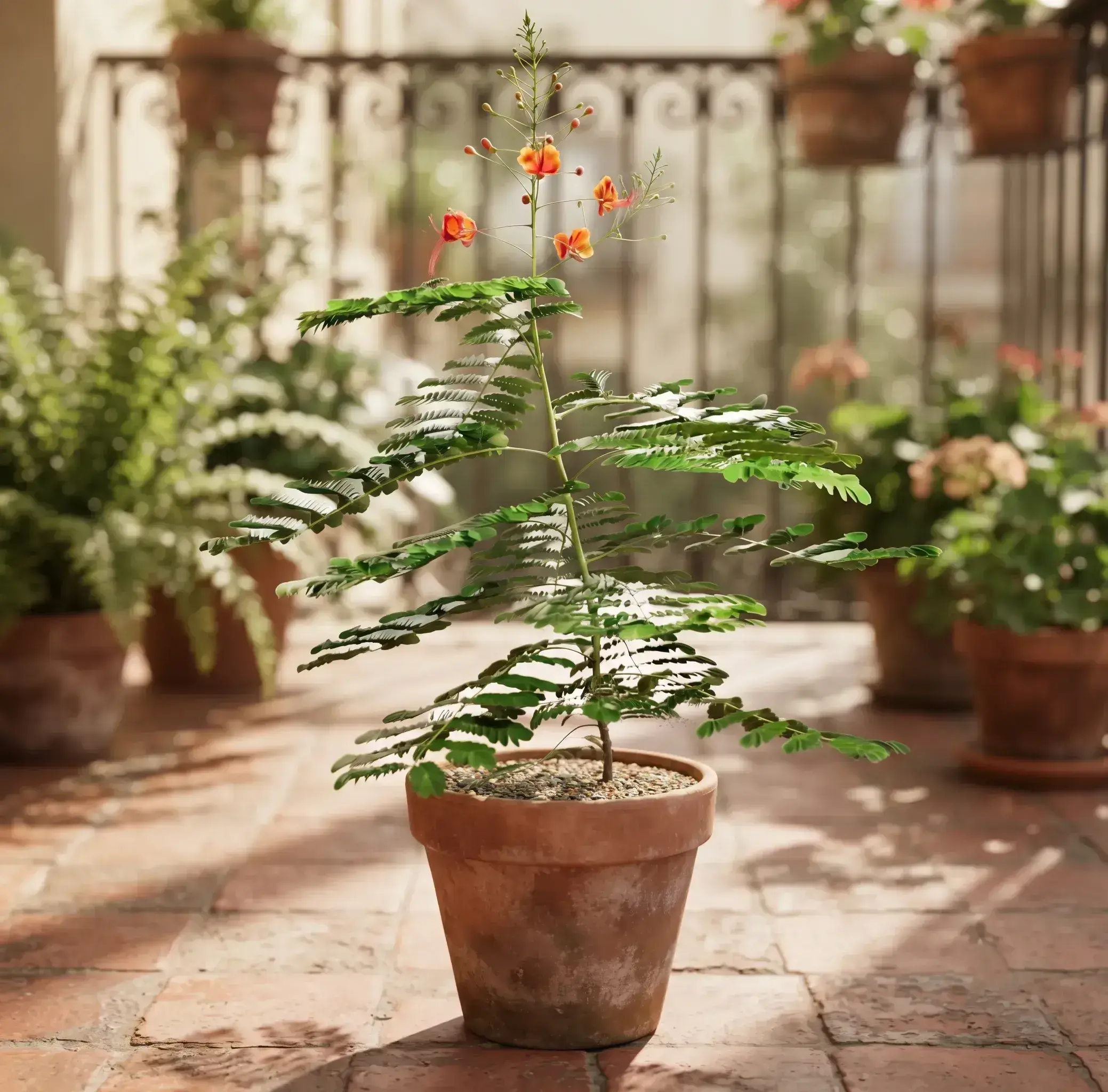

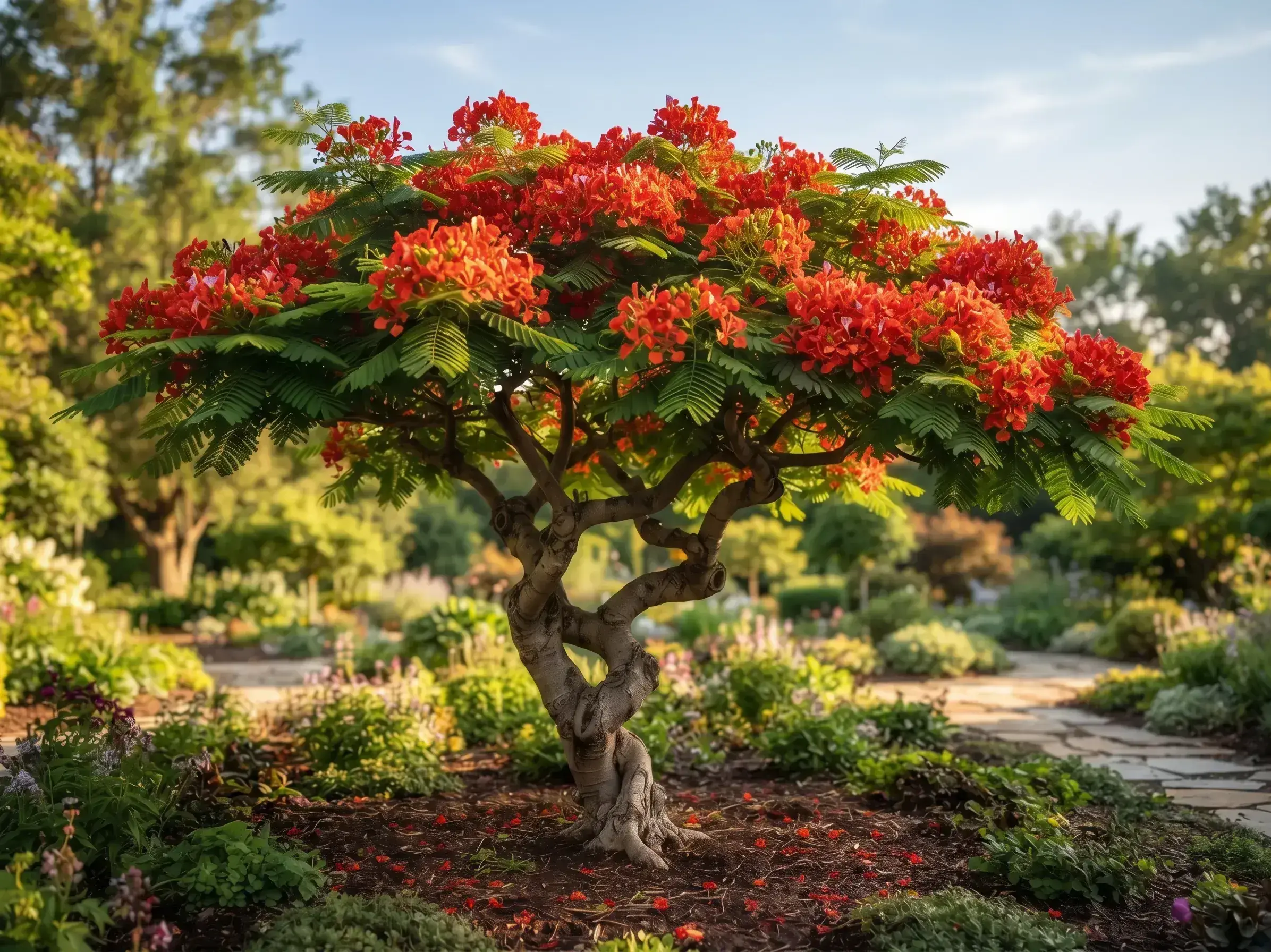
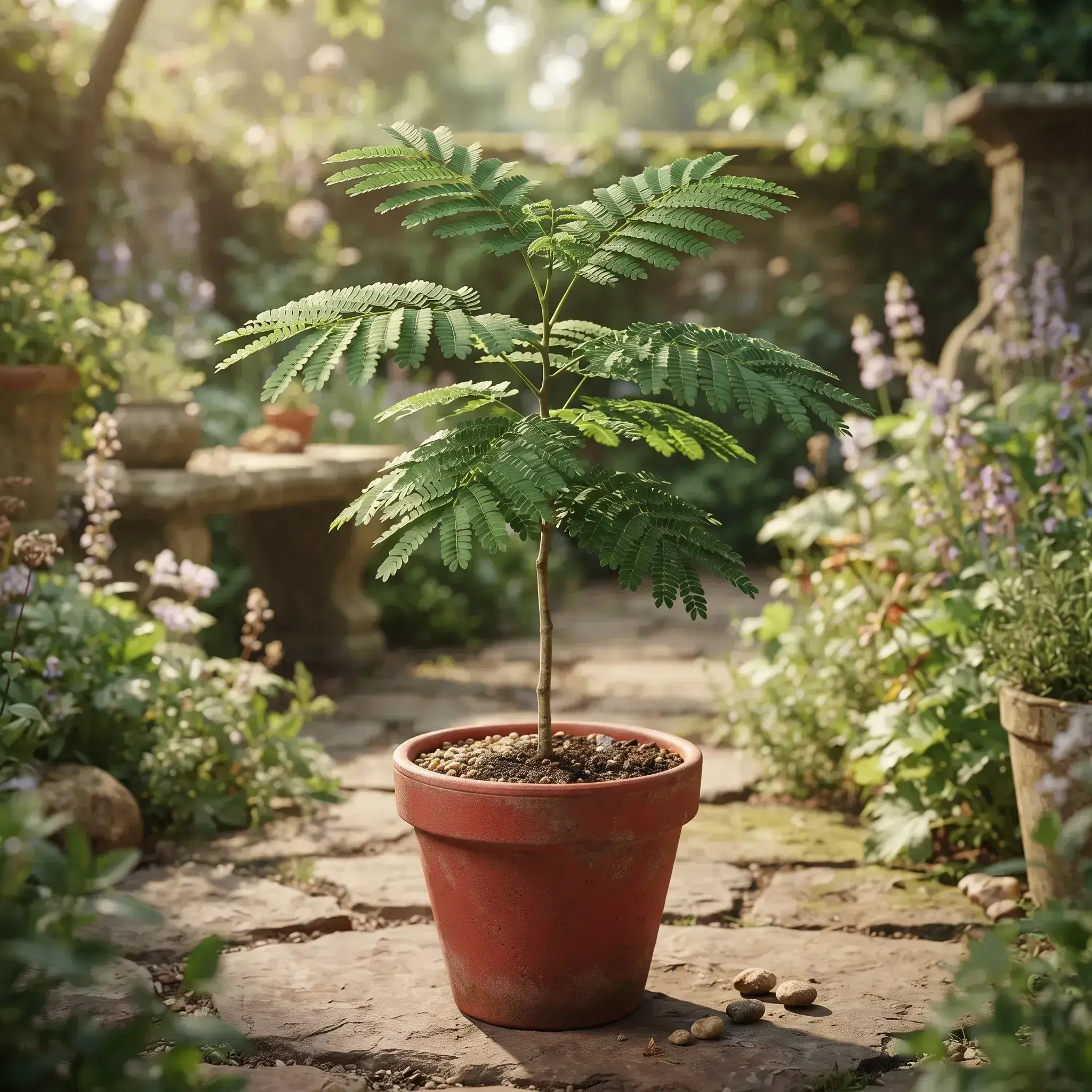

Gulmohar Plant with Paper Pot
🌿 About the Plant
Bring a spectacular tropical look to your garden with the Gulmohar Plant (Delonix regia), popularly known as the Flame Tree, Royal Poinciana, Flamboyant Tree, or Peacock Flower.
Gulmohar is one of the most recognisable flowering landscape trees, valued for its broad spreading crown, delicate fern-like foliage and spectacular clusters of bright red to orange-red flowers. It is widely planted as an ornamental tree in tropical and subtropical regions, including India. Kew records Delonix regia as an accepted species in the Fabaceae family and lists India among its introduced ranges.
The plant offered here comes with a paper pot, making it convenient for establishing in a suitable garden location or transferring into an appropriate larger container during its early growth.
Gulmohar is ultimately a large landscape tree, so although the supplied plant may be small and easy to handle, it should be planted with its future size and spreading root system in mind.
🌱 Plant Characteristics
- Common Name: Gulmohar
- Scientific Name: Delonix regia
- Family: Fabaceae
- Other Common Names: Flame Tree, Flamboyant, Royal Poinciana, Peacock Flower, Gul Mohur
- Native Range: Northern and western Madagascar
- Plant Type: Ornamental flowering tree
- Growth Habit: Broad, spreading and branching
- Foliage: Fine, fern-like compound leaves
- Flowers: Showy red to orange-red flowers
- Fruit: Long, flat, woody seed pods
- Suitable For: Home gardens, large gardens, avenues, parks and landscaping
- Pot: Paper pot included as described in the product listing
RHS describes Gulmohar as a tropical evergreen or semi-evergreen tree with elegant fern-like foliage and clusters of bright red flowers.
🌸 Flowers
The spectacular flowers are the main reason Gulmohar is planted as an ornamental tree.
The flowers are large and showy, generally appearing in bright red to orange-red shades. Kew describes the flowers as approximately 10 cm across, with one upper petal carrying a contrasting white to creamy-yellow area marked with red.
When a mature tree comes into flower, the colourful blooms can cover a significant portion of the canopy and create a striking landscape display.
Flowering depends on:
- Plant age
- Sunlight
- Temperature
- Climate
- Soil conditions
- Water management
- Nutrition
- Tree health
- Seasonal growth
Flowering is not guaranteed immediately after delivery, particularly for young plants.
🌿 Foliage
Gulmohar has attractive fern-like compound leaves that give the tree a soft, airy appearance.
Kew records large leaves with numerous pairs of pinnae and many small opposite leaflets.
The fine foliage creates a very different appearance from trees with large, broad leaves. It is particularly attractive when viewed against the sky or when the tree develops a broad canopy.
Depending on climate and growing conditions, the tree can behave as evergreen or semi-evergreen and may shed foliage during particular seasonal periods.
🌱 Seed Pods
After flowering, Gulmohar can produce distinctive long, flattened seed pods.
Kew records pods approximately 40–70 cm long, containing numerous seeds.
These pods can remain on the tree and become brown as they mature, adding another seasonal feature to the plant.
Young trees may not produce pods for several years, and seed production depends on maturity and growing conditions.
☀️ Sunlight Requirements
Gulmohar is a sun-loving tree.
For strong growth and good flowering potential, choose a location that receives plenty of direct sunlight.
RHS recommends full sun for Delonix regia.
For Indian gardens:
- Choose an open sunny location.
- Avoid planting it permanently in deep shade.
- Give young plants good light from the beginning.
- Allow sufficient space for the future canopy.
- Avoid locations where nearby buildings permanently block sunlight.
Good sunlight is particularly important if the objective is eventually to enjoy the tree’s characteristic flowering display.
💧 Watering
Young Gulmohar plants require regular watering while establishing their root system.
Water thoroughly when the soil begins to dry, but avoid keeping the root zone continuously waterlogged.
A useful approach is:
Newly planted tree: Water regularly during the establishment period.
Established tree: Water according to soil moisture, rainfall and local climate.
Monsoon: Reduce additional watering when rainfall is sufficient and make sure water drains away properly.
Summer: Monitor young plants more frequently because hot weather can dry the soil quickly.
Kew describes Delonix regia as a tree of seasonally dry tropical environments, while also noting that it requires well-drained soils.
🪴 Soil & Planting
Gulmohar grows best in well-drained soil.
Suitable garden soil should provide:
- Good drainage
- Reasonable fertility
- Adequate root space
- Good aeration
- Moderate moisture retention
Avoid planting in locations where rainwater remains stagnant for long periods.
RHS lists loam and sand as suitable soil types and recommends moist but well-drained conditions.
When planting from the paper pot:
- Select a suitable open location.
- Prepare a planting hole wider than the existing root area.
- Handle the young plant carefully.
- Plant at approximately the same depth at which it was growing.
- Fill around the roots with suitable soil.
- Water thoroughly after planting.
- Provide support if the young stem requires it.
- Maintain regular moisture while the plant establishes.
🌱 Fertilizer & Nutrition
Young Gulmohar plants can benefit from balanced nutrition during active growth.
Use well-decomposed organic matter or a suitable balanced fertilizer according to the product manufacturer’s recommendations.
Avoid excessive fertilizer.
Once established in suitable garden soil, trees generally require less intensive feeding than container-grown plants.
RHS notes that newly planted trees benefit from attention to soil conditions and can be fed where necessary after establishment, while mulching can help conserve moisture and improve soil conditions.
🌳 Space Requirement
This is one of the most important considerations before planting Gulmohar.
Gulmohar is not a permanently small or dwarf tree.
Kew’s species profile reports that Delonix regia can grow to approximately 30 metres in height, while RHS gives a smaller mature size under its particular growing conditions.
The actual size varies with:
- Climate
- Soil
- Water availability
- Growing space
- Pruning
- Plant age
- Local conditions
The tree also develops wide-spreading roots. Kew specifically warns that these roots can damage paving, drains and foundations if the tree is planted too close to structures.
Therefore, choose a spacious planting location away from:
- Building foundations
- Narrow pathways
- Underground drains
- Septic systems
- Small paved areas
- Utility infrastructure
- Very small garden beds
🏡 Home Garden & Landscaping
Gulmohar can become an impressive focal tree in a sufficiently large garden.
It can be used for:
- Large home gardens
- Farmhouses
- Estate landscaping
- Large lawns
- Garden boundaries
- Institutional landscaping
- Roadside or avenue planting where permitted
- Parks and public landscapes
Kew notes that the species is widely planted in tropical and subtropical regions as an ornamental tree for streets, parks and gardens.
For a small residential plot, carefully consider the mature canopy and root system before planting.
🪴 Container Growing
Young Gulmohar can be temporarily maintained in containers, but it is fundamentally a large landscape tree.
RHS lists Delonix regia among plants that can be grown as container specimens under suitable conditions, but container growth significantly restricts eventual size and flowering potential compared with a well-sited landscape tree.
If keeping the young plant in a container:
- Use a container with drainage holes.
- Provide plenty of sunlight.
- Avoid permanently waterlogged soil.
- Repot as the root system develops.
- Monitor root crowding.
- Do not expect a container-grown specimen to behave like a mature landscape tree.
For long-term growth, planting in a suitable open garden area is generally more appropriate.
✂️ Pruning & Maintenance
Young Gulmohar trees may require formative pruning to develop a suitable structure.
Remove:
- Dead branches
- Damaged branches
- Weak or poorly positioned shoots
- Crossing branches where appropriate
As the tree becomes larger, pruning should be carried out carefully because mature branches can become substantial.
Kew notes that Gulmohar has brittle branches that can be shed readily, so site selection and tree maintenance are important.
Avoid planting it directly above areas where falling branches could create a safety concern.
🌬️ Wind & Branch Considerations
Gulmohar develops a broad canopy and can have relatively brittle branches.
For this reason, a protected location with adequate space is preferable.
In areas that experience strong storms or cyclonic weather, inspect the tree regularly for:
- Dead branches
- Weak branch unions
- Damaged limbs
- Storm damage
Large branches should be handled by appropriately trained professionals where necessary.
🌧️ Growing Gulmohar in India
Gulmohar is well known as a tropical and subtropical ornamental tree and is cultivated in India. Kew records India among the regions where the species has been introduced.
Summer:
Provide good sunlight and regular water for young plants.
Monsoon:
Ensure excellent drainage and avoid unnecessary additional irrigation.
Winter:
In warm regions, established plants generally continue growing with suitable conditions. In cooler areas, protect young plants from unusually cold conditions.
Coastal areas:
The species can perform well in tropical and subtropical environments, and Kew notes its suitability for maritime tropical and subtropical conditions where drainage is appropriate.
🌱 Planting the Paper Pot
The supplied plant comes in a paper pot.
When transplanting, handle the young plant carefully and avoid unnecessary disturbance to the root system.
If the paper container is designed to be planted directly, follow the nursery’s specific planting instructions. If it is intended as a temporary nursery container, remove it carefully before planting.
The exact behaviour of paper pots can vary depending on the material and construction, so do not assume that every paper pot should be buried intact.
⚠️ Important Safety & Site Note
Gulmohar is an attractive tree, but it requires proper site planning.
Its broad root system can interfere with paving, drains and foundations, and its branches can be brittle. Kew specifically recommends choosing the planting location carefully and keeping the tree away from hard landscape features.
Do not plant it immediately beside a house foundation, narrow pathway, underground drainage line or other vulnerable infrastructure.
📦 Live Plant Delivery & Natural Variation
This is a live plant, so the appearance at the time of delivery may naturally differ from product photographs.
The supplied plant may vary in:
- Height
- Stem thickness
- Leaf size
- Number of leaves
- Branching
- Overall fullness
- Root development
During transportation, the plant may experience temporary stress, which can result in:
- Slight drooping
- Minor leaf yellowing
- Small amounts of leaf shedding
- Bent foliage
- Minor cosmetic damage
Changes in sunlight, temperature, humidity and watering can also temporarily affect the plant’s appearance.
After delivery, place the plant in a suitable location and gradually establish its normal care routine.
Product photographs are representative. The actual live plant may not look exactly identical to the photographs.
⚠️ Important Note
The Gulmohar supplied is Delonix regia, an ornamental flowering tree rather than a dwarf or permanently small plant.
The young plant supplied in a paper pot can be convenient for planting, but its eventual size can be much larger than its initial nursery size.
Flowering is not guaranteed immediately after delivery. Flowering depends on plant age, sunlight, climate, nutrition, water management and growing conditions.
Because of its spreading roots and brittle branches, select the final planting site carefully.
🌱 Why Choose Gulmohar?
- Iconic tropical flowering tree
- Beautiful bright red to orange-red flowers
- Attractive fern-like foliage
- Excellent ornamental landscaping tree
- Suitable for spacious home gardens
- Useful for large lawns and landscape projects
- Attractive seasonal flowering display
- Naturally develops a broad spreading canopy
- Well suited to warm tropical and subtropical conditions
- Popularly known as Flame Tree and Royal Poinciana
- Supplied as a young plant in a paper pot
- Excellent choice for long-term landscape planting
🌿 Botanical Information
Botanical Name: Delonix regia (Bojer ex Hook.) Raf.
Common Name: Gulmohar
Other Names: Flame Tree, Flamboyant, Royal Poinciana, Peacock Flower, Gul Mohur
Family: Fabaceae
Native Range: Northern and western Madagascar
Plant Type: Ornamental flowering tree
Growth Habit: Broad and spreading
Foliage: Fine, fern-like compound leaves
Flower Colour: Bright red to orange-red
Fruit: Long, flat woody pods
Light: Full sun
Soil: Well-drained loam/sandy soil
Water: Regular during establishment; avoid waterlogging
Container: Suitable for young plants, with long-term space considerations
Landscape Use: Gardens, parks, avenues and large landscapes
Kew recognises Delonix regia as an accepted species of the Fabaceae family and records Madagascar as its native range.
🔗 Botanical Information & Further Reading
- Kew – Plants of the World Online: Delonix regia
- Kew – Delonix regia Species Profile
- RHS – Delonix regia Plant Profile
- RHS – How to Grow Trees
- RHS – Container Tree Growing Advice
- Kew – Delonix Genus Information
For More Information
Visit: Nursery-Plant.Com
For Contact Visit:Contact Us
For Shopping Visit: Shop Page


Reviews
There are no reviews yet.