
Himsagar All Time Mango Grafted Plant | Mangifera indica
🌿 About the Plant
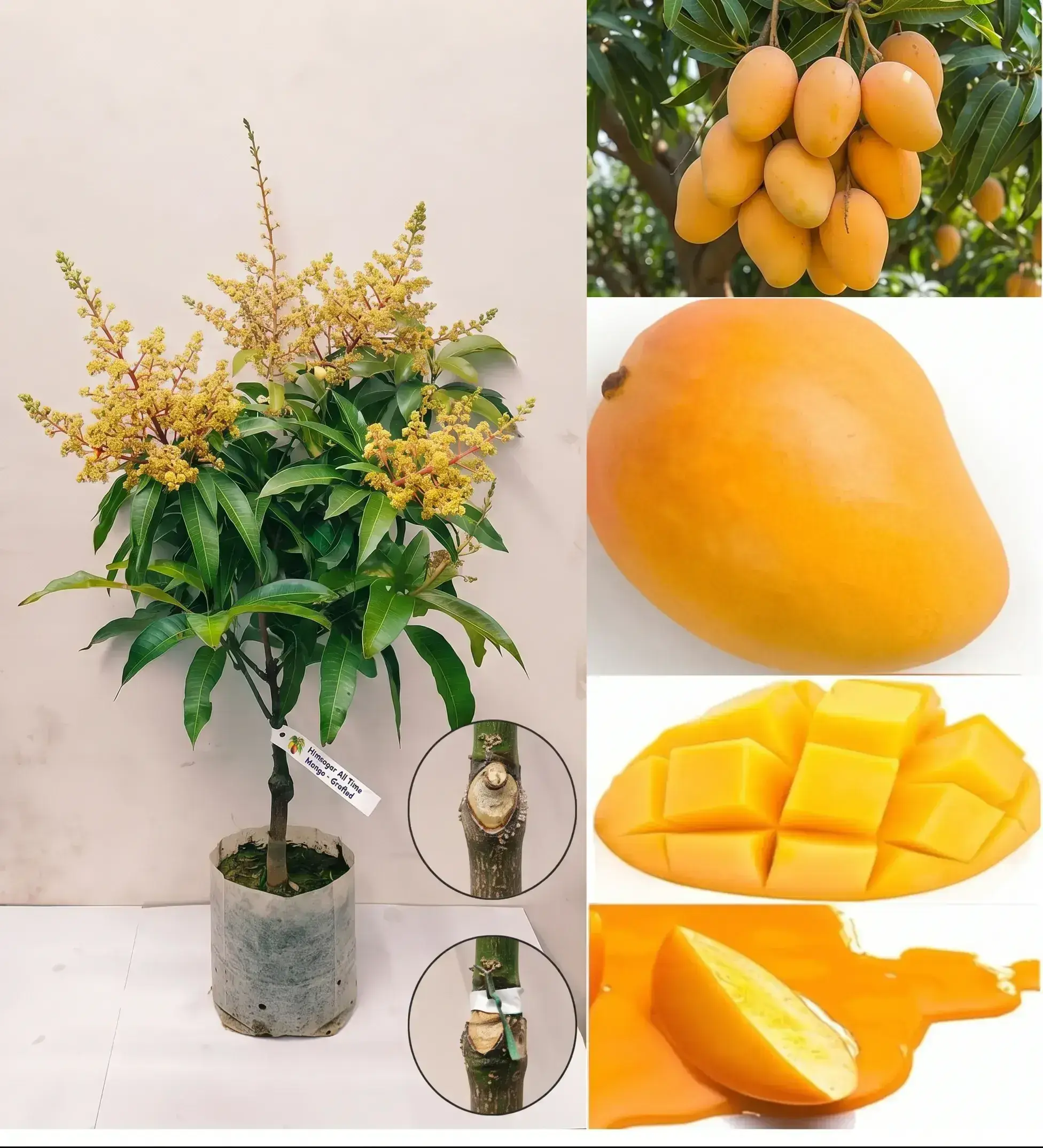
Grow one of Bengal’s most famous traditional mango varieties in your own garden with this Himsagar All Time Mango Grafted Plant. Himsagar, also known as Khirsapati, is a recognised mango cultivar of Mangifera indica associated particularly with West Bengal and Bangladesh. The National Horticulture Board lists Himsagar among the important mango varieties of West Bengal and Bihar, describing it as an early-season variety with good fruit quality and keeping quality.
Himsagar is especially appreciated for its sweet flavour, pleasant aroma, soft yellow to orange flesh and very low-fibre or fibreless eating quality. ICAR’s Indian Horticulture publication identifies Himsagar as a GI-tagged mango associated with West Bengal and notes that the inside is yellow to orange and contains no fibre, with pulp content around 77%.
The variety has a strong connection with the mango-growing areas of West Bengal, including Malda and other important mango districts. A recent West Bengal government-backed field guide describes Malda Himsagar as a GI-tagged premium, fibre-free mango with saffron-orange flesh.
This product is supplied as a grafted mango plant. Grafting is widely used for maintaining desirable characteristics of selected mango varieties. West Bengal’s State Food Processing Industries specifications for grafted mango planting material include Himsagar among the varieties used for grafted planting stock.
The word “All Time” is retained as part of the product name supplied for this listing. It should not be understood as a promise of year-round fruiting. Himsagar is a seasonal mango variety, with sources placing its normal fruiting/availability period around May–June depending on location and season.
🌱 Plant Characteristics
- Common Name: Himsagar Mango, Him Sagar Mango, Khirsapati
- Botanical Name: Mangifera indica L.
- Family: Anacardiaceae
- Plant Type: Evergreen tropical fruit tree
- Propagation: Grafted
- Fruit Type: Mango
- Fruit Season: Generally early-season; commonly around May–June
- Fruit Size: Medium
- Fruit Shape: Ovate to ovate-oblique
- Flesh: Yellow to orange/yellow-orange
- Fibre: Very low to fibreless
- Flavour: Sweet and aromatic
- Sunlight: Full sun
- Water: Moderate and regular during active growth
- Soil: Fertile and well-drained
- Container Suitable: Yes, especially while young
- Garden Use: Home orchard, backyard, terrace and fruit garden
The National Horticulture Board describes Himsagar fruit as medium-sized, ovate to ovate-oblique and yellow, with good quality and good keeping quality.
🥭 Himsagar Mango Fruit
The fruit is the main attraction of this traditional variety.
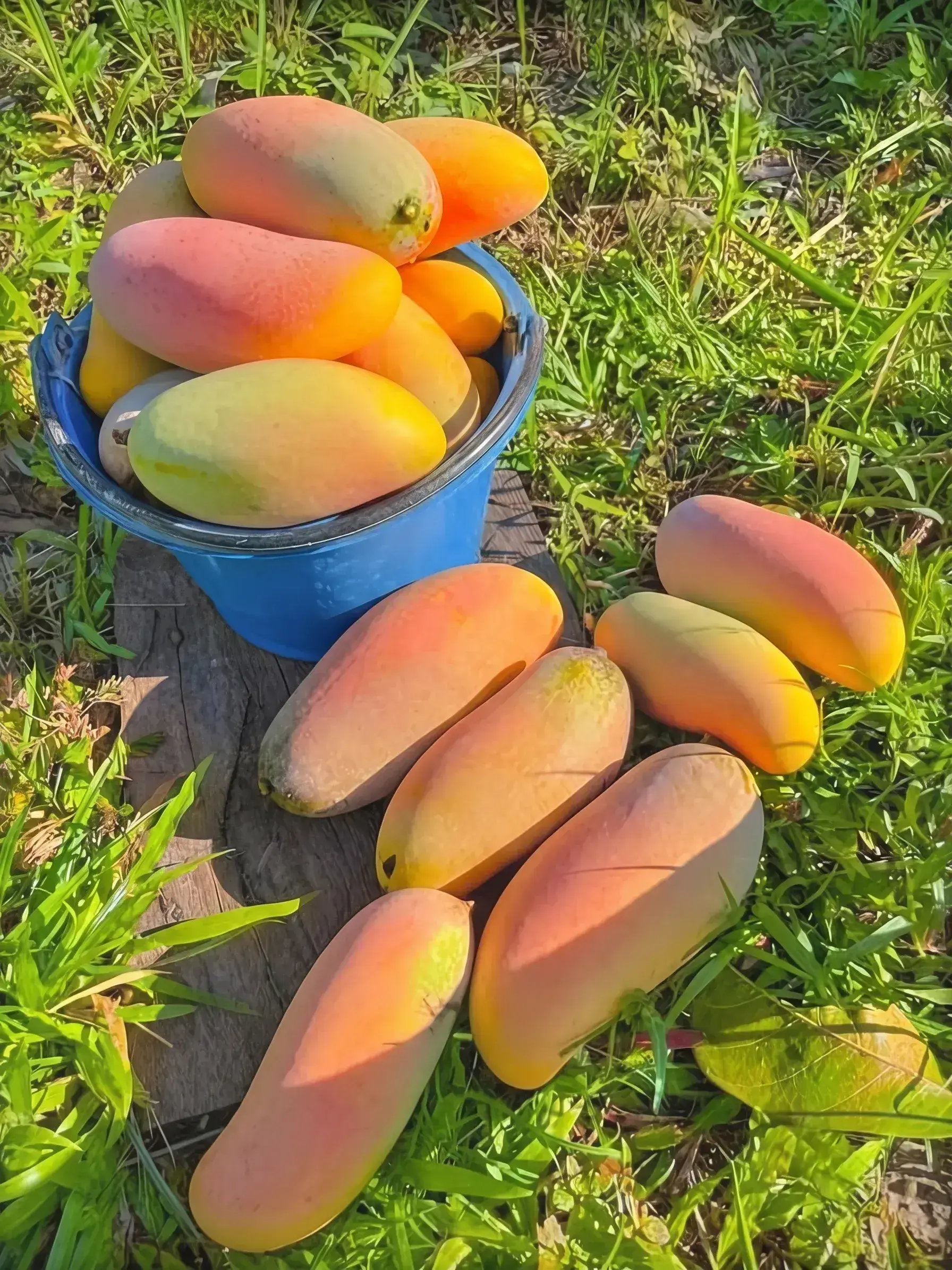
When mature and properly ripened, Himsagar generally develops yellow to yellow-orange flesh, while the skin may remain greenish or develop lighter yellow-green tones depending on maturity and growing conditions.
A detailed study of Himsagar fruits grown in West Bengal reported ovate to ovate-oblique fruit, yellowish-orange to orange pulp, almost no fibre, pleasant aroma and total soluble solids of approximately 18.8–20.1° Brix in the studied fruits.
Typical characteristics associated with Himsagar include:
- Medium-sized fruit
- Ovate or ovate-oblique shape
- Yellow to yellow-orange flesh
- Very low or almost no fibre
- Sweet flavour
- Pleasant aroma
- Soft, juicy eating texture
- Good table-fruit quality
Natural variation can occur between fruits, trees, locations and seasons.
🍯 Taste & Texture
Himsagar is particularly valued as a dessert mango.
Its traditional eating characteristics include a sweet flavour, pleasant aroma and smooth flesh with little or almost no fibre. Educational horticultural material from Tamil Nadu Agricultural University describes Himsagar as one of Bengal’s choicest mango varieties, with good fruit quality and good keeping quality.
The fruit can be enjoyed:
- Fresh after ripening
- In mango shakes
- In smoothies
- With breakfast
- In desserts
- In mango pulp preparations
- In traditional Bengali sweets and recipes
- In homemade juices and beverages
Because Himsagar is valued for its smooth flesh, it is particularly suitable for people who prefer mangoes with minimal fibrous texture.
🌸 Flowering & Fruit Development
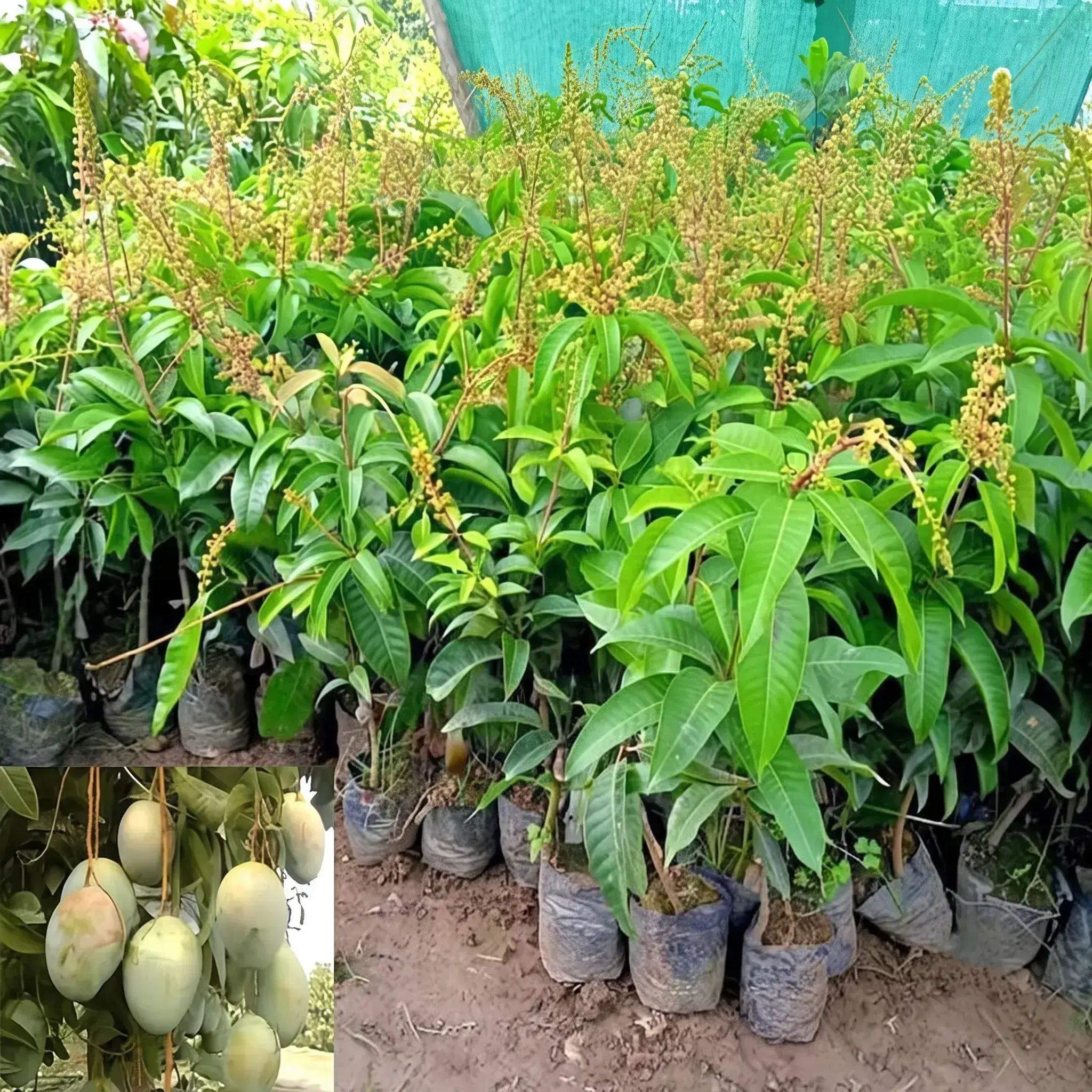
Mango trees produce their flowers in branching flower panicles. After flowering, only a portion of flowers normally develops into mature fruits.
For a young grafted plant, flowering may not occur immediately. The plant needs to establish its root system and canopy before it reaches an appropriate reproductive stage.
Fruit production depends on:
- Age and maturity of the grafted plant
- Authenticity of the scion
- Rootstock
- Local climate
- Temperature
- Sunlight
- Soil fertility
- Water management
- Flowering conditions
- Pest and disease management
- Pruning and canopy management
Fruiting is not guaranteed immediately after delivery and depends on plant age, variety, climate, sunlight, nutrition, water management and growing conditions.
Even a healthy grafted mango plant may require additional growing time before producing a meaningful crop.
☀️ Sunlight Requirements
Himsagar mango should be grown in a bright, sunny location with plenty of direct sunlight.
Good sunlight supports healthy foliage, flowering and fruit development.
For best results:
- Select an open location.
- Avoid heavy shade from buildings or large trees.
- Provide several hours of direct sunlight each day.
- Give terrace-grown plants the brightest practical position.
- Avoid permanently keeping the plant indoors.
Young plants may require gradual acclimatisation if they have been transported from a protected nursery environment into strong outdoor sunlight.
💧 Watering
Young grafted mango plants require regular moisture while establishing, but waterlogging should be avoided.
A practical watering routine is:
- Check the top layer of soil before watering.
- Water thoroughly when the soil begins to dry.
- Allow excess water to drain away.
- Water more frequently during very hot and dry periods.
- Reduce watering during prolonged monsoon rainfall.
- Do not allow the pot to sit in stagnant water.
Mango is not a marsh plant. Poor drainage can cause root problems and weaken the plant.
For container cultivation, drainage holes should always remain open.
🪴 Soil & Potting
Himsagar performs best in a fertile, deep and well-drained growing medium.
For a home garden, the soil can be improved with well-decomposed organic matter while maintaining adequate drainage.
A practical container mix may include:
- Good-quality garden soil
- Mature compost
- Cocopeat or similar organic material
- Coarse sand/perlite or another drainage-supporting component where necessary
Avoid compacted clay-like soil that remains saturated for long periods.
If planting directly into the ground, select a location where rainwater does not collect around the roots.
🌱 Fertilizer & Nutrition
Mango trees need balanced nutrition for healthy vegetative growth and fruit production.
For home cultivation, use:
- Well-decomposed compost or organic manure
- Balanced fruit-tree fertilizer
- Potassium-containing fertilizer when appropriate
- Micronutrients where soil deficiency is identified
Do not apply excessive fertilizer simply to make a young plant grow rapidly.
Too much nitrogen can encourage excessive leafy growth and may not provide the desired balance between vegetative growth and fruit production.
Research conducted on Himsagar mango in West Bengal has specifically examined the influence of organic manures, inorganic fertilizers and biofertilizers on plant growth, soil characteristics and fruit quality.
🌱 Grafted Plant Information
This listing is for a grafted Himsagar mango plant.
Grafting joins a selected scion from the desired mango variety with a compatible rootstock. The purpose is to maintain the characteristics of the selected fruiting variety more reliably than ordinary seed propagation.
Take care of the graft union after delivery:
- Keep the graft union above soil level.
- Do not bury the graft joint.
- Avoid tying supports tightly around the graft.
- Do not damage the union during repotting.
- Remove strong shoots emerging from below the graft when clearly identified as rootstock growth.
- Avoid heavy pruning immediately after transportation.
West Bengal’s official grafted-mango planting-material specification includes Himsagar and describes quality requirements for rootstock, scion, graft union and foliage.
🏡 Home Garden Suitability
Himsagar is well suited to gardeners who want to grow a traditional Bengal mango variety at home.
It can be grown in:
- Backyard gardens
- Home orchards
- Kitchen gardens
- Farmhouses
- Large terrace gardens
- Fruit gardens
- Large containers
The tree has attractive evergreen foliage and can become an important feature of a home fruit garden.
Because mango is a long-lived tree, choose the planting position with its eventual size in mind rather than judging the required space from the size of the young nursery plant.
🪴 Container / Terrace Gardening
A grafted Himsagar can be grown in a container while young and can remain container-grown with appropriate long-term management.
For terrace gardening:
- Use a strong and stable container.
- Ensure several drainage holes.
- Use fertile, well-draining soil.
- Place the plant in full sunlight.
- Monitor moisture more frequently during hot weather.
- Feed according to plant size and growth.
- Prune carefully to maintain a manageable canopy.
- Repot or upgrade the container when the root system becomes restricted.
A container-grown mango requires more attention to watering and nutrition than a tree planted directly into the ground.
Container cultivation can help manage tree size, but it does not mean the plant will remain permanently dwarf.
✂️ Pruning & Maintenance
Young mango plants should be trained gradually to develop a strong and balanced framework.
Pruning may be used to remove:
- Dead branches
- Broken branches
- Diseased growth
- Crossing branches
- Weak unwanted shoots
- Rootstock shoots below the graft
Avoid excessive pruning of a young plant.
Clean and sharp pruning tools should be used, especially when moving between different plants.
For a home-grown mango, canopy management is useful for keeping the tree accessible for maintenance and harvesting.
🌳 Space Requirement
Mango is a substantial evergreen fruit tree. A small grafted nursery plant can eventually develop into a much larger tree.
Allow sufficient space for:
- Future canopy development
- Sunlight
- Air circulation
- Root growth
- Pruning
- Harvesting
Do not assume that the current nursery height represents the mature size of the plant.
For ground planting, avoid placing the tree immediately next to walls, buildings, underground drainage structures or other large trees.
🇮🇳 Himsagar Mango in West Bengal
Himsagar has a particularly strong connection with West Bengal’s mango-growing heritage.
The West Bengal government-backed Aamar Malda field guide identifies Malda Himsagar as a GI-tagged premium mango with saffron-orange, fibre-free flesh and a late-May to June availability window.
ICAR’s Indian Horticulture publication also records Himsagar Mango, GI Tag No. 112, under Mangifera indica, associated with West Bengal.
The National Horticulture Board lists Himsagar among the important varieties of West Bengal and Bihar and describes it as an early-season table mango with yellow fruit and good quality.
These sources make Himsagar particularly relevant for gardeners in eastern India who want to grow a regional mango variety.
🐛 Common Mango Care Problems
Like other mango plants, Himsagar may experience pest and disease problems.
Possible problems include:
- Mango hoppers
- Mealybugs
- Scale insects
- Fruit flies
- Anthracnose
- Powdery mildew
- Mango malformation
- Root problems caused by poor drainage
Inspect new shoots, leaves, flowers and developing fruits regularly.
Good air circulation, proper drainage, clean cultivation practices and appropriate integrated pest-management methods can help maintain plant health.
Do not apply pesticides routinely without identifying the problem first. Follow the product label and applicable safety instructions whenever plant-protection products are used.
📅 Fruiting Season & “All Time” Clarification
Himsagar is an early-season mango, not a naturally year-round fruiting mango.
The National Horticulture Board identifies it as an early-season variety, while horticultural references commonly place its fruiting/market season around May–June.
Therefore, the phrase “All Time Mango” in this product title should be understood as a product/nursery description and not as a claim of continuous fruit production throughout the year.
The actual flowering and harvest period may shift depending on:
- Location
- Temperature
- Rainfall
- Plant maturity
- Management
- Seasonal weather
📦 Live Plant Delivery & Natural Variation
This is a live grafted plant, so its appearance can naturally vary during delivery.
The delivered plant may show:
- Slight leaf yellowing
- Temporary drooping
- Minor leaf shedding
- Different leaf size
- Different height
- Different stem thickness
- Different branching
- Seasonal foliage changes
- Temporary transport stress
Changes in sunlight, temperature, humidity and watering after delivery can also temporarily change the plant’s appearance.
Product photographs are representative. The actual plant supplied may not be identical in height, branching or foliage density to the photographed specimen.
After delivery, unpack the plant carefully and gradually establish it in its normal growing environment.
⚠️ Important Note
The terms “Premium,” “Sweet,” “Fibreless” and “All Time” are used in the product title to describe the marketed Himsagar mango type.
Himsagar is documented as a low-fibre/fibreless mango, but individual fruit characteristics can naturally vary.
The plant is grafted, but grafting does not guarantee immediate fruiting. Fruit production depends on plant maturity, genetic material, rootstock, climate, sunlight, nutrition, irrigation and general care.
No specific fruiting age or number of fruits is guaranteed unless separately stated as a nursery-specific plant specification.
🌱 Why Choose This Plant?
- 🥭 Himsagar / Khirsapati mango, a recognised Bengal mango cultivar
- 🌱 Grafted fruit plant for vegetative propagation
- 🍯 Naturally sweet and aromatic fruit
- 🍊 Yellow to orange/yellow-orange flesh
- 🌿 Traditionally known for very low-fibre or fibreless pulp
- 🇮🇳 Strong connection with West Bengal’s mango heritage
- ☀️ Suitable for sunny home gardens
- 🏡 Suitable for backyard and home orchard cultivation
- 🪴 Can be grown in a large container while young
- 🌳 Attractive evergreen fruit tree
- 🥭 Excellent choice for gardeners interested in traditional Indian mango varieties
🌿 Botanical Information
Botanical Name: Mangifera indica L.
Cultivar: Himsagar / Khirsapati
Family: Anacardiaceae
Common Names: Himsagar Mango, Him Sagar, Khirsapati
Plant Type: Evergreen tropical fruit tree
Propagation: Grafted
Fruit Season: Early season, generally May–June
Fruit Size: Medium
Fruit Shape: Ovate to ovate-oblique
Flesh Colour: Yellow to orange/yellow-orange
Fibre: Very low to fibreless
Flavour: Sweet and pleasantly aromatic
Sunlight: Full sun
Soil: Fertile and well-drained
Water: Moderate; avoid prolonged waterlogging
Container Growing: Suitable with appropriate management
Primary Use: Fresh fruit and home orchard cultivation
ICAR records Himsagar as a GI-tagged mango associated with West Bengal and describes its yellow-to-orange interior, fibre-free flesh and approximately 77% pulp content.
🔗 Botanical Information & Further Reading
- ICAR – Himsagar Mango and GI Information — Indian Horticulture reference identifying Himsagar as a GI-tagged Mangifera indica variety associated with West Bengal.
- National Horticulture Board – Mango Varieties — Government horticulture reference covering Himsagar’s fruit characteristics, season and growing regions.
- Aamar Malda – Himsagar Mango Field Guide — West Bengal-focused information on Malda mango varieties and Himsagar.
- TNAU Agritech – Mango Varieties — Agricultural university resource describing Himsagar as a traditional Bengal mango variety.
- Physico-Chemical Quality Study of Himsagar Mango — Published study documenting Himsagar fruit characteristics in West Bengal, including pulp colour, fibre, TSS and fruit measurements.
- Himsagar Mango Nutrition & Orchard Study – Advances in Horticultural Science — Research on organic, inorganic and biofertilizer effects on Himsagar mango in West Bengal.
- ICAR – Varietal Diversity in Mango — Research overview discussing Indian mango cultivar diversity and the influence of climate, soil and cultivation practices.
Growing note: Himsagar is a seasonal mango variety with a recognised connection to West Bengal. With a healthy grafted plant, adequate sunlight, good drainage, balanced nutrition and suitable long-term care, it can develop into a productive home-garden mango tree. Immediate fruiting or year-round fruit production should not be expected from a newly delivered plant.
For More Information
Visit: Nursery-Plant.Com
For Contact Visit:Contact Us
For Shopping Visit: Shop Page


Reviews
There are no reviews yet.