
Jade Plant Succulent
🌿 About the Plant
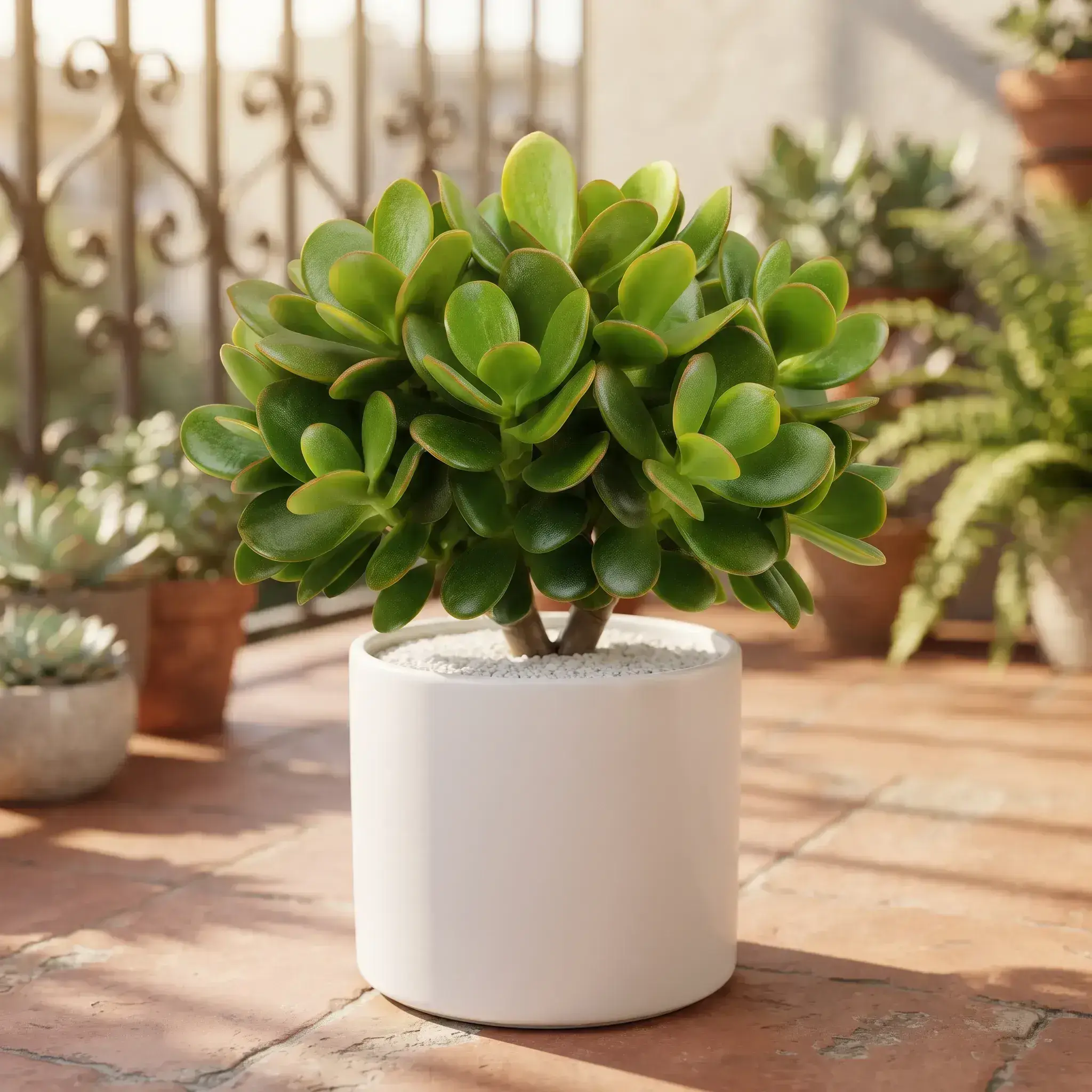
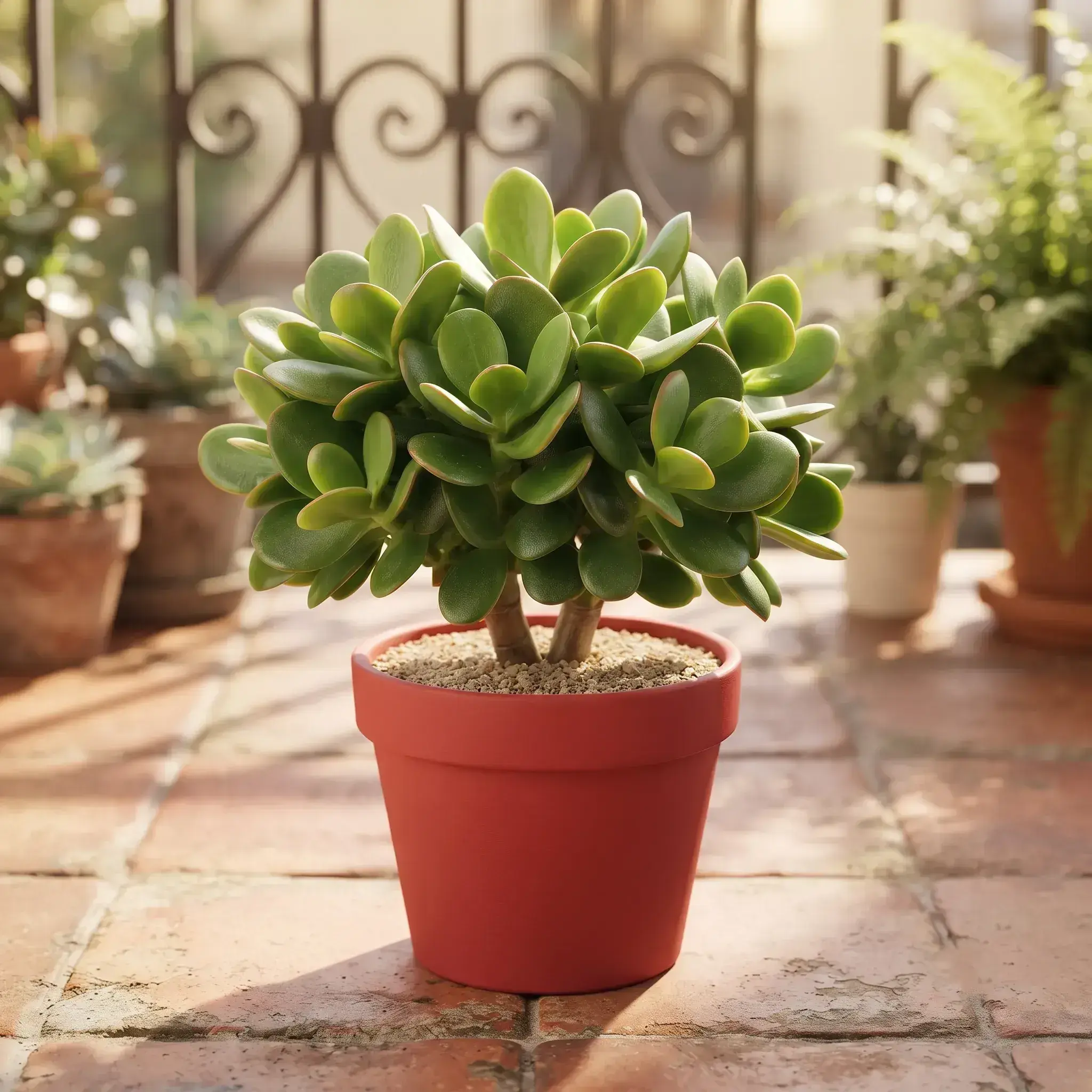
The Jade Plant, scientifically known as Crassula ovata, is a popular succulent appreciated for its thick, glossy leaves, sturdy stems and attractive miniature-tree appearance. It is commonly grown as a decorative indoor and container plant and is suitable for homes, offices, balconies, windowsills and succulent collections.
Crassula ovata belongs to the Crassulaceae family. Kew currently accepts Crassula ovata (Mill.) Druce as the correct botanical name and records its native range from southeastern Mozambique to the southeastern Cape region of South Africa. It is a succulent subshrub or shrub adapted to subtropical conditions.
The plant is widely known by names such as Jade Plant, Jade Tree, Lucky Plant, Money Plant and Friendship Tree. The terms “Lucky Plant” and “Money Plant” refer to traditional and cultural associations with prosperity and good fortune; they are not scientific guarantees of wealth or financial success.
This product is supplied as a live Jade Plant with pot, making it convenient for indoor decorative gardening.
🌱 Plant Characteristics
- Common Name: Jade Plant, Jade Tree, Lucky Plant, Money Plant, Friendship Tree
- Botanical Name: Crassula ovata (Mill.) Druce
- Family: Crassulaceae
- Plant Type: Evergreen succulent shrub
- Native Range: Southeastern Mozambique to South Africa
- Growth Habit: Upright, branched and spreading
- Foliage: Thick, fleshy and glossy
- Stem: Fleshy when young, becoming woody with age
- Flowers: Small, star-shaped flowers
- Flower Colour: White to pale pink
- Light: Bright light to full sun, with gradual acclimatisation
- Water: Low; allow the growing medium to dry between watering
- Soil: Well-drained succulent/cactus mix
- Pot Suitability: Excellent
- Indoor Use: Yes, when adequate light is available
- Maintenance: Relatively low
NCSU describes Jade Plant as a low-maintenance succulent shrub that can develop a miniature-tree form as it matures.
🍃 Foliage
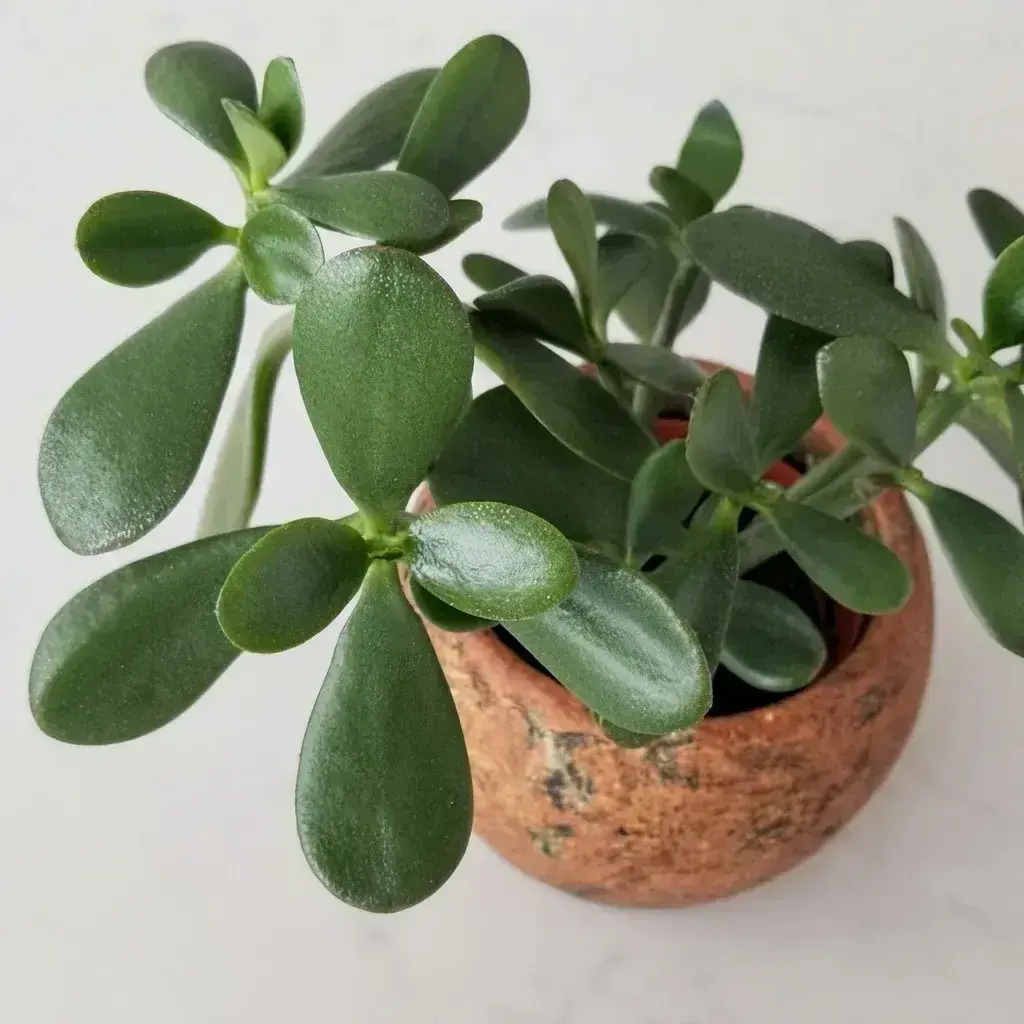
The thick, fleshy leaves are one of the main features of the Jade Plant.
The leaves are generally oval to rounded, glossy and green. Under stronger light, the margins can develop reddish tones. The fleshy leaves store water, helping the plant tolerate periods of relatively dry soil. NCSU describes the foliage as thick, fleshy and glossy, with leaves often developing red-tinted margins in direct sunlight.
As the plant matures, its stems become thicker and more woody, creating a small tree-like or bonsai-style appearance.
The exact leaf colour and shape can vary according to light, plant age and growing conditions.
☀️ Sunlight Requirements
Jade Plant needs bright light to maintain compact, healthy growth.
RHS recommends full light for Crassula ovata, while its indoor guidance notes that a bright location is important and that insufficient light can lead to stretched or leggy growth.
Suitable locations include:
- Bright windowsills
- East-facing windows
- Bright indoor balconies
- Sunny rooms
- Covered terraces
- Bright office windows
If the plant has been grown under filtered nursery light, introduce stronger direct sunlight gradually.
Very intense sunlight can scorch leaves when a plant is not acclimatised, while insufficient light can produce weak, elongated growth.
For Indian homes, a bright location with several hours of good light can help maintain a compact appearance.
💧 Watering
Jade Plant is a water-efficient succulent and should not be watered like a tropical foliage plant.
Allow the potting mix to dry substantially between waterings.
A simple watering method is:
- Check the soil before watering.
- Wait until the growing medium has dried.
- Water thoroughly.
- Allow excess water to drain completely.
- Empty collected water from a saucer or outer pot.
RHS recommends allowing the compost to dry between waterings and watering much more sparingly during periods of slower growth.
Overwatering can be more harmful than underwatering. NCSU notes that excessive watering can contribute to leaf fall and root rot.
During India’s monsoon season, reduce watering whenever the soil remains naturally wet.
🪴 Soil & Potting
Jade Plant requires excellent drainage.
A suitable growing medium can contain:
- Cactus or succulent potting mix
- Loamy soil
- Coarse sand
- Perlite or pumice
- A small amount of mature compost
The objective is to create a medium that drains quickly while providing enough support and nutrition for the roots.
RHS recommends cactus compost and well-drained conditions, while NCSU also recommends well-drained potting soil.
Always use a pot with drainage holes.
Avoid heavy soil that remains saturated for several days.
🌱 Fertilizer & Nutrition
Jade Plant is a relatively light feeder.
During active growth, a balanced liquid fertilizer can be applied at a diluted rate according to the manufacturer’s instructions.
RHS recommends a general liquid fertilizer approximately monthly during the active spring and summer growing period.
Avoid excessive fertilizer, particularly when the plant is growing slowly.
A newly delivered plant should first be allowed to acclimatise before receiving a strong fertilizer application.
🌡️ Temperature & Humidity
Jade Plant is adapted to subtropical conditions and generally does well in normal indoor environments.
It does not require high humidity. RHS notes that it is adaptable to average indoor conditions, while its indoor guidance states that special humidity measures are unnecessary.
Keep the plant away from:
- Strong air-conditioner airflow
- Cold drafts
- Prolonged very cold conditions
- Sudden temperature changes
- Continuously damp locations
For most Indian homes, normal warm indoor conditions are suitable.
🌼 Flowers
Mature Jade Plants can produce small, star-shaped white to pale pink flowers, generally arranged in terminal clusters.
NCSU notes that flowering is uncommon in typical home environments, while RHS describes small starry white or light-pink flowers.
Flowering depends on:
- Plant maturity
- Light exposure
- Seasonal conditions
- Temperature
- Water management
- Overall plant health
Flowering is not guaranteed immediately after delivery.
The primary ornamental value of this product is its attractive succulent foliage and mature tree-like form.
🏡 Home & Office Suitability
Jade Plant is well suited to decorative indoor gardening where sufficient light is available.
It can be displayed in:
- Living rooms
- Home offices
- Work desks
- Study rooms
- Windowsills
- Shelves
- Reception areas
- Bright balconies
- Terraces
- Succulent collections
Its slow, structured growth makes it particularly attractive as a tabletop or miniature-tree style plant.
🪴 Container / Indoor Gardening
Jade Plant is an excellent container plant.
NCSU specifically lists Crassula ovata for houseplants and container use.
For successful container cultivation:
- Use a pot with drainage holes.
- Choose a fast-draining growing medium.
- Provide bright light.
- Avoid frequent watering.
- Allow the soil to dry between watering.
- Rotate the pot occasionally for balanced growth.
- Repot when the roots become crowded.
Jade Plants have relatively small root systems and generally do not require an unnecessarily large container.
✂️ Pruning & Maintenance
Jade Plant generally requires little pruning, but occasional trimming can help maintain a compact shape.
You can remove:
- Dead leaves
- Damaged branches
- Weak growth
- Very long or uneven stems
- Unwanted branches
Use clean, sharp pruning scissors or shears.
Regular shaping can encourage branching and help develop a more attractive miniature-tree appearance.
Because Jade Plant stems can become thick and woody with age, pruning is easier when performed carefully with a suitable sharp tool.
🌱 Propagation
Jade Plant is relatively easy to propagate.
Common methods include:
- Leaf cuttings
- Stem cuttings
- Offsets where available
RHS lists propagation from seed, offsets and root, stem or leaf cuttings.
For stem or leaf propagation, allow the cut material to dry appropriately before placing it into a suitable well-drained growing medium. Avoid excessive watering while roots are developing.
🌳 Space Requirement
Although commonly sold as a small indoor succulent, Crassula ovata can become a much larger branched shrub when allowed to grow for many years.
RHS lists a potential mature height of approximately 1.5–2.5 metres and spread of 1–1.5 metres under its stated growing conditions, with a maturity period of approximately 5–10 years.
Actual container size can remain considerably smaller depending on:
- Pot size
- Pruning
- Light
- Nutrition
- Root space
- Growing conditions
The plant supplied with this product is a nursery-grown specimen and should not be expected to have mature dimensions immediately after delivery.
💰 Lucky Plant & Money Plant Tradition
Jade Plant is commonly associated with luck, prosperity and financial abundance in popular gardening and gifting traditions.
Because of these associations, it is frequently chosen for:
- Housewarming gifts
- Offices
- Shops
- Business spaces
- New homes
- Festivals
- Special occasions
These are cultural and decorative beliefs, not scientifically established effects. Owning or growing a Jade Plant does not guarantee financial prosperity.
🇮🇳 Growing Jade Plant in India
Jade Plant can be grown successfully in many Indian homes when provided with good light, appropriate watering and excellent drainage.
Kew records Crassula ovata as a subtropical succulent shrub native to southeastern Mozambique and South Africa.
For Indian conditions:
- Provide bright light.
- Gradually introduce strong direct sunlight.
- Use a well-drained succulent mix.
- Water only when the soil has dried.
- Reduce watering during monsoon periods.
- Prevent standing water.
- Maintain good ventilation.
During humid and rainy weather, check the soil before watering rather than following a fixed schedule.
🌧️ Monsoon Care
Indian monsoon conditions require extra attention because Jade Plant is a succulent.
During prolonged rain:
- Keep the pot under a bright covered location where practical.
- Protect it from continuous heavy rainfall.
- Ensure drainage holes remain open.
- Do not water already-wet soil.
- Never leave the pot sitting in standing water.
Excess moisture can contribute to root problems and leaf loss. NCSU specifically identifies overwatering and root rot as potential problems.
🐛 Common Problems
Jade Plant is generally low maintenance, but unsuitable growing conditions can cause problems.
Yellow or soft leaves:
Often associated with excessive watering or root stress.
Leaf drop:
Can occur following overwatering, root problems or sudden environmental changes.
Long, stretched growth:
Usually associated with insufficient light.
Leaf scorch:
Can occur when a plant accustomed to lower light is suddenly exposed to intense sunlight.
Root rot:
Usually associated with excessive moisture and poor drainage.
Pests:
Aphids, scale insects, spider mites and mealybugs can occasionally affect Jade Plants.
Inspect leaves and stems periodically, especially when the plant is grown close to other indoor plants.
🐶 Pet Safety
Jade Plant is toxic to dogs, cats and horses if ingested.
NCSU identifies Jade Plant as problematic for cats, dogs and horses and reports signs including vomiting, depression and incoordination.
ASPCA also lists Jade Plant under the older name Crassula argentea and identifies it as toxic to dogs, cats and horses.
For households with pets:
- Keep the plant out of reach.
- Do not allow animals to chew leaves or stems.
- Remove fallen plant material from accessible areas.
- Seek veterinary advice if a pet has eaten the plant.
This product is intended for ornamental use only.
📦 Live Plant Delivery & Natural Variation
This is a live plant, so natural differences between individual plants are expected.
Depending on season, nursery conditions and transportation, the delivered plant may show:
- Slight yellowing of older leaves
- Temporary drooping
- Minor leaf shedding
- Different plant height
- Different leaf size
- Different stem thickness
- Different branching pattern
- Fewer or no flowers
- Temporary transport stress
Changes in sunlight, temperature, humidity and watering after delivery can temporarily affect the plant’s appearance.
The product photographs are representative. The exact plant supplied may not look identical to the photographed specimen.
Allow the plant to acclimatise after delivery before making major changes to sunlight or watering.
⚠️ Important Note
The botanical identity of this product is Crassula ovata.
The terms “Lucky Plant,” “Money Plant” and “Jade Plant” are common names and cultural associations. They should not be interpreted as a guarantee of wealth, luck or financial success.
This product is primarily sold as an ornamental succulent.
Flowering is uncommon in typical indoor conditions and is not guaranteed immediately after delivery. Final size and growth rate depend on plant age, light, pot size, pruning, nutrition and growing conditions.
Because Jade Plant can be harmful if eaten by pets, keep it away from dogs, cats and horses.
🌱 Why Choose This Plant?
- Attractive Jade succulent with thick fleshy leaves
- Popular Lucky Plant and Money Plant
- Excellent indoor ornamental plant
- Suitable for homes and offices
- Ideal for containers and decorative pots
- Requires relatively little watering
- Suitable for bright windowsills
- Attractive miniature-tree appearance as it matures
- Easy to maintain for beginners
- Can be propagated from leaves or stem cuttings
- Suitable for balconies and terraces
- Popular gifting plant for homes and workplaces
- Supplied with a pot for convenient display
🌿 Botanical Information
Botanical Name: Crassula ovata (Mill.) Druce
Family: Crassulaceae
Genus: Crassula
Plant Type: Evergreen succulent subshrub/shrub
Native Range: Southeastern Mozambique to South Africa
Common Names: Jade Plant, Jade Tree, Lucky Plant, Money Plant, Friendship Tree
Foliage: Thick, fleshy and glossy
Growth Habit: Upright, branched and spreading
Flowers: Small, star-shaped white to pale pink flowers
Light: Bright light to full sun
Soil: Well-drained succulent/cactus mix
Water: Low; allow soil to dry between watering
Humidity: Average indoor humidity generally suitable
Container: Excellent
Indoor Use: Yes, with adequate light
Pet Safety: Toxic to dogs, cats and horses if ingested
Kew currently accepts Crassula ovata as the correct botanical name and places it in the Crassulaceae family.
RHS recommends growing Jade Plant in full light and well-drained soil, while NCSU describes it as a low-maintenance succulent suitable for houseplant and container cultivation.
🔗 Botanical Information & Further Reading
- Kew Science – Plants of the World Online: Crassula ovata
- Royal Horticultural Society – Crassula ovata Jade Plant
- RHS – Jade Plant Indoor Growing Guidance
- North Carolina Extension Gardener – Crassula ovata
- NCSU – Crassula ovata ‘Variegata’ Growing Information
- Kew Medicinal Plant Names Service – Crassula ovata
For More Information
Visit: Nursery-Plant.Com
For Contact Visit:Contact Us
For Shopping Visit: Shop Page


Reviews
There are no reviews yet.