
Adenium Pink Flower Plant with Pot | Adenium obesum Desert Rose Live Flowering Succulent
🌿 About the Plant
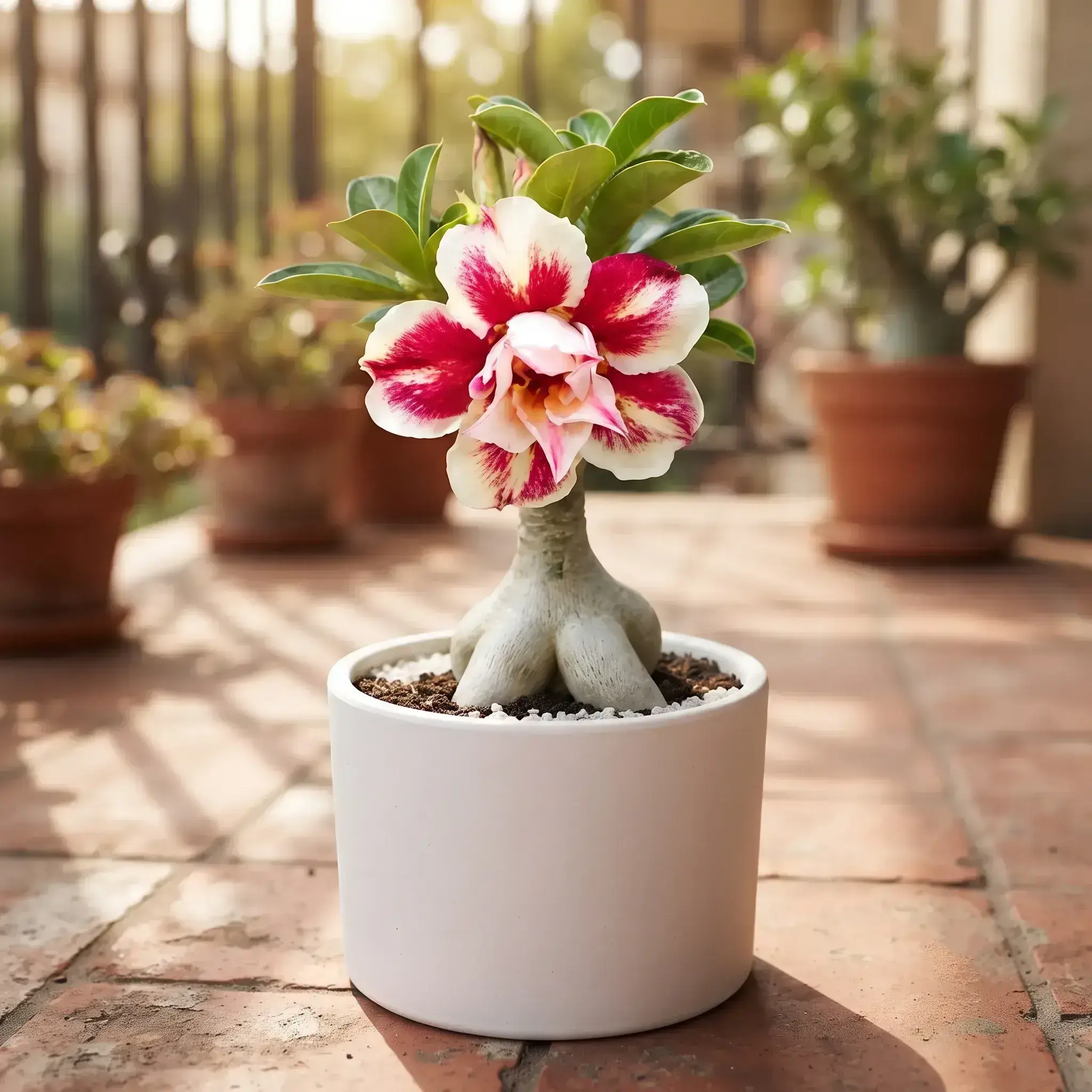
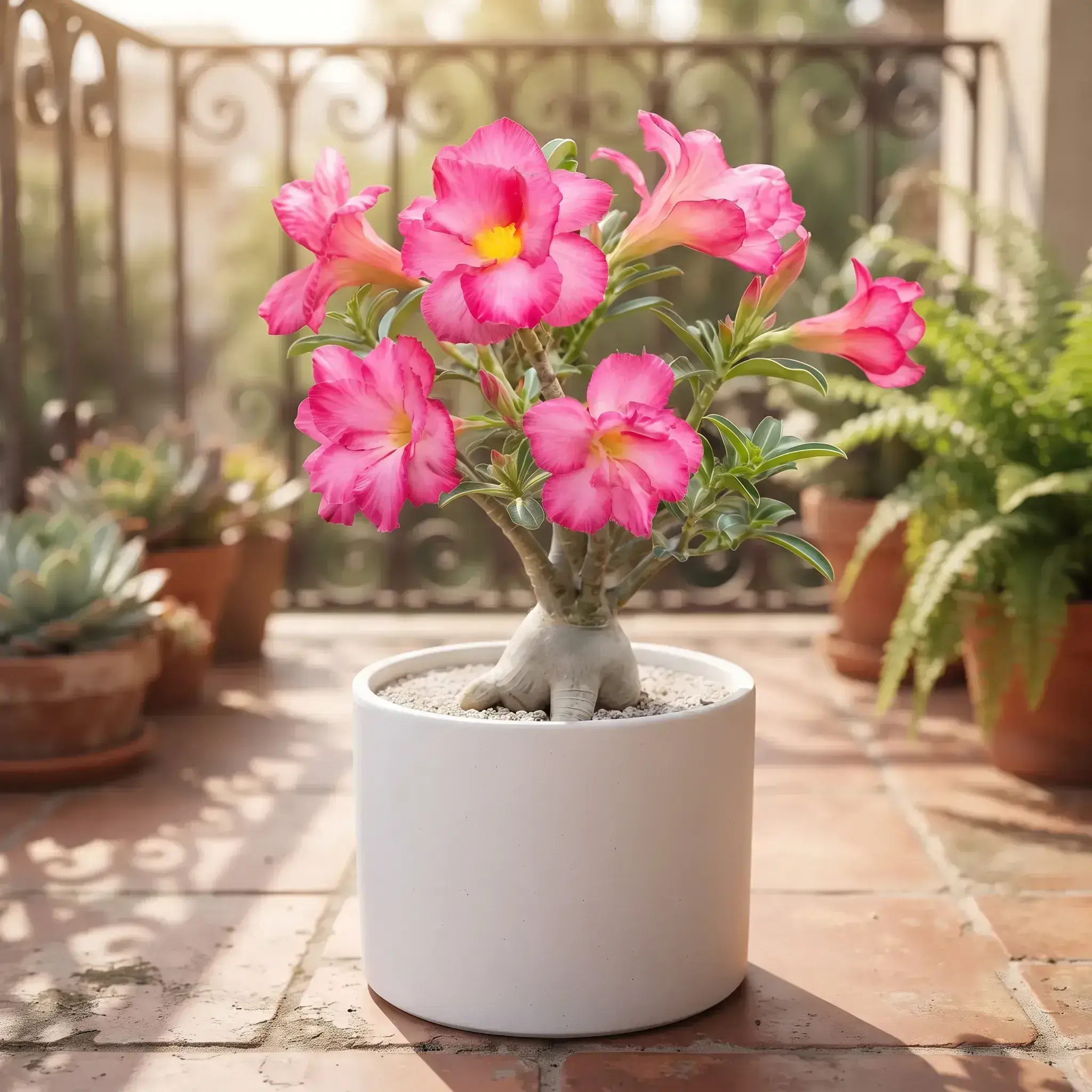
Adenium Pink Flower, commonly known as Desert Rose, Sabi Star, Desert Azalea, Impala Lily or Kudu Lily, is a distinctive succulent shrub admired for its swollen trunk, attractive green foliage and beautiful pink flowers.
The botanical name is Adenium obesum, and the plant belongs to the Apocynaceae family. Kew recognises Adenium obesum as an accepted species and records it across dry regions of Africa and the Arabian Peninsula. It naturally grows in dry bushland, semi-desert scrub, dry woodland and related habitats.
Its unusual swollen stem base, sometimes called a caudex, gives mature plants a sculptural appearance. The combination of a thick stem, compact branching and colourful flowers makes Adenium especially popular for container gardening, sunny balconies, terraces, patios and ornamental plant collections.
🌱 Plant Characteristics
- Common Name: Desert Rose
- Popular Name: Pink Adenium
- Scientific Name: Adenium obesum
- Family: Apocynaceae
- Plant Type: Succulent shrub
- Growth Habit: Upright, branching and compact when pruned
- Stem: Thick and swollen at the base
- Leaves: Green, fleshy-looking, clustered near branch tips
- Flowers: Pink to reddish-pink
- Light: Bright light to full sun
- Water: Moderate to low; allow the growing medium to dry appropriately
- Soil: Very well-drained
- Pot: Supplied with pot as stated in the product listing
- Main Use: Ornamental flowering succulent
Kew describes the species as a succulent shrub with a swollen stem base and pink to reddish-pink flowers.
🌸 Beautiful Pink Flowers
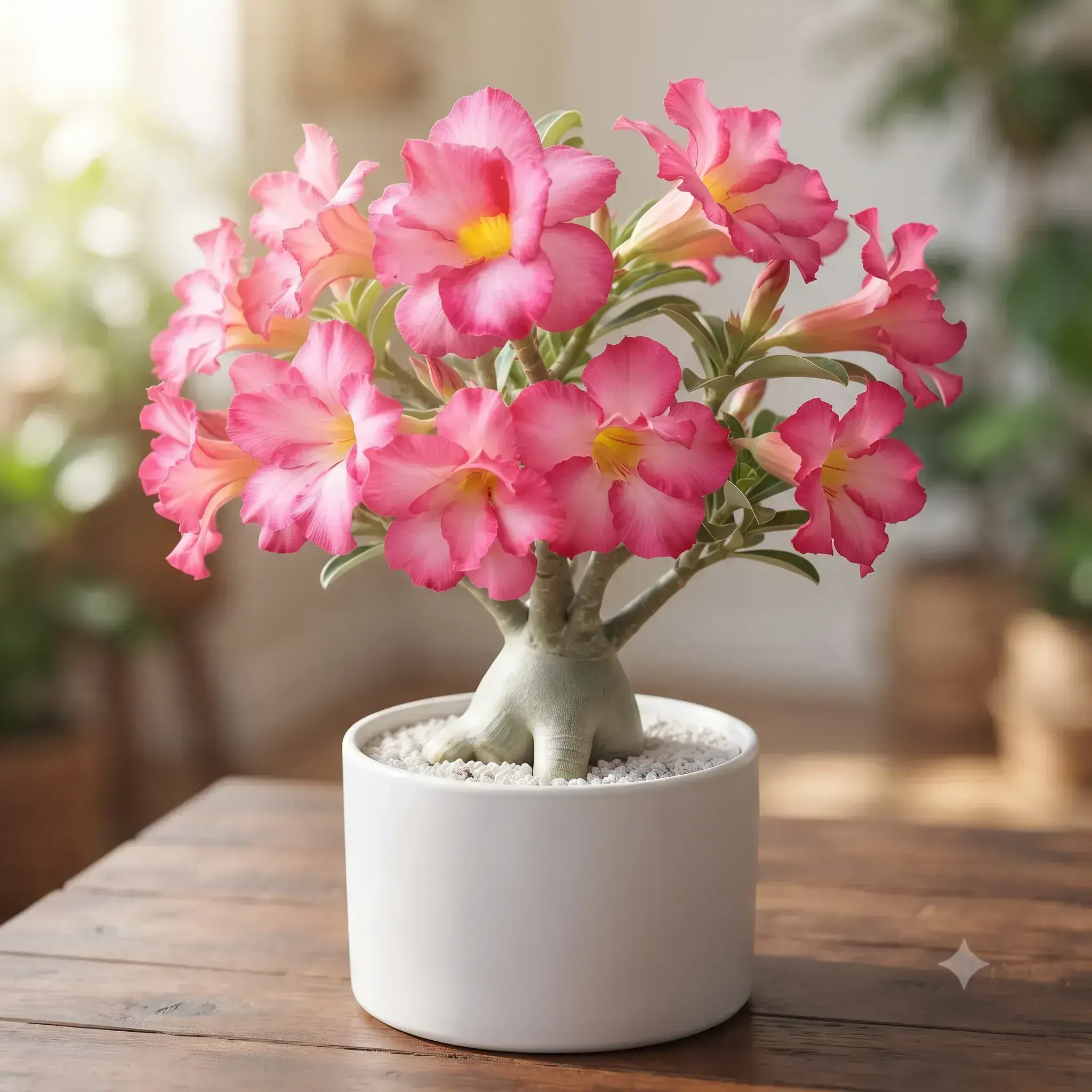
The main attraction of this Adenium is its pink flowering display.
The natural species has pink to reddish-pink flowers, with a funnel-shaped corolla and flowers appearing in clusters near the ends of branches.
The exact shade, flower size and pattern can vary between plants and nursery selections.
Flower production depends on:
- Plant maturity
- Sunlight
- Temperature
- Water management
- Nutrition
- Pruning
- Root health
- Seasonal conditions
Flowering is not guaranteed immediately after delivery.
A young nursery plant may require time to establish and develop before producing a strong flowering display.
🌳 Distinctive Swollen Trunk
One of the most recognizable features of Adenium is its thickened stem base.
The swollen trunk stores water and gives the plant a miniature-tree or bonsai-like appearance.
As the plant grows, the trunk can become more prominent and branch into several attractive stems.
This makes Adenium useful not only as a flowering plant but also as a sculptural foliage and caudex plant.
☀️ Sunlight Requirements
Adenium is a sun-loving plant and generally performs best with plenty of bright light.
A suitable location can include:
- Sunny balcony
- Terrace garden
- Outdoor patio
- Bright veranda
- Sunny windowsill
- Open garden area with good drainage
Adenium grown under insufficient light may become weak, elongated or produce fewer flowers.
If a plant has been kept under shade at the nursery, gradually introduce it to stronger sunlight rather than moving it suddenly into intense afternoon sun.
For Indian conditions, bright morning sunlight followed by suitable protection from extreme heat can be useful, especially during very hot summer periods.
💧 Watering
Adenium should not be treated like an ordinary moisture-loving flowering plant.
Its succulent stem allows it to tolerate periods of dryness, while continuously wet soil can create serious root problems.
A practical watering routine is:
- Check the growing medium before watering.
- Allow the soil to dry substantially between waterings.
- Water thoroughly when watering is required.
- Allow excess water to drain completely.
- Do not leave the pot standing in water.
- Reduce watering during cool or inactive periods.
The exact watering frequency depends on temperature, sunlight, pot size, soil type, humidity and season.
Overwatering is generally more concerning than occasional short periods of dryness.
🪴 Soil & Potting
Adenium requires a fast-draining growing medium.
Heavy soil that remains wet for long periods is unsuitable for this type of succulent.
A suitable container mix should provide:
- Excellent drainage
- Good aeration
- Moderate organic matter
- Enough support for the roots
- Rapid removal of excess water
Suitable ingredients can include materials such as coarse sand, perlite, pumice, coco-based material and other well-draining components.
Avoid compacted garden soil in containers.
The pot should have functional drainage holes.
🌱 Fertilizer & Nutrition
Adenium can benefit from regular but controlled feeding during active growth.
A balanced fertilizer or fertilizer formulated for flowering ornamental plants can be used according to the manufacturer’s instructions.
Good nutrition should be combined with:
- Adequate sunlight
- Proper watering
- Good drainage
- Healthy roots
- Appropriate pruning
Avoid excessive nitrogen, especially when the goal is a compact flowering plant.
Heavy fertilizer application does not guarantee more flowers.
🌸 Encouraging Flowering
For a healthy flowering Adenium:
- Provide plenty of sunlight.
- Avoid continuously wet soil.
- Maintain good drainage.
- Use balanced nutrition.
- Prune appropriately when required.
- Give the plant enough time to mature.
- Protect it from prolonged cold or unsuitable weather.
The natural flowering cycle varies with climate and growing conditions.
In warm Indian regions, Adenium can perform particularly well during suitable warm and sunny periods, but flowering timing can vary.
✂️ Pruning & Shaping
Pruning can help create a more attractive branching structure.
It can be used to:
- Remove weak growth
- Remove damaged branches
- Encourage branching
- Maintain a compact shape
- Improve the overall appearance
- Manage plant size
Use clean, sharp pruning tools.
Because Adenium produces irritating/toxic sap, wear suitable gloves while pruning and avoid contact with the eyes, mouth and broken skin.
Allow freshly cut areas to dry appropriately and avoid excessive watering immediately after major pruning.
🌱 Propagation
Adenium can be propagated by seeds and vegetative methods such as suitable cuttings.
Plants grown from seed can show variation in flower characteristics, trunk development and growth habit. Vegetatively propagated plants can be used when maintaining characteristics of a selected parent plant is important.
Propagation success depends on:
- Healthy plant material
- Warm conditions
- Suitable growing medium
- Proper moisture
- Good drainage
- Appropriate light
🪴 Container Gardening
Adenium is particularly well suited to container gardening.
It can be grown in:
- Decorative pots
- Terracotta pots
- Ceramic planters
- Bonsai-style containers
- Balcony pots
- Terrace planters
- Patio containers
- Outdoor succulent collections
A container with excellent drainage is essential.
Avoid using an oversized pot filled with moisture-retentive soil because the large volume of wet soil can remain damp around the roots for too long.
🌿 Bonsai-Style Appearance
Although Adenium is not necessarily a traditional bonsai species, its swollen trunk and branching structure make it popular among gardeners who enjoy bonsai-style ornamental plants.
With careful pruning and appropriate container culture, the plant can develop a compact, sculptural appearance.
The natural shape varies between plants, so pruning should be gradual rather than aggressive.
🌡️ Temperature & Climate
Adenium is adapted to warm, dry environments.
It performs best in warm weather and should be protected from prolonged cold conditions.
During cooler periods:
- Reduce watering.
- Keep the plant in a bright location.
- Protect it from cold rain.
- Avoid waterlogged soil.
- Do not force active growth with heavy feeding.
In much of India, warm conditions can support active growth, while winter care should be adjusted according to local temperature.
🌧️ Monsoon Care in India
Adenium needs particular attention during India’s monsoon season.
Frequent rain combined with poor drainage can keep the root zone wet for too long.
During prolonged rainy weather:
- Keep potted Adenium under a rain-protected area where practical.
- Ensure drainage holes remain open.
- Use a fast-draining growing medium.
- Do not water unnecessarily.
- Allow the soil to dry appropriately between watering.
This is particularly important for plants kept in humid regions of eastern and coastal India.
🪴 Pot & Placement
The supplied pot makes the plant convenient for immediate decorative placement.
Choose a location where:
- The plant receives sufficient light.
- Water can drain freely.
- The pot is stable.
- The plant is protected from accidental knocks.
- Children and pets cannot easily chew the plant.
Adenium is better suited to a bright location than a dark indoor corner.
🌿 Indoor Cultivation
Adenium can be kept indoors temporarily or grown indoors where it receives strong natural light, but it is not a low-light indoor plant.
A bright south-facing or similarly sunny window may work in suitable climates.
If the room does not provide adequate natural light, outdoor or balcony cultivation may be more appropriate.
Do not keep Adenium permanently in a dark office or room simply because it is sold as a potted plant.
🐾 Pet & Child Safety
Adenium obesum is toxic to dogs, cats and horses.
ASPCA identifies cardiac glycosides as the toxic principle and reports possible signs including vomiting, diarrhoea, loss of appetite, depression and irregular heartbeat. Severe poisoning can be life-threatening.
The plant’s sap should also be treated carefully.
Keep the plant away from:
- Dogs
- Cats
- Horses
- Young children
- Areas where leaves, stems or roots could be chewed
Wear gloves when pruning or repotting and wash your hands after handling the plant.
If ingestion is suspected, seek veterinary or medical assistance promptly.
⚠️ Sap & Handling Precautions
Adenium produces latex/sap. Kew’s botanical information records clear or white latex in the species.
Avoid getting the sap into the:
- Eyes
- Mouth
- Broken skin
- Food
- Drinking water
Do not allow children or pets to handle damaged stems or roots.
🌱 Common Growing Problems
Yellow leaves: Can occur because of overwatering, seasonal changes, root problems or other environmental stress.
Soft or swollen damaged stem: May indicate excessive moisture or rot.
Few flowers: Can be associated with insufficient light, young plant age, unsuitable nutrition or environmental stress.
Long weak branches: Often associated with insufficient light or lack of suitable pruning.
Leaf drop: Can occur during seasonal changes, watering stress or dormancy.
Root problems: Frequently associated with poor drainage and excessive moisture.
A single symptom can have multiple causes, so consider watering, sunlight, soil, temperature and recent environmental changes together.
🌱 Space Requirement
Adenium can remain relatively compact in a container but may develop into a larger branching shrub with age.
Provide enough room for:
- Branch development
- Trunk expansion
- Good sunlight
- Air circulation
- Root development
Regular pruning can help maintain a compact shape.
Kew records Adenium obesum as a succulent shrub capable of reaching approximately 2 metres under suitable conditions, although container-grown plants can remain much smaller.
🌸 Flower Colour Variation
This listing is for a pink-flowering Adenium.
Natural variation may occur in:
- Pink shade
- Flower size
- Number of petals
- Flower markings
- Throat colour
- Branching
- Leaf size
Unless a specific registered cultivar is identified, the term Pink Flower should be understood as the nursery’s flowering type/colour description rather than a claim of a particular named cultivar.
📦 Live Plant Delivery & Natural Variation
This is a live plant, so natural changes can occur during packing, transportation and acclimatisation.
You may notice:
- Slight leaf drooping
- Temporary yellowing of older leaves
- Minor leaf shedding
- Small cosmetic marks
- Slight branch movement or bending
- Differences in plant height
- Different trunk thickness
- Different number of branches
- Different number of leaves
- Temporary stress after delivery
Changes in temperature, sunlight, humidity and watering during transportation can affect the plant’s appearance.
Product photographs are representative. The exact plant supplied may naturally differ from the photographed specimen.
⚠️ Important Note
The scientific identity used for this listing is Adenium obesum, a succulent shrub in the Apocynaceae family. Kew records pink to reddish-pink flowers and a characteristic swollen stem base.
The listing’s “Pink Flower” description refers to the flower colour/type offered and does not by itself identify a particular registered cultivar.
Flowering is not guaranteed immediately after delivery. Flower production depends on plant maturity, sunlight, temperature, watering, nutrition and growing conditions.
Most importantly, Adenium obesum is toxic to dogs, cats and horses, so appropriate placement and handling are essential.
🌱 Why Choose This Adenium Plant?
- Attractive pink flowers
- Distinctive swollen trunk
- Beautiful succulent growth habit
- Suitable for sunny balconies
- Excellent for terrace gardens
- Suitable for patios and outdoor containers
- Attractive bonsai-style appearance
- Compact when maintained in a pot
- Good choice for succulent collections
- Can be shaped through careful pruning
- Suitable for warm Indian climates
- Decorative even when not flowering because of its unusual trunk and branching structure
- Supplied with pot as specified in the product listing
🌿 Botanical Information
Scientific Name: Adenium obesum (Forssk.) Roem. & Schult.
Family: Apocynaceae
Genus: Adenium
Common Names: Desert Rose, Desert Azalea, Sabi Star, Impala Lily, Kudu Lily
Plant Type: Succulent shrub
Growth Habit: Upright, branching and compact in cultivation
Stem: Swollen at the base, water-storing succulent structure
Leaves: Green, clustered toward branch tips
Flowers: Pink to reddish-pink in the species
Native Range: Tropical and subtropical dry regions of Africa and the Arabian Peninsula
Habitat: Dry bushland, semi-desert scrub, dry woodland and wooded grassland
Light: Bright light to full sun
Water: Moderate to low; allow soil to dry appropriately
Soil: Fast-draining succulent/cactus mix
Propagation: Seeds and suitable vegetative methods
Main Use: Ornamental flowering succulent and container plant
Kew’s botanical record describes Adenium obesum as a succulent shrub with a swollen stem base, green leaves and pink-to-red flowers, occurring naturally across parts of Africa and the Arabian Peninsula.
🔗 Botanical Information & Further Reading
- Kew Science – Plants of the World Online: Adenium obesum
- ASPCA – Desert Rose / Adenium obesum Safety Information
- ASPCA – Sabi Star / Adenium obesum
- ASPCA – Desert Azalea / Adenium obesum
- Kew Science – Apocynaceae Family Information
- NCBI Taxonomy – Adenium obesum
🌿 Final Care Tip
For a healthy Pink Adenium, focus on strong sunlight, excellent drainage, careful watering and warm conditions. Allow the growing medium to dry appropriately between watering and protect the plant from prolonged monsoon wetness.
Its swollen trunk and pink flowers make it an attractive ornamental plant even in a relatively small container. With suitable light and seasonal care, the plant can develop a beautiful branching form over time. Always handle it carefully and keep it away from pets and young children because Adenium obesum is toxic if ingested.
For More Information
Visit: Nursery-Plant.Com
For Contact Visit:Contact Us
For Shopping Visit: Shop Page


Reviews
There are no reviews yet.